Smart rings represent one of the most space-constrained categories in wearable electronics. Unlike wrist-worn devices, a smart ring must integrate electronics, sensors, antennas, and a battery into a closed-loop structure while maintaining comfort, aesthetics, and long-term reliability for continuous daily wear.
In this project, our client was developing a high-end smart ring designed for all-day use. The industrial design prioritized a slim profile and seamless inner curvature, leaving very limited internal volume for energy storage. Traditional battery form factors quickly became the primary bottleneck, restricting both usable capacity and overall product design freedom.
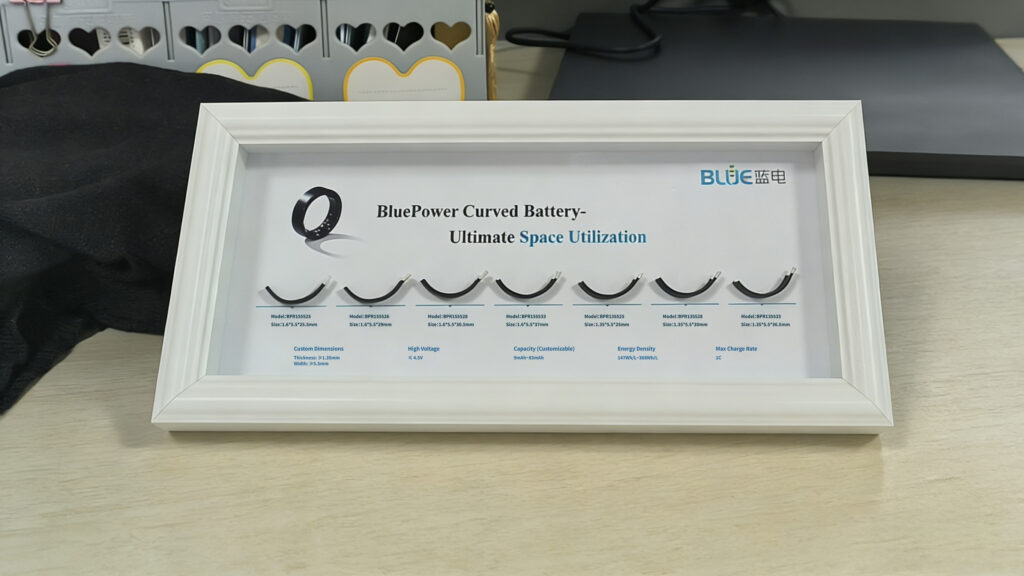
Key Engineering Challenges in Smart Ring Battery Design
Designing a battery for a smart ring introduced multiple, overlapping engineering constraints:
- Closed-loop geometry: Standard square or rectangular LiPo cells could not conform to the continuous inner curvature of the ring.
- Severely limited thickness: The battery was restricted to a maximum thickness of 1.7 mm, leaving minimal tolerance for structural variation.
- Low space utilization: Off-the-shelf batteries resulted in unused gaps, significantly limiting usable capacity.
- Electrical stability after bending: Curved battery designs risk inconsistent internal resistance if not properly engineered.
- High safety requirements for wearables: Continuous skin contact demanded exceptional stability and reliability.
- Scalability concerns: Small, curved cells are particularly vulnerable to consistency and yield issues during mass production.
These challenges made it impossible to adopt conventional battery solutions without compromising performance or design intent.
Why Standard Battery Solutions Failed
The client initially evaluated several common approaches:
- Coin cells offered simplicity but wasted internal space and could not meet runtime expectations.
- Standard ultra-thin LiPo batteries failed to match the curved geometry, leaving unused volume and forcing design compromises.
- Partially curved or segmented battery designs introduced mechanical stress points and unstable electrical performance.
Each option either limited capacity, introduced reliability risks, or prevented the product from moving toward scalable manufacturing.
Custom Curved LiPo Battery Solution
To overcome these limitations, we developed a fully custom curved LiPo battery engineered specifically for the smart ring’s internal structure.
Key aspects of the solution included:
- Full curvature conformity
The battery geometry was designed to precisely match the inner curvature of the ring, enabling maximum use of the available volume without altering the industrial design. - Ultra-thin structural control
The cell was engineered to remain within the 1.7 mm thickness constraint, with tight control over layer stacking and packaging tolerances. - Electrical stability under curved conditions
Internal cell architecture and material selection were optimized to maintain consistent internal resistance despite the curved form factor. - Wearable-grade safety design
The battery was developed with long-term daily wear in mind, prioritizing stability and reliability over extreme performance claims.
Rather than forcing the product to adapt to a battery, the battery was engineered to support the product’s original design intent.
Ensuring High Consistency and Mass Production Readiness
Curved and ultra-compact batteries often fail not at the prototype stage, but during scale-up. From the outset, this project focused on manufacturing feasibility, not just form factor innovation.
Our engineering and production teams worked closely to ensure:
- Tight dimensional consistency across curved cells
- Stable electrical characteristics between batches
- Controlled processes suitable for repeatable manufacturing
- Quality inspection methods adapted to non-standard geometries
By addressing these factors early, the custom curved LiPo battery was developed with production consistency in mind, avoiding the common pitfalls that prevent wearable batteries from reaching mass production.
Project Outcome
The final battery solution successfully enabled:
- Full utilization of the ring’s internal curved space
- A slim, comfortable design suitable for all-day wear
- Stable electrical performance in an ultra-compact form factor
- A clear path toward pilot production and future scaling
Most importantly, the battery no longer constrained the product design. Instead, it became an enabling component that supported both aesthetics and functionality.
Engineering Collaboration Beyond the Battery
This project highlighted the importance of early-stage engineering collaboration between battery specialists, industrial designers, and hardware engineers.
By aligning on structural constraints, safety requirements, and production goals from the beginning, the development process remained efficient and technically grounded—reducing iteration cycles and minimizing late-stage risks.
Conclusion
Smart rings demand battery solutions that go far beyond standard form factors. Custom curved LiPo batteries provide a practical path forward when space, safety, and consistency are equally critical.
If you are developing smart rings or other ultra-compact wearable devices and facing similar space or scalability challenges, early collaboration on battery design can significantly reduce risk and unlock greater design freedom.
Contact us to explore custom battery solutions engineered for real-world wearable products.
Email: [email protected]
Whatsapp: +86 18938252128
