Introduction
With the rapid development of electric vehicles and renewable energy systems, there is an increasing demand for lithium-ion batteries with high energy density and long cycle life. In this context, the silicon carbon battery has emerged as a promising next-generation energy storage solution, as conventional lithium-ion batteries employing graphite anodes—with a theoretical specific capacity limited to 372 mAh·g⁻¹—struggle to meet the performance requirements of future energy storage technologies.
However, silicon undergoes approximately 300% volume expansion during charge–discharge cycles, leading to electrode pulverization, continuous growth of the solid electrolyte interphase (SEI), and disruption of the conductive network, which severely limits its practical application. To overcome these challenges, silicon-carbon anodes, which integrate the high capacity of silicon with the buffering and conductive properties of carbon matrices, have become a core material system in silicon carbon battery development.
Recent research has focused on synergistic optimization through hierarchical structural designs (e.g., core–shell, yolk–shell, and porous architectures) and low-cost fabrication methods (such as biomass-derived approaches and ball milling) to suppress volume expansion while improving electrochemical performance. This review systematically summarizes mainstream preparation techniques, performance optimization strategies, and application progress of silicon carbon batteries in power batteries, energy storage systems, and solid-state batteries, aiming to provide guidance for the development of next-generation high-energy-density lithium-ion battery materials.
1. Main Preparation Techniques and Their Characteristics
The preparation method of Si-C composite anodes directly affects the material’s microstructure, electrochemical performance, and industrial feasibility. Current mainstream techniques include sol-gel, electrospinning, chemical vapor deposition (CVD), ball milling, and biomass-derived methods
1.1 Sol-Gel Method
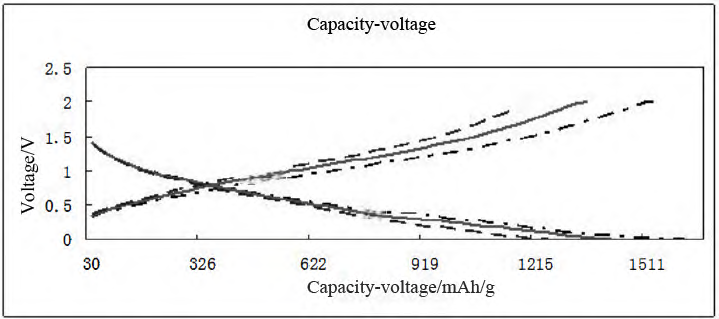
This method forms a uniform precursor via hydrolysis and polycondensation of silicon sources (e.g., tetraethyl orthosilicate) and carbon sources (e.g., phenolic resin) in solution, followed by high-temperature carbonization to obtain the composite. Advantages include controllable composition and uniform dispersion, effectively mitigating silicon particle agglomeration. For example, Qin et al. prepared porous Si/SiOx/C composites by controlling precursor ratios and reaction conditions, achieving a capacity retention of 89.03% after 100 cycles at 0.1C. However, this method has long cycles, complex processes, and high energy consumption due to high-temperature carbonization.
1.2 Electrospinning
Electrospinning uses a high-voltage electric field to form nanofibers from a silicon-containing polymer solution, constructing a 3D conductive network that significantly enhances electrode conductivity. Wang et al. used PVP as a carrier and silicon nanoparticles as the active material, introducing carbon nanotubes to reduce electrode resistance from 250 Ω to 80 Ω. Jin et al. prepared coaxial electrospun core-shell pSi-CNF materials, where carbonization generated internal voids to buffer expansion. This method is suitable for high-performance lab-scale materials but suffers from low output and difficulty in continuous production.
1.3 Chemical Vapor Deposition (CVD)
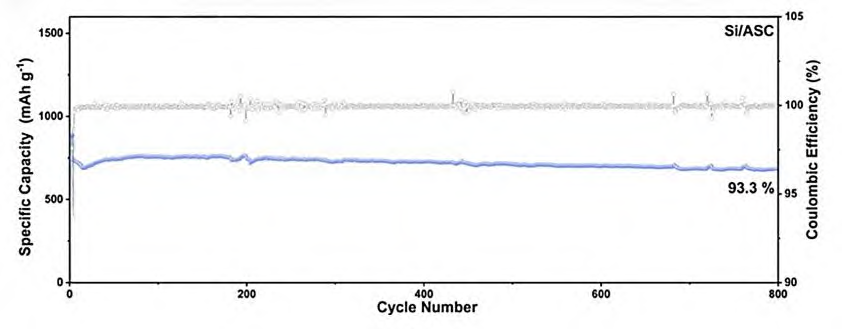
CVD deposits a uniform carbon layer on silicon particles, allowing precise control of coating thickness and structure, significantly improving interface stability and conductivity. Fu et al. used methane as the carbon source at 800°C, introducing diborane doping to increase conductivity to 120 S/cm. CVD-prepared materials exhibit excellent cycling performance; for instance, Mu et al. synthesized Si/ASC composites maintaining 93.3% capacity after 800 cycles. However, the method involves high equipment costs and complex procedures, making it suitable for high-end materials fabrication.
1.4 Ball Milling
Ball milling mechanically mixes and refines silicon and carbon materials. It is simple, low-cost, and suitable for large-scale production. Li et al. prepared layered Si-C composites via high-energy ball milling, achieving excellent rate performance even at 4000 mA·g⁻¹. However, prolonged milling may lead to overly fine particles, contamination, and reduced tap density.
1.5 Biomass-Derived Carbon Strategy
Biomass sources such as corn stalks and wood alkali are used as carbon precursors. They are cost-effective, widely available, and naturally porous, aiding electrolyte infiltration and volume buffering. Zhang et al. prepared anodes from corn stalk-derived carbon, achieving 91.44% capacity retention after 616 cycles. This approach aligns with green manufacturing trends but carbon performance depends heavily on source and carbonization conditions.
2. Performance Optimization and Structural Design
The performance of Si-C anodes depends on the synergy of electrochemical properties, conductivity, interface stability, and microstructure.
2.1 Electrochemical Performance
- High Specific Capacity: Si-C composites can achieve reversible capacities above 1000 mAh·g⁻¹. For example, Xu et al. reported an initial capacity of 1714 mAh·g⁻¹ for Si/ASC materials.
- Cycling Stability: Core-shell, porous, and yolk-shell structures can significantly prolong cycle life. Zhang et al. designed interlayer-core-shell materials with over 80% capacity retention after 200 cycles.
- Rate Capability: Dependent on conductive networks and ion diffusion rates. Huang et al. constructed hierarchical structures achieving 100.6 mAh·g⁻¹ at 0.2 A·g⁻¹, with good performance at high rates.
2.2 Conductivity and Interface Stability
Carbon matrices greatly enhance conductivity. Xu et al. designed double-graphene-coated structures (3DG@Si@G) maintaining 1503.9 mAh·g⁻¹ after 100 cycles at 0.2 A·g⁻¹. Interface stability can be further improved via surface coating, pre-lithiation, and electrolyte additives. Lai et al. enhanced first-cycle efficiency from 76.8% to 93.98% through chemical pre-lithiation.
2.3 Structural Features
- Porous Structures: Provide expansion space and enhance cycling stability but may reduce tap density.
- Core-Shell/Yolk-Shell: Buffer expansion via internal voids, e.g., Wu et al.’s yolk/double-shell structure maintained 1066 mAh·g⁻¹ after 200 cycles.
- Embedded Structures: Disperse silicon in carbon matrices to prevent agglomeration; insufficient embedding may cause detachment.
- Composite Structures: 3D conductive networks improve ion/electron transport but involve complex fabrication.
3. Applications and Prospects
3.1 Power Batteries
Si-C anodes significantly increase battery energy density. Mu et al.’s Si/ASC composites paired with NCM523 cathodes achieved a full-cell energy density of 580 Wh/kg. Tang et al.’s Si/C-LIBs reached 554 Wh/kg at 0.5C, with ~90% capacity retention after 500 cycles.
3.2 Energy Storage Systems
This sector emphasizes cost and cycle life. Zhao et al. prepared ternary composites with micron-sized silicon, achieving 71.34% capacity retention after 100 cycles at 1 A·g⁻¹. Rao et al.’s porous Si-C materials demonstrated stable performance from -30 to 50°C, suitable for energy storage applications.
3.3 Solid-State Batteries
Interface stability between Si-C anodes and solid electrolytes is critical. Qin et al. designed pre-stressed anodes maintaining stability under low external pressure. Cheng et al.’s porous Si/N-doped carbon hierarchical structures delivered 1769.8 mAh·g⁻¹ after 300 cycles in solid-state batteries, with a decay rate of only 0.016%.
4. Challenges and Future Directions
4.1 Existing Challenges
- Insufficient Volume Expansion Suppression: High-silicon-content carbon frameworks may fracture.
- Unclear Long-Term Cycling Mechanisms: Structural evolution and degradation mechanisms beyond 1000 cycles are not fully understood.
- Scale-Up Difficulties: Lab-scale performance often differs from industrial production; cost control remains challenging.
- First-Cycle Efficiency vs. Cycle Stability: Achieving high first-cycle efficiency often compromises specific capacity.
4.2 Future Research Directions
- Atomic-Level Design: Enhance interface stability via strong Si-C bonds and transition metal doping.
- Intelligent Fabrication: Develop continuous production methods (e.g., combined spray-drying and microwave sintering) and AI-optimized process parameters.
- Green Manufacturing: Promote biomass carbon sources and recycled silicon technologies to reduce carbon emissions.
- Full Lifecycle Management: Develop SOH monitoring, direct regeneration, and LCA evaluation systems.
Conclusion
Si-C composite anode materials are a key solution to overcome the energy density bottleneck of lithium-ion batteries, with notable progress in structural design, performance optimization, and process innovation. Through hierarchical structure construction, interface engineering, and low-cost fabrication, cycling stability, rate performance, and industrial feasibility have steadily improved. Looking forward, with the integration of atomic-level precise design, intelligent manufacturing, and full lifecycle management, Si-C anodes are expected to become mainstream for high-energy-density batteries within 5–10 years, providing critical material support for electric vehicles and large-scale energy storage, and driving energy storage technologies toward higher performance and sustainability.
At BluePower, we are already applying silicon-carbon anodes in practical battery designs, achieving volumetric energy densities of up to 778 Wh/L. Through advanced material integration and custom-shaped battery engineering, we help customers unlock higher energy density within limited space. Contact our team to explore how silicon-carbon anode technology can elevate your next-generation battery solution.
Email: [email protected]
Whatsapp: +86 18938252128
