Lithium Polymer batteries have become the preferred power source for modern electronic devices. Their lightweight design, high energy density, and flexible form factor make them ideal for applications where space, weight, and performance are critical. However, when choosing a LiPo battery, understanding its specifications is essential. Terms like voltage, capacity, discharge rate (C-rating), and size are more than just numbers on a label — they determine how your device performs, how long it runs, and how safely it operates.
In this guide, we’ll break down everything you need to know about lipo battery specifications. You’ll learn what each specification means, how to interpret battery labels, and how different parameters affect performance and lifespan.
What Are Lipo Battery Specifications?
LiPo battery specifications describe the key electrical and physical parameters that define how a lithium polymer battery performs, delivers power, and fits into a device. These specifications are printed on the battery label or datasheet and serve as a technical summary of the battery’s capabilities.
A typical LiPo battery label includes information such as:
- Voltage (V): Indicates the nominal voltage of each cell and the total pack voltage.
- Capacity (mAh): Represents the total charge the battery can store — the higher the capacity, the longer the run time.
- Discharge Rate (C-Rating): Defines how quickly the battery can safely deliver current without overheating or damaging the cells.
- Number of Cells (S): Shows how many LiPo cells are connected in series (e.g., 3S = 3 cells = 11.1V nominal voltage).
- Dimensions and Weight: Determines the physical fit and suitability for compact or lightweight designs.
- Connector Type: Identifies the interface used to connect the battery to a device or charger.
For example, a LiPo battery labeled “3S 11.1V 2200mAh 25C” tells you it’s a 3-cell pack with a nominal voltage of 11.1 volts, a capacity of 2200mAh, and a maximum continuous discharge rate of 25C.
LiPo Battery Capacity
LiPo battery capacity is usually measured in milliamp-hours (mAh) or amp-hours (Ah) and describes how much electrical charge the battery can store. Simply put, it tells you how long a device can run before the battery needs to be recharged.
To put it into perspective, 1 Ah equals 1000 mAh. For example, a 2200 mAh LiPo battery can theoretically supply 2.2 amps of current for one hour under ideal conditions.
In real-world applications, a higher-capacity battery generally means longer operating time. However, this benefit comes with trade-offs. Increasing capacity usually results in a larger and heavier battery, which can impact the overall design, balance, and performance of a device.
LiPo Battery Voltage
LiPo batteries can be made up of multiple cells connected in series to increase the total voltage of the battery pack. The number of cells in series is usually shown with an “S” rating:
- 1S = 3.7V
- 2S = 7.4V
- 3S = 11.1V
- 4S = 14.8V
- 6S = 22.2V
In general, higher-voltage battery packs can deliver more power, since power is the product of voltage and current (P = V × I). For this reason, higher-voltage LiPo batteries are commonly used in applications that require greater speed, torque, or thrust, such as drones, RC vehicles, and electric tools.
1. Nominal Voltage
Nominal voltage refers to the average working voltage of a single LiPo cell during normal use.
- Typically 3.7V per cell
- 3.8V–3.85V per cell for high-voltage (HV) LiPo cells
This value is commonly used as the standard reference when designing electronic systems and battery packs.
2. Fully Charged Voltage
This is the maximum voltage a LiPo cell reaches when it is fully charged.
- Normally 4.2V per cell
- Up to 4.35V–4.4V for high-voltage LiPo cells
Charging beyond this limit can lead to overcharging, which may cause performance issues or permanent damage to the battery.
3. Fully Discharged Voltage
This indicates the lowest safe voltage a LiPo cell should reach during discharge.
- Generally 3.0V–3.2V per cell
Discharging below this range can result in over-discharge, leading to capacity loss, reduced cycle life, or even battery failure.
4. Cut-off Voltage
Cut-off voltage is the minimum voltage threshold set by the BMS or ESC to automatically stop discharge and protect the battery.
- Typically set around 3.0V per cell
This protection helps prevent deep discharge and significantly extends battery lifespan.
5. Storage Voltage
Storage voltage is the recommended voltage level for long-term storage of LiPo batteries.
- Usually 3.7V–3.85V per cell
Storing LiPo batteries at this level reduces stress on the cell and helps slow aging while avoiding over-discharge.
Discharge Specifications of a LiPo Battery
The discharge specifications of a LiPo battery describe how much current the battery can safely supply during operation. These ratings are important because they have a direct impact on performance, heat generation, and overall battery lifespan. One of the most important discharge parameters is the C-rating, which you’ll find listed on every LiPo battery label.
1. C-rating
The C-rating indicates the maximum continuous discharge rate relative to the battery’s capacity. In simple terms, it tells you how fast the battery can release its stored energy without causing damage.
The maximum continuous discharge current can be calculated as:
Maximum Continuous Current (A) = Capacity (Ah) × C-rating
For example, a 2200 mAh (2.2 Ah) LiPo battery rated at 25C can safely deliver:
2.2 × 25 = 55 A of continuous discharge current.
2. Burst Discharge Rate
In addition to the continuous C-rating, many LiPo batteries also specify a burst discharge rating, such as 25C / 50C. This burst rating defines the maximum current the battery can supply for a very short period, typically 5–10 seconds, to handle brief power demands.
Burst discharge is commonly used during moments like drone takeoff, rapid acceleration, or sudden load changes. While this extra power can be useful, running a battery at its burst rating for too long can lead to excessive heat buildup and reduced battery life.
3. Discharge Rate Curve of a LiPo Battery
The discharge rate curve shows how the battery’s voltage changes as it discharges under different load conditions, also known as different C-rates. This curve is an important tool for understanding a LiPo battery’s voltage stability, efficiency, and real-world performance.
Typically, higher discharge rates cause the voltage to drop faster and reduce the usable capacity. In the example chart below, the voltage-versus-capacity curves of a LiPo cell are measured at 0.2C, 0.5C, 1C, 2C, and 3C discharge rates at 25°C, with a cut-off voltage of 3.0V.

How to Read the Discharge Curve
- Voltage Axis (Y-axis):
Represents the battery’s output voltage (in volts). The higher the line stays during discharge, the better the voltage stability. - Capacity Axis (X-axis):
Indicates the percentage of the battery’s usable capacity as it discharges from 100% (fully charged) to 0% (cutoff). - Different Curves (0.2C to 3C):
Each line represents a different discharge rate.- At lower C-rates (e.g., 0.2C, 0.5C), the voltage remains more stable throughout discharge, indicating higher efficiency and lower internal losses.
- At higher C-rates (e.g., 2C, 3C), the voltage drops more quickly because the internal resistance causes greater voltage sag and heat generation.
- Cutoff Region:
Near the end of the discharge (around 90–100% capacity), the voltage drops sharply. This area marks the end of usable energy. Continuing to discharge beyond this point (below 3.0V) can permanently damage the battery.
Charge Specifications of a LiPo Battery
The charge specifications of a LiPo battery explain how the battery should be charged safely and efficiently to reach full capacity while maintaining a long service life. Unlike many conventional battery types, LiPo batteries require precise control during charging to prevent overcharging, overheating, or long-term performance degradation.
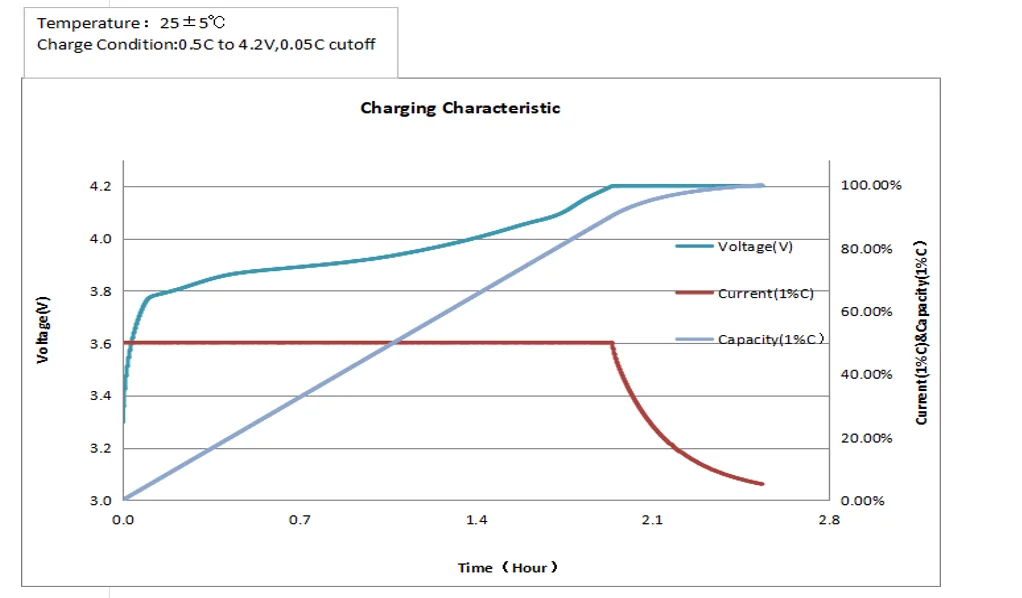
LiPo batteries are typically charged using a CC–CV (Constant Current – Constant Voltage) charging method. During the first stage, the battery is charged at a constant current until it reaches its maximum charge voltage. Once that voltage is reached, the charger switches to constant voltage mode, gradually reducing the current until the battery is fully charged.
The chart below shows a typical LiPo cell charging curve measured at 25 ± 5°C, using a 0.5C charging rate up to 4.2V, with a 0.05C cutoff current. This curve helps illustrate how voltage and current change throughout the charging process and why controlled charging is essential for both safety and battery longevity.
1. Charging Phases: CC–CV Mode
A LiPo battery is charged in two main stages:
- Constant Current (CC) Stage:
During the initial phase, the charger supplies a steady current (in this example, 0.5C). The battery voltage gradually rises from around 3.0V to 4.2V as the battery stores energy. This stage typically restores about 70–80% of the total capacity. - Constant Voltage (CV) Stage:
Once the cell voltage reaches 4.2V, the charger switches to a constant voltage mode. The charging current then begins to decrease gradually, allowing the remaining 20–30% of the capacity to be filled safely. The process ends when the current drops to the cutoff level (usually 0.05C), indicating full charge.
This dual-phase method prevents overcharging, which can lead to cell swelling, electrolyte breakdown, or even thermal runaway.
2. Understanding the Curve
- The blue line (Voltage) shows a smooth increase until it stabilizes at 4.2V during the CV stage.
- The red line (Current) remains constant initially and then drops sharply as the battery approaches full charge.
- The gray line (Capacity) rises progressively, reaching 100% when the cutoff condition is met.
This curve demonstrates how charging speed slows down near full capacity — a design that protects the cell and ensures long-term stability.
Cycle Life of a Battery
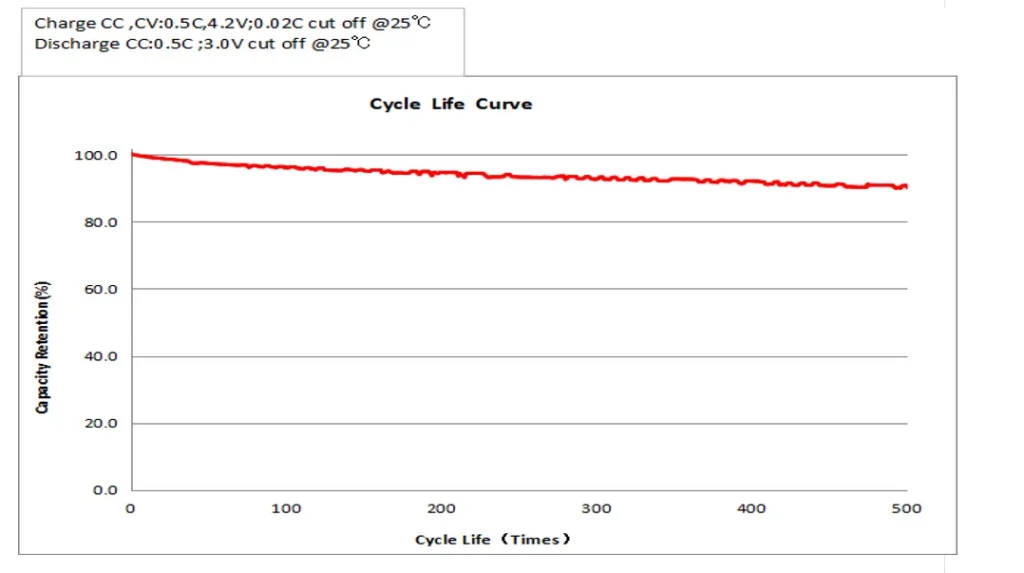
Cycle life describes how many charge–discharge cycles a battery can go through before its performance drops noticeably. One full cycle is counted when 100% of the battery’s capacity is used, even if that happens over several partial charges and discharges rather than a single use.
In most cases, a battery is considered to have reached the end of its useful life when its capacity falls to about 80% of its original capacity.
How to Read the Cycle Life Curve
The degradation of a battery over time is usually shown in a cycle life curve, which makes the aging process easy to visualize:
- Y-axis (Capacity Retention %): Indicates how much capacity the battery retains compared to when it was new.
- X-axis (Cycle Life – Number of Cycles): Represents how many charge–discharge cycles the battery has completed.
As the number of cycles increases, the capacity gradually decreases, showing how the battery ages with regular use.
How to interpret it:
- Start from the top left: a new battery has 100% capacity.
- The line slopes downward as the number of cycles increases, meaning the battery slowly loses its ability to hold a full charge.
- Find where the curve meets the 80% capacity line. The number on the bottom axis at that point is the battery’s rated cycle life.
In short, a higher cycle life means a longer-lasting battery. Note that using your battery hard (high discharge rates, extreme temperatures) can make it degrade faster than the chart shows.
Internal Resistance of a LiPo Battery
Internal resistance (IR) is a key factor that influences a LiPo battery’s performance, efficiency, and safety. It refers to the natural resistance inside the battery that limits the flow of current during charging and discharging.
A battery with low internal resistance can deliver high current more efficiently, with less energy loss. In contrast, higher internal resistance leads to greater voltage drop, more heat generation, and reduced overall performance.
Why Internal Resistance Matters
Voltage Drop Under Load
When a battery has high internal resistance, its voltage drops more noticeably as current is drawn. This voltage sag reduces the actual power available to the device, especially under heavy load.
Heat Generation
The energy lost due to internal resistance is converted into heat. Excessive heat not only lowers efficiency but can also accelerate cell aging, damage internal materials, and in extreme cases increase the risk of thermal runaway.
Performance in High-Drain Applications
Applications such as drones, RC vehicles, and other high-power electronics depend on batteries with low internal resistance to deliver strong, stable current without significant voltage sag. Lower IR ensures better responsiveness, higher efficiency, and more consistent performance during peak power demands.
Energy Density of a LiPo Battery
Energy density is one of the most important factors when evaluating a LiPo battery. It describes how much energy a battery can store relative to its weight or physical size. In practical terms, higher energy density allows devices to run longer on a single charge while keeping the battery lightweight and compact—a critical advantage for applications such as drones, wearable devices, RC vehicles, and other portable electronics.
Energy density is usually described in two ways: gravimetric and volumetric energy density.
Gravimetric vs. Volumetric Energy Density
Gravimetric Energy Density (Wh/kg)
This value indicates how much energy is stored per kilogram of battery weight. A higher gravimetric energy density means more usable energy without adding significant weight, which is especially important for flight time, mobility, and efficiency.
Volumetric Energy Density (Wh/L)
Volumetric energy density measures how much energy is stored per liter of battery volume. This parameter becomes critical when space is limited, such as in smartphones, compact drones, and wearable electronics, where the battery must fit into a tightly constrained enclosure.
Conclusion
Understanding these key LiPo battery specifications makes it easier to select the right battery, use it correctly, and maintain it over time. When factors such as voltage, capacity, discharge rate, internal resistance, and cycle life are properly matched to the application, a LiPo battery can deliver stable performance and a longer service life. As always, following the manufacturer’s recommended guidelines is essential for safe operation and reliability.
At BluePower, we focus on providing custom LiPo battery solutions tailored to the specific needs of different applications. By optimizing parameters such as energy density, cycle life, discharge capability, form factor, and charging performance, we help customers achieve dependable results in real-world use cases.
If you have questions or need a customized LiPo battery solution, feel free to get in touch with our team.
Email: [email protected]
Whatsapp: +86 18938252128
