1. What is a Thin Film Battery?
A thin-film battery is not merely a miniature version of a conventional lithium-ion battery; it represents a complete innovation in both materials and structure. Its essence lies in the term “thin-film,” with each functional layer measuring only a few micrometers—tens of times thinner than a human hair. This allows the entire battery to be as light and thin as a postage stamp.
Unlike traditional batteries that use liquid electrolytes, thin-film batteries generally employ solid-state electrolytes, which bring two revolutionary advantages: absolute safety and extremely long lifespan. Liquid electrolytes are the main cause of battery flammability and explosion, whereas solid-state electrolytes fundamentally eliminate the risks of leakage and combustion. At the same time, the solid-state system is more stable during charge and discharge, enabling thin-film batteries to achieve a cycle life of tens of thousands of times—far exceeding that of ordinary batteries.
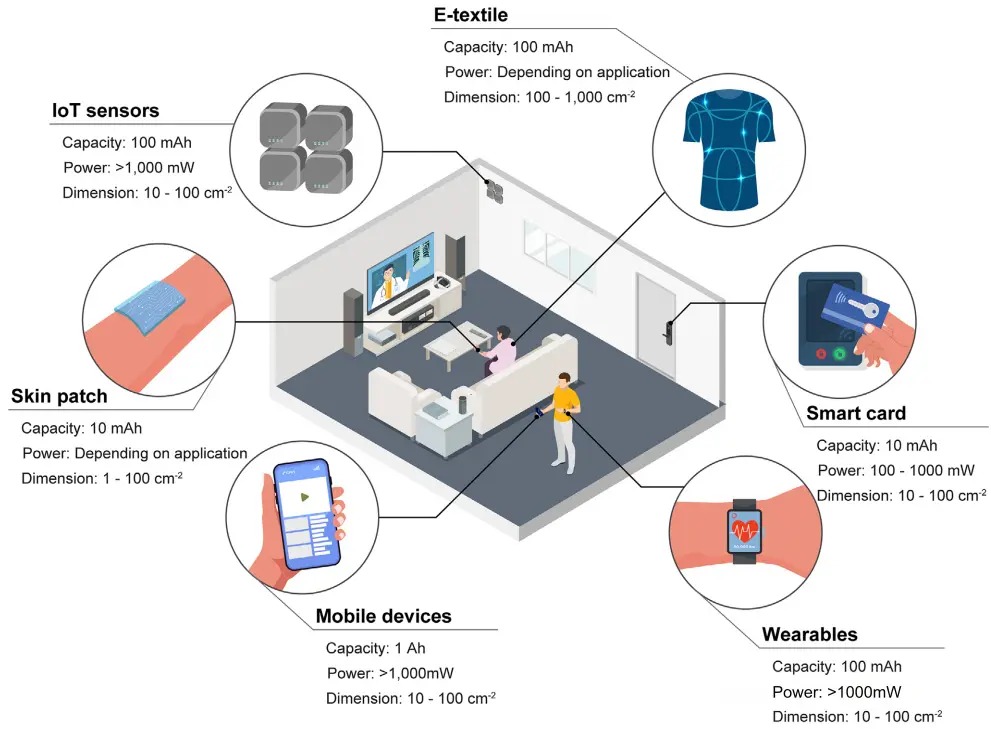
Moreover, the manufacturing process of thin-film battery is closely aligned with the semiconductor industry. This means they can be directly integrated onto circuit boards, much like chips, enabling on-chip energy storage. This plug-and-play capability greatly simplifies electronic product design, saves valuable space, and paves the way for extreme miniaturization of devices.
How are Thin-Film Batteries Manufactured?
Manufacturing high-performance thin-film battery is a meticulous process carried out at the nanoscale. Researchers draw on various advanced coating technologies from modern industry.
Physical Vapor Deposition (PVD): Magnetron sputtering is the most commonly used technique. It bombards a target material with plasma, causing atoms to drift evenly onto the substrate like dust, forming a dense and smooth thin film. This method is key to fabricating the classic solid-state electrolyte LiPON.
Atomic Layer Deposition (ALD): This technique alternately introduces precursor gases into the reaction chamber, allowing materials to “grow” on the substrate layer by layer at the atomic scale. It achieves unparalleled uniformity and perfectly conforms to complex three-dimensional structures, which is crucial for building high-performance 3D thin-film battery.
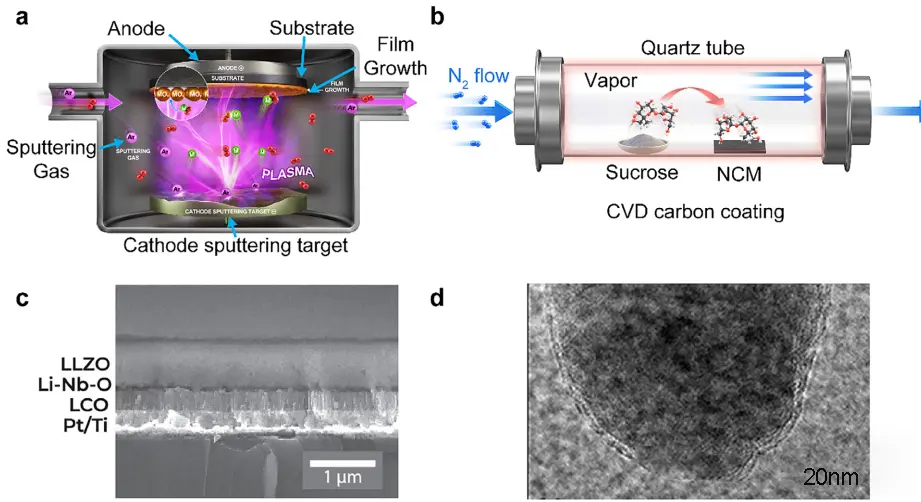
In addition, wet chemical methods such as sol-gel processing and electrochemical deposition are also employed, as well as scalable printing technologies like inkjet printing and 3D printing. For example, researchers have used 3D printing to fabricate interdigitated electrode structures, significantly enhancing the energy density per unit area of the battery.
Material Selection
The performance of thin-film batteries largely depends on the selection and design of their core materials.
1) Challenges and Opportunities of the Anode
The ideal anode is lithium metal, which offers the highest theoretical capacity. However, in thin-film battery, the interfacial contact between lithium metal and the solid-state electrolyte is often poor, and lithium dendrites can easily form, piercing the electrolyte layer and causing short circuits.
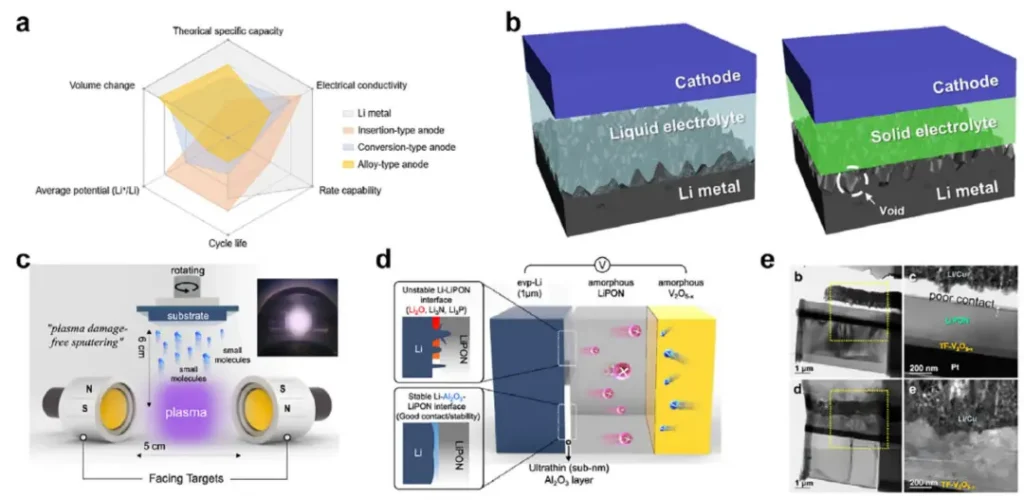
To address these issues, scientists have explored various strategies. For example, introducing an ultrathin aluminum oxide layer as a “buffer” between the lithium metal and the electrolyte effectively stabilizes the interface. Silicon is another star material, offering extremely high capacity, but it undergoes sponge-like expansion and contraction during charge and discharge, making it prone to pulverization. By designing multilayer “sandwich” structures such as silicon/carbon/silicon or constructing 3D porous architectures, researchers can cleverly buffer the mechanical stress, significantly enhancing cycling stability.
2) Solid-State Electrolytes
The goal is to find materials with high ionic conductivity, wide electrochemical stability windows, and excellent mechanical properties.
LiPON, a pioneering electrolyte for thin-film battery, is fabricated via magnetron sputtering. Although its ionic conductivity is not the highest, its outstanding mechanical stability and excellent compatibility with electrodes make it remain the mainstream choice to this day.
Oxide Electrolytes: Examples include garnet-type LLZO and NASICON-type LATP. Their ionic conductivity can be several orders of magnitude higher than that of LiPON, but they are brittle, difficult to form into thin films, and exhibit high interfacial impedance with electrodes.
Sulfide Electrolytes: For instance, LGPS possesses an ionic conductivity approaching that of liquid electrolytes. However, it is extremely sensitive to moisture, producing highly toxic hydrogen sulfide gas upon contact with water, which places very stringent requirements on the manufacturing process.
Challenges and Solutions
Despite a promising outlook, thin-film batteries still face several core challenges on the path from the laboratory to large-scale commercialization.
1) Interfacial Challenges:
This is a common drawback of all solid-state batteries. The natural point contact between solid materials leads to high interfacial resistance, and mechanical stress during cycling can cause cracks or delamination. Solutions include interface engineering, such as using pulsed laser deposition to fabricate electrode materials with specific crystal orientations, achieving epitaxial growth and atomically smooth interfaces; or introducing ultrathin functional interlayers to improve contact and suppress side reactions.
2) Energy Density Limitations:
Due to their extremely thin profiles, the absolute capacity of a single thin-film battery is limited. To address this, scientists have turned to the third dimension and designed 3D thin-film batteries. By etching micron-scale pores or pillar arrays into the substrate and then depositing the battery layers onto these structures, the effective reaction area can be multiplied, achieving higher energy and power density per unit area.
3) Packaging Challenges:
Thin-film structures are extremely sensitive to moisture and oxygen, especially lithium-containing components. Even a pinhole-sized defect can lead to complete battery failure. Developing ultrathin, flexible, and highly impermeable encapsulation layers—such as multilayer composite organic/inorganic films—is crucial for ensuring long-term stability and reliable operation.
Conclusion
Thin-film batteries represent a major advance over conventional lithium-ion technology, offering an ultra-thin, safe, and long-lasting solid-state alternative. Their compatibility with semiconductor manufacturing enables seamless on-chip integration, making them ideal for miniaturized and flexible electronics. Progress in deposition techniques and material design has further improved their performance, laying a strong foundation for future development.
However, challenges remain for large-scale commercialization. Key issues include high interfacial resistance, limited energy density due to their thin structure, and strict packaging requirements. These challenges are being addressed through ongoing research into interface engineering, 3D structural designs to boost capacity, and advanced barrier films for protection.
Looking ahead, thin-film batteries are set to play a vital role in powering the next generation of small-scale, connected devices. As materials and manufacturing continue to improve, they will enable breakthroughs in wearables, medical implants, and the IoT. Ultimately, thin-film batteries are more than just an advanced power source—they are a key technology enabling a safer, more compact, and connected future.
Contact Us
If you’re developing ultra-miniaturized, flexible, or space-constrained electronic devices and need a reliable, high-performance power source, BluePower specializes in custom ultra-thin battery solutions tailored to your specific requirements. We can deliver batteries as thin as 0.6 mm while maintaining excellent safety, cycle life, and energy density. Whether you need standard footprints or fully customized form factors, BluePower provides end-to-end support from design and prototyping to mass production, helping you bring smaller, smarter, and more innovative products to market faster.
Email: [email protected]
Whatsapp: +86 18938252128
