Mechanism of Lithium Plating on Anode
Conditions for Lithium Plating on Anode
The lithium intercalation potential of graphite is about 65–200 mV (vs. Li⁺/Li⁰). When the anode potential approaches or becomes lower than the lithium metal deposition potential, lithium ions are reduced and deposit as metallic lithium on the anode surface.
Experiments show that lithium deposition on the anode surface and lithium intercalation into graphite occur at the same time. During charging, part of the lithium ions deposit on the anode surface as metallic lithium, while the remaining lithium ions intercalate into the graphite. During discharging, lithium ions deintercalate from graphite, and the deposited lithium metal is stripped. During the stripping process, some lithium cannot be fully removed and becomes “dead lithium.” The reaction between dead lithium and the electrolyte is one of the main reasons for capacity loss and reduced cycle life in lithium-ion batteries.
Lithium plating on the anode is caused by both charge transfer limitation (CTL) and solid-state diffusion limitation (SDL). As charging continues, the available sites for lithium intercalation between graphite layers gradually decrease, which limits lithium diffusion in the solid phase and reduces the intercalation current. At the same time, lithium ions move from the electrolyte to the anode surface much faster than they can intercalate into graphite. As a result, lithium ions accumulate on the graphite surface, pushing the anode potential closer to the lithium deposition potential and finally leading to lithium plating.
Chemical Reactions of Lithium Plating on Anode
During the charging process of lithium-ion batteries, if metallic lithium deposits on the surface of the graphite anode, the following four chemical reactions may occur:
(1) Lithium intercalation reaction:
xLi⁺ + Li₍ᵈ₎C₆ + xe⁻ → Li₍ᵈ⁺ˣ₎C₆
(2) Lithium metal deposition reaction:
(1 − x)Li⁺ + (1 − x)e⁻ → (1 − x)Li⁰
(3) Reaction between deposited lithium and unsaturated graphite, forming reversible lithium:
eLi⁰ + Li₍ᵈ⁺ˣ₎C₆ → Li₍ᵈ⁺ˣ⁺ᵉ₎C₆
(4) Reduction reaction between deposited lithium metal and electrolyte solvent, forming a solid electrolyte interphase (SEI) and irreversible lithium:
R + Li⁰ → R–Li
These reactions show that lithium plating on the anode includes both reversible processes, which can participate in normal charge–discharge cycling, and irreversible processes, which lead to lithium loss and capacity degradation.
Distribution States of Lithium Plating on Anode
According to its distribution, lithium plating on the anode can be classified into edge plating, local plating, and uniform plating.
Edge Lithium Plating
In the design of lithium-ion batteries, for safety reasons and to reduce the risk of lithium plating, the area of the anode is usually larger than that of the cathode. Typically, the anode extends 1–3 mm beyond the cathode. This extended area of the anode is called the overhang.
Edge lithium plating mainly occurs for two reasons. First, if the overhang is too large, excess lithium ions accumulate near the cathode edge. During charging, the anode overhang area cannot intercalate all the lithium ions coming from the cathode, which leads to lithium plating in this region [5]. Second, during the coating process of the cathode and anode, a thick-edge effect may occur, causing a mismatch in areal density at the electrode edges. For example, an excessively high areal density at the cathode edge or an excessively low areal density at the anode edge can both lead to lithium plating.
Local Lithium Plating
Local lithium plating has a random distribution and does not occur in fixed areas. It usually appears as discontinuous, spot-like regions. The main causes of local lithium plating include local mechanical stress on the cell (such as compression or cell deformation), local defects in the electrode sheets, and local defects in the separator [9]. In addition, insufficient electrolyte wetting and residual gas trapped in the separator or the anode can also cause lithium plating during the charging process.
Uniform Lithium Plating
Uniform lithium plating refers to a condition in which metallic lithium evenly covers the entire surface of the anode. This type of plating is closely related to the uniformity of current distribution during charging. Current distribution uniformity depends on the quality of the electrode sheets, including pore size distribution, tortuosity, surface morphology, and the conductive network. In addition, current distribution is also affected by the position and number of current tabs (electrode tabs).
Factors Affecting Lithium Plating on Anode
Low-Temperature Charging
From a thermodynamic point of view, when the ambient temperature decreases, the charge transfer resistance increases and the anode potential drops. When the anode potential reaches the lithium plating potential, lithium ions are reduced and deposit as metallic lithium on the anode surface.
From a kinetic point of view, a lower temperature slows down chemical reaction rates. During low-temperature charging, the diffusion rates of lithium ions in the electrolyte, in the SEI film, and in the graphite solid phase all decrease. When the energy barrier remains unchanged, the probability of lithium intercalation becomes lower. As a result, a large number of lithium ions gain electrons at the anode surface and form metallic lithium.
Therefore, when lithium-ion batteries are used or charged at low temperatures, it is necessary to reduce electrode polarization resistance and improve lithium-ion diffusion in the electrolyte, the SEI film, and the graphite solid phase, in order to avoid lithium plating on the anode.
Fast Charging (Ultra-Fast Charging)
During fast charging, the electrode surface experiences a high current density per unit area, which means a higher local concentration of lithium ions. The driving force for lithium ions to intercalate from the graphite surface into the solid phase is the concentration gradient. When lithium-ion transport is slow (such as at low temperature, high state of charge, or when the material has a high energy barrier), and the charging current density is high, lithium plating is likely to occur.
In addition, high C-rate charging can push the anode potential to the lithium plating potential, further promoting lithium deposition. Therefore, at a low state of charge (SOC), high-rate charging can be used, but as SOC increases, the charging current should be reduced to avoid lithium plating. Under low-temperature conditions, charging should be carried out with a lower current. After charging, the battery should rest for a period of time, during which the deposited lithium metal can re-intercalate into the graphite, reducing the loss of active lithium.
Overcharging
Overcharging refers to the continued charging of a battery after it has reached full charge, with the charging voltage exceeding the upper cut-off voltage. The degree of overcharge in lithium-ion batteries is usually described by SOC. When SOC exceeds 185%, the anode surface becomes completely covered with metallic lithium.
In power battery systems, individual cells are connected in series and parallel. If there are large differences in voltage, internal resistance, or capacity among the cells, some cells may become overcharged. This can lead to lithium plating on the anode surface and may cause serious safety accidents.

Overcharging in lithium-ion batteries can be controlled in two main ways:
(1) external control through a battery management system (BMS);
(2) internal improvement by increasing the oxidation stability of the electrolyte and raising the onset temperature of thermal runaway.
Excessive Overhang
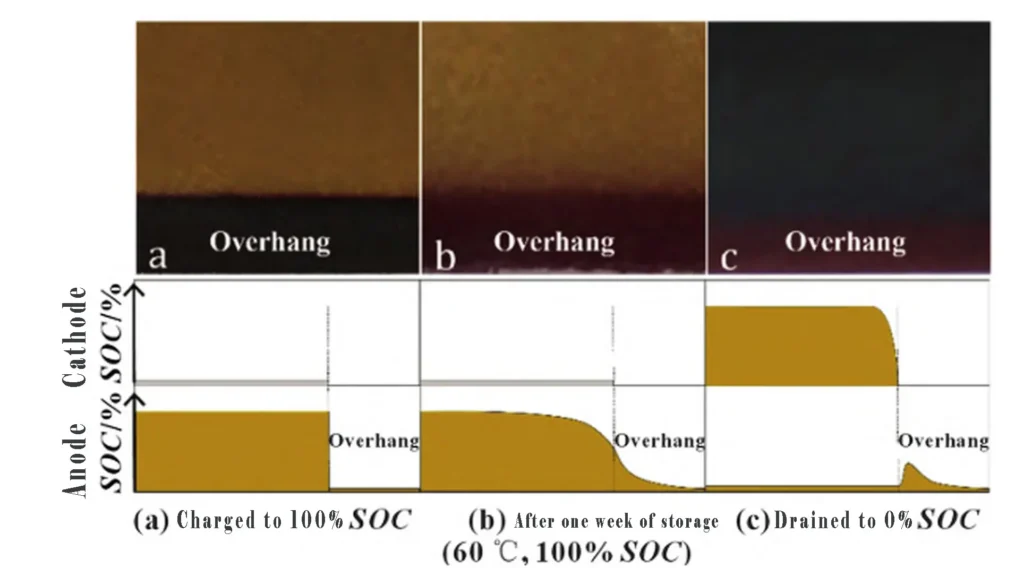
The movement of lithium ions between the active area of the anode and the overhang area is closely related to capacity change and lithium plating on the anode.
For example, during battery charging, due to the presence of the overhang area, the anode overhang is not fully lithiated at the end of charging, as shown in Figure (a). This results in a lithium concentration gradient near the edge of the anode. During the subsequent resting period, the lithium intercalated in the anode diffuses from the center toward the edge, as shown in Figure (b).
After discharging, lithium still remains in the overhang area and is not fully deintercalated. This indicates that during discharge, the edge of the cathode not only receives lithium ions from the anode area directly facing it, but also receives lithium ions released from the anode overhang area. As cycling continues, the lithium concentration at the cathode edge gradually increases. As a result, during charging, lithium plating is more likely to occur at the edge of the anode.
Therefore, within the limits of electrode manufacturing quality and equipment accuracy, the overhang area should be designed as small as possible to reduce the risk of lithium plating.
Solutions to Lithium Plating on Anode
Battery Structure Optimization
Battery structure has a strong influence on lithium plating.
- Reducing the overhang area helps prevent lithium ions from moving to the anode edge during charging, which can cause edge lithium plating.
- Multi-tab designs improve current distribution during charging and reduce local high current density, lowering the risk of lithium plating.
- Proper N/P ratio design is also an effective way to suppress anode lithium plating.
Electrode Quality Control
Electrode manufacturing includes slurry mixing, coating, and calendering. These processes affect porosity, tortuosity, and areal density, which influence current distribution during charging.
- Poor slurry mixing or coating defects can cause local lithium plating.
- Excessive calendering limits lithium-ion diffusion and insertion kinetics, leading to large-area lithium plating.
Electrode Surface Treatment
Lithium plating can be reduced by lowering anode polarization and increasing the overpotential for lithium deposition.
- Depositing a nano-scale metal layer on the anode surface can increase lithium deposition overpotential and weaken lithium growth.
- Laser-etched surface structures can reduce lithium-ion diffusion resistance and charge transfer resistance, especially at low temperatures, thus lowering plating risk.
Anode Material Optimization
Lithium-ion insertion kinetics in graphite depend strongly on crystal structure.
- Lithium ions insert more easily through edge planes than basal planes.
- Element doping at graphite edges (such as B, N, or Ni) improves charge transfer and mass transport.
- Nano SiO₂ or silicon coatings raise the alloying potential and help prevent the anode from reaching the lithium plating potential.
Electrolyte Additive Optimization
Lithium plating is closely related to anode polarization and lithium-ion insertion kinetics, which are affected by SEI film properties.
- Film-forming electrolyte additives help create a stable SEI with low resistance and high ionic conductivity.
- FEC forms a stable LiF-rich SEI, but its ionic conductivity is relatively low.
- TMSP suppresses side reactions and improves SEI ionic conductivity.
- At low temperatures, LiFSI shows the best lithium plating suppression, while LiDFOB may increase plating due to unbalanced kinetics between the cathode and anode.
Electrolyte additives must be selected to balance both anode and cathode kinetics.
Conclusion
Lithium plating on the anode is a major degradation and safety issue in lithium-ion batteries. It occurs when lithium-ion intercalation cannot keep up with charging conditions, causing metallic lithium to deposit on the anode surface. Low-temperature charging, fast charging, overcharging, and excessive anode overhang are the main factors that increase the risk of lithium plating.
Lithium plating involves both reversible and irreversible processes, but irreversible lithium loss leads to capacity fade and reduced cycle life. To effectively suppress lithium plating, a system-level approach is required, including optimized battery structure, strict electrode quality control, advanced surface treatments, improved anode materials, and carefully selected electrolyte additives. Only by balancing electrochemical kinetics at both the anode and cathode can lithium plating be minimized, ensuring better performance, longer life, and improved safety of lithium-ion batteries.
Preventing lithium plating on the anode requires a system-level design approach rather than a single material solution.
We integrate cell structure design, electrode engineering, and electrolyte optimization to deliver safer and longer-lasting lithium battery solutions for demanding applications.
If your application requires fast charging or reliable low-temperature performance, BluePower’s custom battery solutions can help reduce lithium plating risks from the design stage.
Email: [email protected]
Whatsapp: +86 18938252128
