Smartwatches offer many advanced features, but their small size limits them to batteries of only tens to a few hundred milliamp-hours. As a result, battery life is a major concern for users. Long periods of high screen brightness, continuous GPS tracking, frequent notifications, and background app activity can all drain the battery quickly.
For example, Apple has stated that features such as heart rate monitoring, GPS tracking, and notifications require significant power. In addition, OLED displays that turn on often in “raise-to-wake” mode further increase power use.
In summary, the following factors can cause a smartwatch battery to drain faster:
- Screen and display:
High brightness or keeping the screen on for a long time uses a lot of power. This is especially true in high-brightness or “always-on” modes, where OLED screens light up very often. Even using on-demand screen wake or dark mode can only reduce power use to some extent. - Location and sensors:
Keeping GPS or location services on greatly increases power use, especially during workouts with full route tracking. Continuous health features like heart rate and blood oxygen monitoring also consume more energy. In addition, when the watch connects to external devices such as Bluetooth earphones or heart rate straps, it needs extra power to maintain the connection. - Notifications and background apps:
Frequent messages, calls, app alerts, and weather updates wake the watch again and again, which drains the battery. Apps running in the background or screens that refresh data constantly (such as workout stats or market data) also use more power. - Hardware and system:
High-performance chips, raise-to-wake features, and constant connections (Wi-Fi or cellular) increase power use. For example, Apple Watch uses power-saving technologies, but new system features and faster processors still put pressure on battery life.
Brand Battery Life Comparison
Different smartwatch brands focus on battery life in different ways, so real-world endurance can vary a lot. Below is a comparison of several major brands for reference:
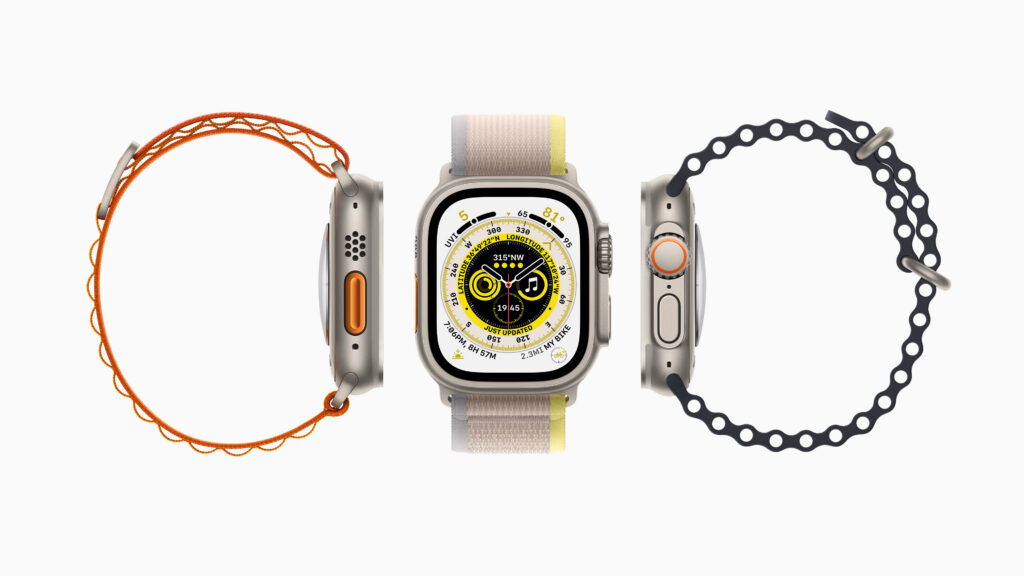
Apple Watch:
Apple Watches use relatively small batteries. Apple states that typical daily battery life is about 18 hours. For Series 11, total battery life is around 24 hours (about 18 hours of daytime use plus 6 hours of sleep tracking).
The latest Ultra models are larger and use low-power optimization, extending battery life to over 36 hours in normal mode, and up to 60 hours with Low Power Mode enabled.
Huawei Watch GT series:
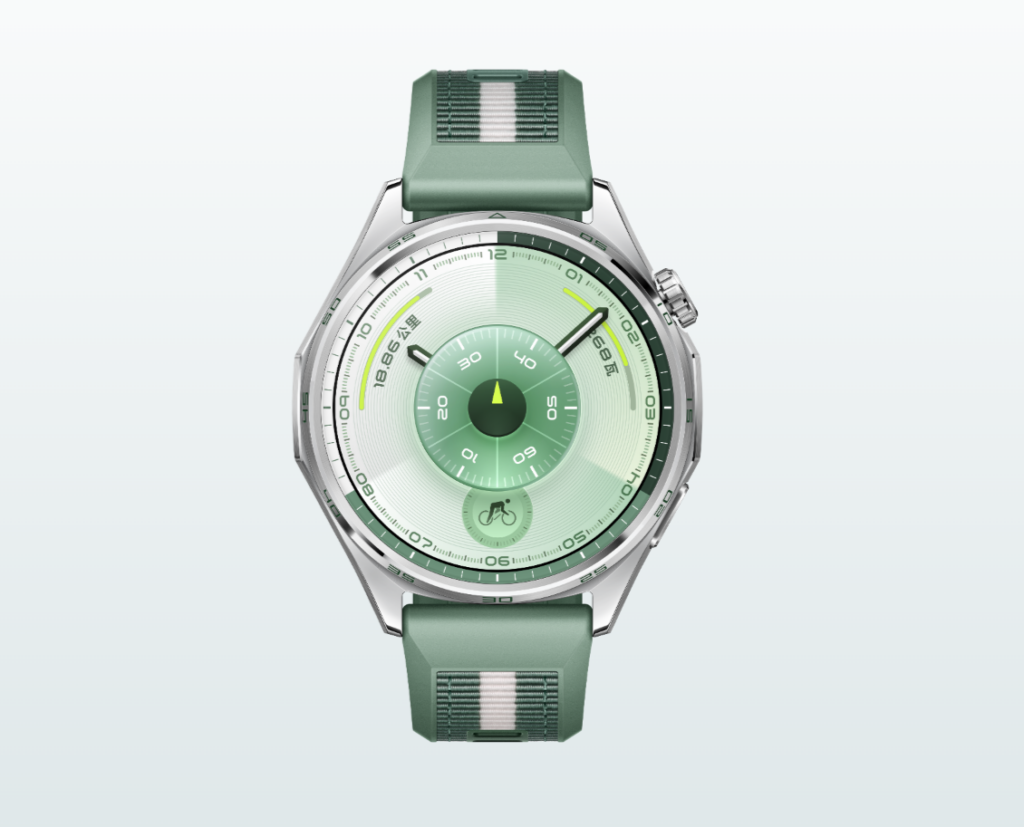
The Watch GT series is well known for long battery life. For example, the latest GT 6 (46 mm) can last up to 21 days with light use and about 12 days with normal use. Even with always-on display enabled, it can last around 7 days.
The 41 mm version offers about 14 days (light use), 7 days (normal use), and 5 days with always-on display. Many GT models can last over a week, or even longer, when some features are turned off.
Garmin Forerunner series:
Garmin watches are designed for sports and outdoor use and usually offer excellent battery life. According to the Forerunner 965 manual, it can run for about 23 days in smartwatch mode.
With GPS tracking enabled, battery life ranges from about 20 to 31 hours, depending on the GPS mode. Some Garmin outdoor models also support solar charging, which further extends usage time.
Samsung Galaxy Watch:
Samsung smartwatches usually last around 2–3 days. The Watch 5 Pro is rated for up to 80 hours (about 3.3 days) under normal use, and about 20 hours with GPS on.
The latest Galaxy Watch Ultra offers longer battery life. With always-on display enabled and no power-saving mode, it can last about 60 hours. Without always-on display, it can reach around 80 hours. In real use, many users still need to charge once per day, but power-saving settings can help extend battery life.
Each brand takes a different approach to battery life. Apple focuses on performance and compact design, with shorter endurance. Huawei’s Watch GT series prioritizes ultra-long battery life, ideal for travel. Garmin targets sports and outdoor users with very long battery life. Samsung balances smart features and endurance, using power-saving modes to extend usage time.
How to Solve Smart Watch Battery Life Issues
Smartwatch battery life issues cannot be solved by software or hardware alone. Adjusting settings helps, but only to a limited extent. Real improvement comes from a system-level approach that combines both hardware and software optimization.
Software-Level Solutions: Reducing Unnecessary Power Consumption
The primary goal of software optimization is simple:
reduce unnecessary wake-ups and lower continuous power draw.
Display System Optimization (Most Critical Software Factor)
- Control screen-on frequency
- Reduce false “raise-to-wake” triggers
- Shorten auto screen-off time
- Always-On Display (AOD) optimization
- Use ultra-low refresh rates (e.g. 1Hz)
- Display only essential information such as time
For example, Apple Watch uses LTPO displays to dynamically adjust refresh rates and reduce power consumption.
- Dark UI and OLED-friendly design
- Black pixels consume almost no power on OLED screens
- Dark system themes significantly reduce display energy usage
Sensor and Algorithm Optimization
- On-demand sensor operation
- Heart rate monitoring: interval sampling instead of continuous tracking
- SpO₂ and temperature monitoring: activated only during sleep or rest periods
- Algorithm replacing hardware usage
- Motion algorithms infer activity states instead of keeping GPS and motion sensors running continuously
This approach is widely used in sports-oriented smartwatches such as those from Garmin, where efficiency is critical.
- Motion algorithms infer activity states instead of keeping GPS and motion sensors running continuously
System and Application Management
- Limit background activity of third-party apps
- Reduce high-frequency notifications and vibration alerts
- Intelligent switching between Bluetooth, Wi-Fi, and cellular modules
Many users experience fast battery drain even when “not actively using” the watch. In most cases, the cause is background processes constantly waking the system.
Hardware-Level Solutions: Defining the Upper Limit of Battery Life
Software determines how efficiently power is used.
Hardware determines how long the system can run.
Battery Design: “Right Fit” Matters More Than “Bigger”
Smartwatches face strict constraints:
- Extremely limited internal space
- Irregular internal structures
- High safety requirements for wearable devices
As a result, the industry trend is clear:
custom lithium polymer batteries, not standard off-the-shelf cells
Key hardware optimization directions include:
- Ultra-thin and irregular-shaped battery designs to fit curved housings
- Higher energy density cells
- Low internal resistance and high consistency to reduce energy loss
This explains why two watches with similar sizes can have vastly different battery life—one lasting a single day, another lasting several days.
Power Management System (PMU / BMS)
- High-efficiency DC-DC conversion
- Fine-grained multi-voltage power rails
- Hardware-level power gating for individual modules
For example:
- When GPS is not in use, it is not only disabled by software, but physically powered off at the hardware level
- Display, sensors, and communication modules operate on independent power domains
SoC and Peripheral Component Selection
- Low-power MCUs or SoCs instead of overpowered processors
- Bluetooth Low Energy (BLE 5.x)
- Sensors optimized for ultra-low standby power
This is why sports and fitness watches often achieve much longer battery life than full-featured smartwatches.
BluePower Custom Round Battery for Smartwatch
Most smartwatches use standard rectangular batteries, which do not fully match the circular internal space of the watch case. This often leaves unused space and limits battery capacity.
At BluePower, we replace traditional rectangular cells with custom round batteries designed to fit the internal structure of smartwatches more precisely.
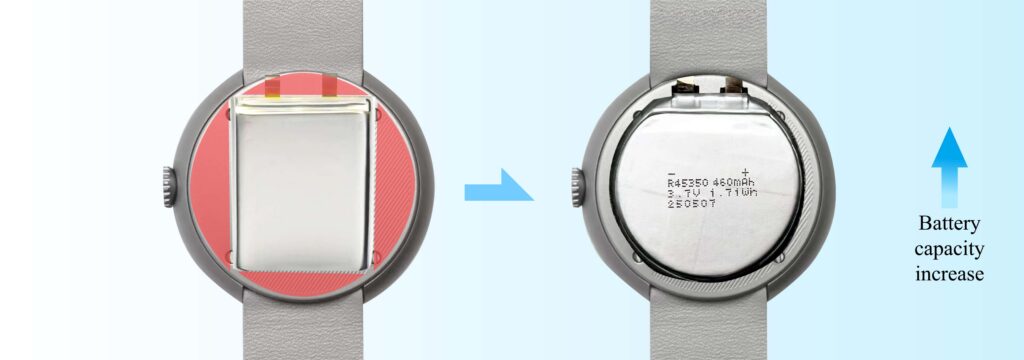
Better Shape, Higher Capacity
By using a round battery design, we can:
- Better utilize the circular internal space
- Reduce wasted volume inside the watch
- Increase battery capacity without increasing thickness
- Improve overall battery life without changing the external design
In many cases, a custom round battery delivers noticeably longer runtime compared to a standard rectangular cell.
Silicon-Carbon Battery Option for Higher Energy Density
For smartwatches that require even longer battery life, BluePower also offers silicon-carbon battery solutions.
Compared with conventional lithium batteries, silicon-carbon technology provides:
- Higher energy density in the same size
- Increased capacity without enlarging the battery
- Better support for power-intensive features like AMOLED displays and GPS
By combining custom round battery design with silicon-carbon chemistry, smartwatch manufacturers can extend battery life while keeping devices thin, lightweight, and comfortable to wear.
Conclusion
Smartwatch battery life is ultimately a system-level challenge. Software optimization helps reduce power consumption, but long-term endurance depends on how well the battery, power management, and internal structure are designed to work together. As smartwatches adopt brighter displays and more advanced sensing features, battery design is becoming a key factor that directly influences user experience.
By using custom-shaped, high–energy-density battery solutions, manufacturers can make better use of limited internal space and extend battery life without compromising design or comfort. Exploring battery options early in the design phase often creates more flexibility for both performance and product innovation.
If battery life or space efficiency is a challenge in your smartwatch design, a technical discussion at the system level can be a valuable starting point.
Contact
Email: [email protected]
Whatsapp: +86 18938252128
