When a wearable device is no longer just used to count steps or show the time, but can help stroke patients express language again, its meaning goes far beyond consumer electronics.
A recently introduced wearable voice reconstruction device is a good example. Worn on the neck, it captures extremely weak muscle movement signals. With the help of algorithms, these signals are converted into clear and natural speech, allowing some people who lost their voice due to stroke to communicate with the world again.
When talking about breakthroughs like this, people often focus on AI, sensors, algorithms, and human–machine interaction. However, if we look deeper from an engineering and long-term use perspective, we find that the battery—especially a custom battery solution—is one of the key foundations that makes this kind of device truly practical and usable in real life.
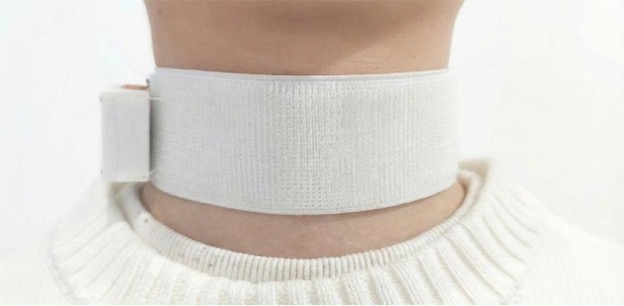
How Medical Wearables Change Design Logic Compared to Consumer Devices
Unlike ordinary smartwatches or earbuds, medical wearable devices operate in a completely different environment:
- Users are often people with limited or sensitive physical conditions
- Devices must work for long periods in a stable and continuous way
- Wearing comfort directly affects whether patients are willing to use the device long term
- Any safety risk can lead to serious consequences
This means medical wearables are not about simply adding more features. Instead, they must achieve a very delicate balance between reliability, comfort, safety, and stability.
And the battery sits right at the center of this balance.
Powering All-Day Medical Wearables: Higher Demands on Battery Systems
Using voice reconstruction devices as an example, these products do not work in an on-and-off mode. Instead, they:
- Continuously collect biological signals
- Process and analyze data in real time
- Stay on standby for long periods and respond instantly to the user
This places several demands on the battery that may sound simple, but are actually very strict:
Stable and predictable discharge behavior
The battery must not show sudden drops or unstable power levels, especially at critical moments.
Sufficient energy density
The device needs to be thin, lightweight, soft, and close to the body, while still supporting a full day of use.
Balance between low power and peak power
Most of the time, the device runs in low-power monitoring mode, but power demand rises during signal processing and audio output.
If standard battery specifications are used without modification, designers often have to compromise on size, runtime, or safety. Medical devices, however, are one of the few application areas where compromise is simply not acceptable.
Why Standard Batteries No Longer Fit Advanced Wearable Devices
In early wearable products, engineers often selected the closest available battery model and then adjusted the device structure around it.
Today, this approach is gradually becoming ineffective, for very practical reasons:
- Device shapes are becoming more aligned with the natural curves of the human body
- Internal space is highly fragmented
- The number of functional modules continues to increase
- Weight and thickness are extremely sensitive design factors
In this context, the idea of “fitting the device to the battery” no longer works. Instead, the battery must be designed specifically for the device.
This is the fundamental value of custom batteries.
The Real Value of Custom Batteries Goes Far Beyond Shape Design
When people talk about custom batteries, the first thought is often “making the battery thinner, curved, or cut into a special shape.” However, in medical wearable devices, customization means much more than that.
1. Form factor customization: designed for wearing comfort
Areas such as the neck, wrist, and chest are extremely sensitive to weight and pressure distribution. Custom batteries can use non-standard shapes to spread weight more evenly, reducing pressure and discomfort during long-term wear.
2. Electrical performance customization: designed for real use conditions
The goal is not simply higher discharge rates or maximum capacity. Instead, the battery is optimized based on the device’s actual working profile, including discharge stability, internal resistance, and cycle life.
3. Safety structure customization: designed for close-to-body medical use
This includes multiple protection designs, careful material selection, and suitable packaging methods to ensure reliability during long-term skin contact and repeated charge–discharge cycles.
4. System-level integration: designed for overall device lifespan
The battery is no longer treated as an isolated component. It is developed together with the main board, algorithms, and power management strategy as part of a complete system design.
There is one important goal worth thinking about:
the most successful medical wearable devices are often the ones users barely notice.
To achieve this, the battery must:
- Generate no noticeable heat
- Avoid swelling or shape change
- Not interfere with flexible structures
- Not require frequent charging
- Create no psychological burden for the user
This is why, in medical devices designed for true long-term wear, engineering teams invest far more effort into battery solutions than most people realize.
From “Technically Possible” to “Truly Usable”: Custom Batteries as the Hidden Enabler
Returning to voice reconstruction wearable devices, their real value is not only about whether the technology works in theory, but whether patients can wear them every day, use them continuously, and build trust over time.
In medical wearables, “can be used” and “want to be used” are often two very different things.
When we look at this from an engineering and user experience perspective, we can see a clear but often overlooked chain of logic:
Human-friendly design
→ Stable and reliable power supply
→ Long-term, uninterrupted use
→ User trust
→ Technology that truly changes lives
In this chain, the battery is not the main focus. However, if it fails at any point, the entire system can collapse.
In real projects, this situation is common:
the algorithms are already mature, and the sensors meet performance targets. But once real-world user testing begins, unstable battery life, heat during wear, structural limits, or frequent charging quickly reduce user compliance.
It is at this stage that the true value of custom batteries becomes clear.
In medical wearable customization projects, the battery is not a component chosen at the final design stage. Instead, it is one of the engineering elements involved early in defining the system:
- Whether the battery size and shape follow the natural curves of the human body, instead of forcing design compromises
- Whether the discharge profile matches the device’s real power consumption, rather than only looking good on paper
- Whether there is enough thermal stability and safety margin for long-term, close-to-body use
- Whether performance aging remains controlled and predictable over repeated charge and discharge cycles
These challenges cannot be solved by simply switching to a “larger-capacity” standard battery. They require targeted design at the level of materials, cell structure, packaging, and system-level integration.
As a result, in many medical wearable projects that truly move toward clinical or long-term use, custom batteries act more like a hidden engineering partner.
They are not noticed by users, yet they directly determine whether the device can operate quietly, reliably, and continuously.
When the power system is reliable enough, users no longer need to worry about battery levels or sudden failure. Only then can the device evolve from a “high-tech product that needs constant attention” into a “daily tool that can be trusted.”
And this is the real dividing line between technology that is merely possible and technology that is truly usable.
Conclusion
When we talk about the future of wearable medical devices, AI, algorithms, and sensors are undoubtedly exciting. However, for these devices to truly become part of everyday life—and tools that patients can rely on daily—the underlying technologies that go unnoticed by users, yet operate with consistent stability, deserve equal attention.
The true value of custom batteries lies exactly here.
They are not designed to impress, but to enable complex technologies to accompany people’s real lives in the most natural, safe, and reliable way possible.
And perhaps this is the true sign that advanced wearable medical devices are finally reaching maturity.
If you are developing the next generation of medical wearable devices,
and want the battery to stop being a design compromise and become a real product advantage—
You’re welcome to connect with BluePower.
We focus on custom lithium battery solutions for wearables and medical devices. From ultra-thin structures and non-standard shapes to safety and lifespan optimization, we help batteries work quietly in the background—yet remain consistently reliable.
👉 Contact us to discuss a custom battery solution tailored to your product.
Let technology return to its essence, and let users feel only confidence and trust.
Email: [email protected]
Whatsapp: +86 18938252128
