In FPV drone racing, a difference of just a few seconds can decide the final result.
Pilots need to control drones through high-speed tracks, sharp turns, dives, and rapid acceleration. At the same time, the drone must deliver a large amount of power in a very short time.
Many people think the winner of an FPV race depends on:
- More powerful motors
- A more responsive flight controller
- A better camera system
- Better flying skills
However, there is another important factor that is often overlooked — battery performance.
For FPV drones, the battery is not just a component that provides power. It is more like the drone’s “energy source.” It affects how quickly the drone can accelerate, how stable the power output is, and whether it can deliver enough power at critical moments.
How Are FPV Drones Different from Regular Camera Drones?
The type of drones most people know are camera drones.
These drones usually focus on:
- Longer flight time
- More stable video recording
- Smarter automatic controls
FPV drones are different and they are built for speed and control. During a race, the drone needs to:
- Accelerate instantly
- Change direction quickly
- Handle continuous high-power output
- Stay responsive during high-speed flight
This means FPV drones have much higher requirements for batteries. A normal battery may allow a drone to fly, but it may not be able to support aggressive racing performance.
Why Do FPV Drones Depend So Much on Battery Performance?
1. Acceleration Depends on Battery Power Output
In FPV racing, one important factor is the thrust-to-weight ratio.
Simply put, it shows how quickly a drone can climb, accelerate, and change direction.
When a pilot pushes the throttle, the motors need a large amount of power immediately.
If the battery cannot release energy quickly enough, the drone may experience:
- Slower acceleration response
- Reduced power
- Noticeable voltage drops during high-speed flight
These problems may not be obvious during normal flying.
But in a racing competition, even a small difference in power can affect the final result.
2. Battery Weight Directly Affects Flight Performance
For FPV drones, every gram matters.
A larger battery usually means:
- Higher capacity
- Longer flight time
But it also means:
- More weight
- Higher load on the drone
Therefore, FPV pilots are always looking for the right balance:
How can a drone get more energy and more power without adding too much weight?
This is why lightweight and high-energy-density batteries are becoming an important direction for drone development.
Why Do FPV Batteries Need More Than Just Large Capacity?
Many people think a larger battery means a drone will always fly longer and perform better.
However, for racing drones, things are more complicated.
FPV batteries need to achieve a balance between several key factors.
1. High Discharge Capability
During racing, motors need large amounts of current very quickly.
Therefore, FPV batteries usually require a high discharge rate (C-rate) to support strong and instant power output.
A battery with better discharge performance can help the drone:
- Accelerate faster
- Respond more quickly
- Maintain stronger power during aggressive flying
2. Low Internal Resistance
Every battery has internal resistance. When a drone operates at high speed and draws large current, some energy is lost as heat.
Lower internal resistance means:
- Better energy efficiency
- More stable voltage output
- Less heat generation
This is especially important for continuous high-speed flights.
3. Lightweight Design
The drone industry is constantly looking for ways to reduce weight.
A lighter battery can help:
- Improve acceleration
- Reduce motor workload
- Enhance flight control
Therefore, battery design is no longer only about increasing capacity. It is about finding the best balance between weight, size, and performance.
How Do Battery Structures Like Stacking and Winding Affect FPV Performance?
Besides battery materials and capacity, the internal structure of a battery cell also affects its final performance.
Today, two common lithium battery cell structures are:
- Winding structure
- Stacking structure
Both technologies are widely used, but they have different design approaches.
Winding Cells: A Mature and Efficient Traditional Solution
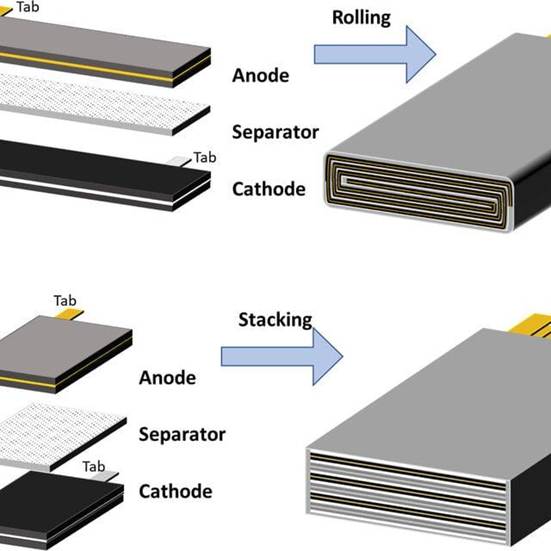
Winding is one of the most common battery manufacturing methods. It forms a battery cell by rolling the positive electrode, negative electrode, and separator together.
This method offers several advantages:
- High production efficiency
- Mature manufacturing process
- Suitable for large-scale production
Because of this, many consumer electronics products and standard battery designs use winding structures.
Stacking Cells: Designed for High Performance and Flexible Designs
Stacking technology uses multiple individual electrode sheets that are placed layer by layer to form the battery cell. Compared with winding structures, stacking designs provide several advantages.
1. Better Space Utilization
In winding cells, the curved areas can create some unused space inside the battery.
With stacking technology, the electrode sheets remain flat, allowing better use of internal space.
This is especially valuable for products such as drones and wearable devices, where every bit of space matters.
2. More Balanced Current Distribution
The stacking structure can help create a more balanced current flow inside the battery.
This can help:
- Reduce local heat buildup
- Improve stability
- Support better high-power performance
3. More Flexible Battery Shapes
Drone designs are becoming more diverse.
Future drones may require:
- More compact designs
- Special battery shapes
- Better space utilization
Stacking technology allows battery manufacturers to create more flexible cell designs for different applications.
The Future of FPV Racing May Also Be a Competition of Battery Technology
As FPV drones continue to develop, the focus of competition is changing.
In the past, people mainly focused on:
- Motor performance
- Flight controllers
- Camera systems
In the future, battery technology may become one of the most important factors affecting drone performance.
This is especially true for:
- Professional racing drones
- AI-powered autonomous drones
- Industrial drones
- Robotic platforms
In these fields, better batteries can directly improve product capabilities.
Conclusion: A Drone’s Speed Depends on Its Energy Source
FPV drone racing looks like a competition of speed, but behind every race is a combination of different technologies.
Every acceleration, turn, and high-speed movement depends on a battery that can provide stable and powerful energy.
In the future, lighter, more efficient, and more flexible battery designs will help drones overcome current limitations.
For FPV pilots, the battery may not be the most visible part of a drone, but it plays a major role in deciding how fast the drone can fly, how long it can stay in the air, and who wins the race.
