In recent years, smart rings have become one of the fastest-growing wearable devices. From health tracking and sleep monitoring to AI assistants and contactless payments, more and more features are being packed into a tiny ring that weighs only a few grams.
However, if you compare different smart ring brands, you may notice something interesting.
Some smart rings are rated for 7 to 8 days of battery life, while others can last 10 days or even nearly two weeks. For example, the Samsung Galaxy Ring is officially rated for up to about 7 days, while the RingConn Gen 2 claims up to around 12 days. Considering that these rings are similar in size, why is there such a big difference in battery life?
Many people think the answer is the processor, software optimization, or the number of sensors. These factors certainly matter. But there is another important factor that is often overlooked—the battery manufacturing process.
Although most smart rings use curved batteries, their internal structure can be very different. Today, there are two main ways to make smart ring batteries: winding and stacking. They may look similar from the outside, but the internal design affects space utilization, battery capacity, internal resistance, heat dissipation, and cycle life.
So, what is the difference between these two manufacturing methods? And why are more high-end custom-shaped batteries using stacking technology?
Same Shape, Completely Different Inside
From the outside, most smart ring batteries have a curved shape so they can fit inside the ring.
But if you open them, the internal structure is completely different.
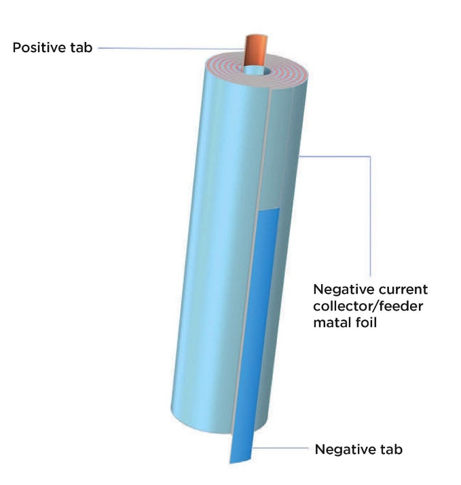
The winding process, as the name suggests, continuously rolls the cathode, separator, and anode together into a structure often called a jelly roll, and then seals it inside the battery cell. Inside the battery, the electrodes are tightly rolled together.
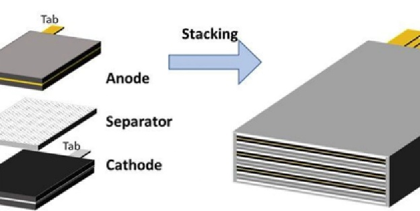
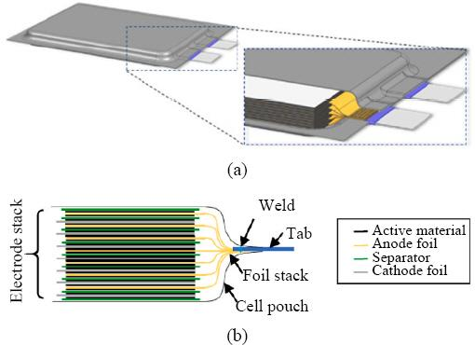
The stacking process works differently. First, the cathode and anode are cut into individual pieces. Then they are stacked layer by layer in the order of cathode, separator, anode, and separator. Finally, the tabs with the same polarity are welded together to create a single output.
Although both methods can produce a curved battery, the different internal structures lead to different performance.
Why Does a Stacking Battery Usually Offer Longer Battery Life?
For a smart ring, the biggest challenge is not simply making a battery. The real challenge is fitting as much energy as possible into an extremely small space.
This is where the stacking process has a clear advantage.
Better Space Utilization Means Higher Capacity
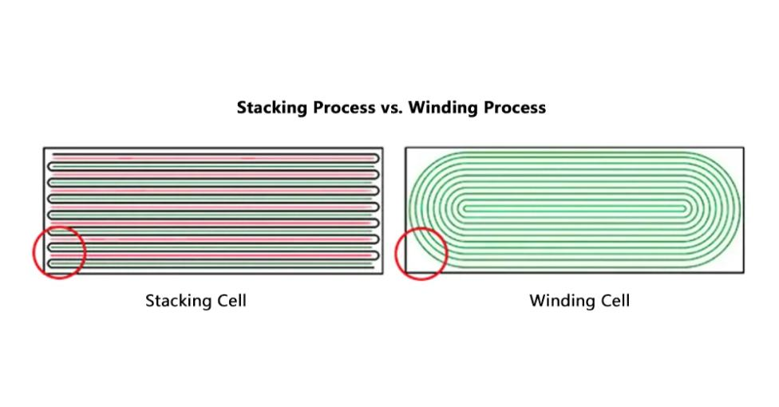
In a winding battery, the electrodes must bend during the rolling process. Because of this, the corners require a certain bending radius. Extra space is also needed to reduce mechanical stress caused by bending.
As a result, some space—especially around the corners—cannot be fully used for active battery materials.
A stacking battery is different. Since it uses flat electrode sheets instead of rolled ones, it does not have the same bending limitation. This allows it to use the available space more efficiently.
Under the same battery size, a stacking cell can typically achieve about 20% higher volumetric energy density than a winding cell. For very small batteries like those used in smart rings, this advantage becomes even more important because the corner area makes up a larger percentage of the battery.
In simple terms, a stacking battery can fit more active material into the same space. More active material means more battery capacity, which directly helps extend battery life.
Lower Internal Resistance Makes Better Use of Every mAh
Battery capacity is not the only thing that affects battery life.
If a battery has high internal resistance, more energy is lost during discharge. It also creates more voltage drop and heat.
A winding battery usually has only a small number of tabs. The current must travel a longer distance along the electrodes before reaching the output tabs, resulting in higher internal resistance.
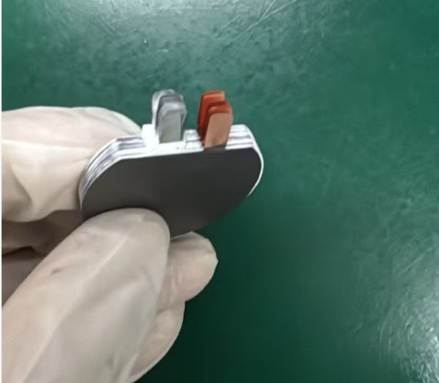
In a stacking battery, every electrode layer can have its own tab. These tabs are connected together, creating shorter current paths and a more even current distribution. This helps reduce internal resistance and polarization.
For smart rings, features such as blood oxygen monitoring, heart rate tracking, AI processing, and wireless communication may work at the same time. Lower internal resistance helps reduce energy loss, allowing the battery to use its capacity more efficiently.
More Even Heat Distribution Helps Maintain Battery Performance
Heat is generated whenever a battery is working.
In a winding battery, heat must travel from the tightly rolled inner layers to the outside. This makes the center and curved areas more likely to develop hot spots.
A stacking battery has a layer-by-layer structure with more uniform heat paths. Heat spreads more evenly throughout the battery, making thermal management more efficient.
More even heat distribution helps improve discharge stability and reduces performance loss caused by high temperatures, which also supports more stable battery life over time.
Stacking Offers More Than Just Longer Smart Ring Battery Life
Longer battery life is only one benefit of the stacking process.
For high-end smart rings, stacking also provides several other important advantages.
Better High-Rate Performance
Because stacking batteries have lower internal resistance and shorter current paths, they experience less voltage drop and generate less heat during high-current discharge.
As AI features, on-device computing, and more sensors are added to smart rings, the demand for higher discharge performance will continue to increase.
Longer Cycle Life
Every charge and discharge cycle causes the electrodes to expand and shrink slightly.
In a winding battery, the curved areas experience uneven mechanical stress. Over many cycles, these areas are more likely to develop lithium plating, interface degradation, and localized swelling, which can lead to faster capacity loss.
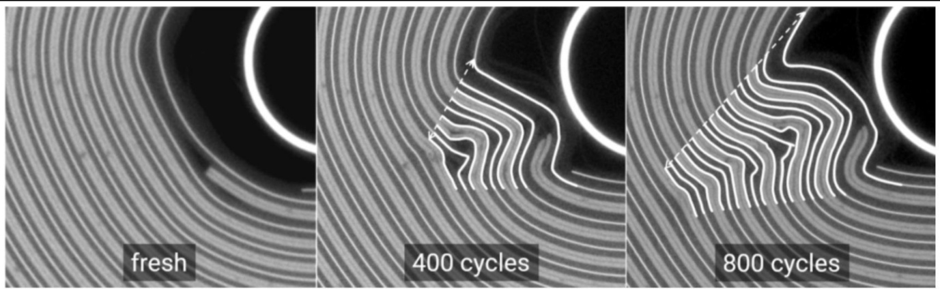
A stacking battery uses flat electrodes with more even stress distribution. This helps maintain a more stable internal structure, resulting in longer cycle life and better thickness consistency.
For smart rings that are worn and charged every day, a longer cycle life means a longer service life.
Higher Safety
Safety is always one of the most important requirements for wearable devices.
The stacking structure has more even internal stress and better heat distribution, making the battery mechanically more stable.
In comparison, the curved areas inside a winding battery have higher stress concentration, making them more sensitive under extreme conditions.
Of course, battery safety also depends on battery materials, manufacturing quality, and the battery management system (BMS). The manufacturing process is an important factor, but it is not the only one.
Does This Mean the Winding Process Is Outdated?
The answer is no.
In fact, winding is still the most widely used battery manufacturing process in the lithium battery industry.
It offers continuous production, mature equipment, high automation, lower manufacturing costs, and high production efficiency. That is why it remains the mainstream choice for standard rectangular battery cells.
The stacking process, on the other hand, requires more complex equipment, higher manufacturing costs, and more precise electrode cutting and alignment. However, it provides clear advantages in high energy density, long cycle life, high-rate performance, ultra-thin batteries, and custom-shaped battery designs.
In other words, neither process is better in every situation. The right choice depends on the requirements of the final product.
Conclusion: Battery Manufacturing Is Becoming a Key Competitive Advantage
Smart rings continue to add new features such as AI assistants, health monitoring, NFC, and UWB. But the space available for the battery has not become any larger.
In the future, the competition will not only be about processors and software. It will also be about how efficiently every millimeter of internal space is used.
For ultra-small curved batteries, the manufacturing process is no longer just part of production. It has become an important factor that affects battery life, performance, durability, and reliability.
The winding process remains a mature and reliable solution. At the same time, stacking technology is becoming the preferred choice for high-end smart rings and other custom-shaped wearable devices because it offers better space utilization, higher energy density, lower internal resistance, longer cycle life, and improved thermal performance.
When two smart rings look almost the same on the outside, the real difference in battery life is often hidden inside—the battery manufacturing process.
Looking for a Better Battery Solution for Your Smart Ring?
As smart rings become smaller and more powerful, battery design is becoming one of the biggest engineering challenges. Choosing the right cell structure can make a significant difference in battery life, performance, and product reliability.
BluePower specialize in custom-shaped lithium polymer batteries for smart rings, smart glasses, medical devices, and other space-constrained wearable products. Our stacking technology enables higher space utilization, higher energy density, and flexible battery designs tailored to your product.
If you’re developing your next wearable device and need a custom battery solution, contact our engineering team to discuss your project or request a prototype.
Email: [email protected]
Whatsapp: +86 18938252128
