Electricity grids had been designed with the same strength of predictable, manageable generation, including coal, gas, nuclear, and hydropower, for many years. However, renewable energy is changing that. The increase in the use of solar and wind energy contributes to lower pollution, but it also makes electricity generation unpredictable. Battery energy storage systems are the missing element in this new scheme. They accumulate excess energy when production is high and supply energy to the grid when generation is lower than needed or consumption grows.
Thus, the battery energy storage system market is rapidly growing at this time, capturing the attention of energy companies, developers, and investors.
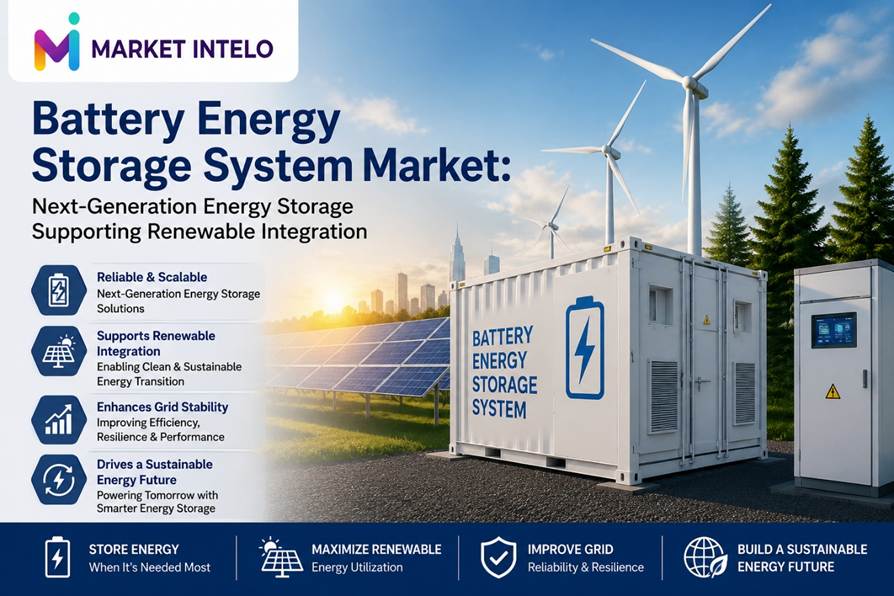
According to MarketIntelo,the market for battery energy storage systems worldwide has grown very fast, expected to reach a worth of $62.8 billion by 2025 and increase to $318.2 billion by 2034, with an annual compound growth rate of 19.8% throughout this period.
Why Batteries Matter for Renewable Integration
- The adoption of renewable energy resources brings three significant complications for power systems:
- Variability: Solar generation stops working at night and is limited on cloudy days; wind revisions are subject to variations both from hour to hour and from season to season.
- Mismatch in timing: Solar production reaches its peak during the day, but demand may be high during the night.
- Stability of the power grid: Changes in the production process may lead to the problem of voltage and frequency operation of the power system.
Battery energy storage systems address these issues by:
Changing energy with time: Using extra solar and wind power and we will release it when we need it the most.
- Offering fast response: Responding in milliseconds in order to keep frequency stable and thus help in maintaining stability in the grid.
- Minimizing curtailment: Enabling renewable energy sources, which would be otherwise wasted, to be captured for the future.
This means in practice that batteries make it possible to convert the variable energy sources into steady supply, which ensures that renewables can bring stable benefits instead of acting erratically.
Market Momentum: From Pilot Projects to Mainstream Infrastructure
Just up to the last few years, large-scale batteries were thought to be either experimental or niche reliability devices. But this has now changed significantly due to a number of fundamental changes driving BESS into the mainstream:
- The lowering of costs of Lithium-ion technology: The average prices of batteries have fallen dramatically over the last decade, making large-scale electric energy storage viable in far more markets than before;
- The implementation of new regulations and mandates: Energy regulators and system operators are gradually introducing storage in their resource planning, capacity auctions, and modernization programs;
- The necessity for utilities and corporations to decarbonize: Due to the net-zero goals set by the corporations and utilities, energy storage becomes an important enabler for high levels of renewable generation
Because of the above changes, battery projects are now ubiquitous in the portfolios of utilities, bids for renewable energy projects, and integrated resource plans. It has become common for new solar and wind projects to be started together with energy storage projects right from the beginning.
Key Technologies Powering Next-Generation BESS
Not so long ago, large batteries were considered to be experimental or specialized reliability equipment. Several major developments made BESS have a strong chance of becoming a common approach:
- The decline in costs of Lithium-ion solutions: The price of batteries has decreased significantly over the last decade, which made large-scale energy storage applicable in many more markets;
- The advent of new regulatory measures: Energy regulators and system operators have started including storage in their planning, tendering of capacity, and modernization;
- The requirement for power companies and companies to decarbonize: Because of the zero-emission targets established by various businesses, energy storage emerged as a very helpful instrument.
Emerging and Long-Duration Technologies
In order to facilitate better decarbonization and long-term storage solutions, many technologies are emerging as worthy alternatives.
- Flow batteries (vanadium redox etc.): They are superior for long-run energy storage solutions since they effectively vary in energy capacity.
- Sodium and other technologies: These are cheaper, but have a totally different set of features and limitations.
- Hybrid technologies: They may combine batteries with various storage solutions (thermal storage, pumped hydro technologies, hydrogen etc.) in order to have many hours of energy.
Core Use Cases in a Renewable-Rich Grid
- Battery energy storage solutions provide benefits at all levels of the power industry. The typical applications are as follows:
1. Solar and Wind Firming
- BESS smoothes generation from renewable power plants, lowering changes and fluctuations, which helps to make wind and solar energy easier to manage and integrate into the existing market and grid.
2. Peak Shaving and Capacity Support
- In this case, batteries charge at night and discharge in the daytime, therefore:
- Reducing the load on generation and transmission systems.
- Avoiding (or postponing) construction of new peaking plants and grid upgrade.
- Supporting capacity markets as flexible, fast response sources.
3. Frequency and Voltage Regulation
- To keep frequency and voltage in a safe range, quick and precise response is necessary, which batteries are very good at doing:
- Frequency containment and regulation services.
- Voltage support in renewable-rich locations.
- Providing synthetic inertia in addition to many other ancillary services, usually delivered by rotating machines.
4. Microgrids and Resilient Systems
- In microgrids, remote locations, and sensitive facilities, BESS provides:
- Uninterrupted supply during outages/impacts on the grid.
- Increased share of locally generated renewables while remaining reliable.
- Less dependence on diesel generators and related fuel logistics.
Business and Investment Perspective
- From the viewpoint of business, the BESS market is a combination of energy infrastructure, technological innovation, and financial engineering. The following characteristics make it attractive:
- Multiple ways of earning. Each battery can make money in capacity markets, energy markets, and ancillary services to increase the revenues and economics of a project.
- Scalability and modularity. The systems can range from megawatt systems behind the meter to multi-hundred-megawatt grid-scale systems.
- Alignment with ESG and sustainability goals. Storage projects help in decarbonisation and augment grid resilience which corresponds with ESG reporting and principles of sustainable finance.
However, investment decisions must navigate:
Changing rules and guidelines present in the marketplace.
• Technological impact and guarantees of efficiency.
• Compatibility with the situation in the power grid, permission-giving processes, and society’s perspective on the development of the project.
In the case of developers and asset owners, understanding local market structure, consumer preferences, and technology prospects will be crucial for success.
Challenges and Next Steps for the Market
Although the BESS sector is developing rapidly, it still has to cope with several difficulties:
- Impacts of life cycle and sustainability: More and more important questions about raw materials sourcing, end-of-life treatment, and recycling are seen in project evaluations.
- Grid integration and planning: Storage has to be integrated properly into overall system planning so that congestion or wrong location is avoided.
- Regulation clarity: Clear explanations on how storage is categorized (as generation, load, or both) and how it may be paid for is needed in order to develop investments.
- Emerging technology: Innovation is very fast at present which is good, but there is a problem of making long-lasting assets future-proof.
In order to deal with these issues cooperation between utilities, regulatory bodies, technology providers and financial institutions is necessary.
Conclusion: From Supporting Role to Central Infrastructure
Battery energy storage systems have evolved from a convenient tool for renewable energy operations to a vital link of the next-generation grid network. BESS is causing a disruption in the industry through its contribution to the performance of renewable energy projects by making it possible to implement wind and solar power systems on a larger scale and to unlock innovative business opportunities.
Successful companies on the market learn to treat storage not as a separate installation but as a part of an overall strategy of integrated energy systems using generation, digital control, and deployable capacity.
Reference : https://marketintelo.com/report/battery-energy-storage-system-market
Author Details
Ashish Kolte is a Marketing Manager at MarketIntelo with expertise in marketing, market intelligence, and business strategy. He combines marketing insights with industry research to analyze market trends, identify growth opportunities, and provide data-driven perspectives on emerging industries and global business developments.
