Today, wearable AI devices are developing fast. Many products are already very mature in terms of functions: recording, transcription, translation, summarization, and cloud sync are all available.
But if we shift our focus from user experience to internal structure, you’ll find many products are still just engineering compromises.
In this teardown of a button-shaped AI recorder, we won’t judge whether the product is good or bad. Instead, we’ll look at it from a more practical point of view:
The device is already tiny, so why does its internal space still look underused?
The answer has a lot to do with battery shape.
Teardown of a Wearable AI Recorder
One obvious but easily overlooked fact from the teardown photos.
Conclusion first, then the details.
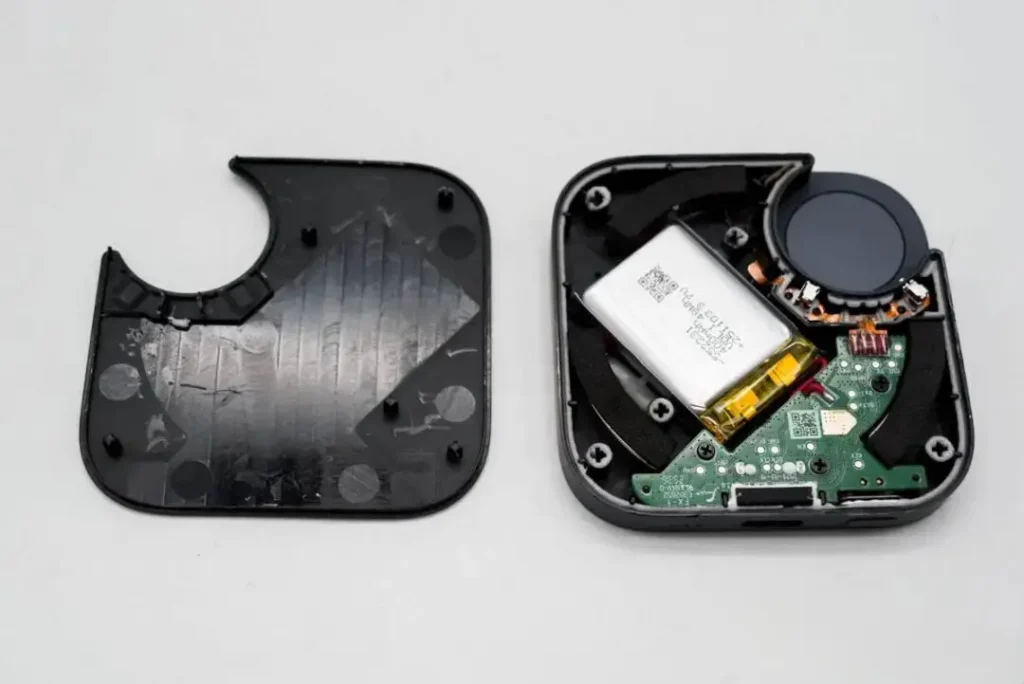
From the teardown images, we can clearly see:
This AI recorder uses a standard rectangular lithium battery, not a custom-shaped one.
If you look closely, you’ll notice several clear features:
- The battery has a standard rectangular shape
- There are gaps between the battery and the casing
- Some curved and corner areas are not covered by the battery
- The battery is simply placed where it fits,rather than being custom-designed for the device structure
This is not a design mistake. It is a typical engineering choice.
Why Do These Products Still Use Rectangular Batteries?
From an engineering and mass-production perspective, this choice makes perfect sense.
First, standard batteries are mature and low-risk.
Standard rectangular batteries offer:
- Mature supply chains
- Stable production processes
- High consistency
- Clear certification paths
For consumer electronics that need to launch quickly and scale up, this is a very safe choice.
Second, the product is already small enough — some wasted space is acceptable.
These devices already weigh only about 10 grams.
Many teams ask:
“Is it worth the effort to save just a little more space?”
If the current design already meets battery life, weight, and user experience goals,
there is little reason to take on the higher cost of developing custom-shaped batteries.
Third, custom-shaped batteries require deeper early collaboration.
Custom batteries are not “off-the-shelf” parts. They usually require:
- Earlier involvement in structural design
- Multiple rounds of sample testing
- More complex project management
When project timelines are tight, standard batteries are the practical choice.
The Structural and User Experience Value of Custom-Shaped Batteries
From the teardown results, one fact is obvious yet easily overlooked:
Inside these wearable AI devices, you’ll find a standard rectangular battery, even though the internal space of the device is clearly irregular.
Understanding this design choice does not mean we ignore its flaws.
From an engineering perspective, the combination of standard-shaped battery + irregular internal space is inherently a compromise.
While this compromise may be acceptable in current products, the limitations it creates are real.
First, there is the problem of low space utilization.
As seen in the teardown photos, the curved areas and corners around the battery are not effectively used.
These spaces exist, but because the battery shape is fixed, they cannot store energy and are simply wasted.
Second, the path to longer battery life is restricted.
With a standard rectangular battery, the almost only way to increase capacity is to make the battery thicker.
But for wearable devices, thickness directly affects wearing comfort and appearance, so this is often not a practical solution.
Third, design freedom is limited.
When the battery shape is fixed, the outer casing and internal component layout must be adjusted around the battery, not the other way around.
This may not matter in early product iterations, but as more functions are added and space becomes tighter, it becomes a hard constraint.
All these issues may be “acceptable engineering trade-offs” in today’s products.
But for the next generation of devices — especially as users demand longer battery life, thinner bodies, and better wearing comfort — these compromises will no longer be enough.
This is where the true value of custom-shaped batteries emerges.
Many people assume:
Do we only need custom-shaped batteries when the space is too small for a standard battery?
From an engineering viewpoint, this is a misunderstanding.
What custom-shaped batteries really solve is not just “fitting inside the device” — it’s about who controls the design.
If we rethink the product, everything becomes clear:
- Can the battery follow the curves of the casing, instead of being trapped in a rectangle?
- Can those wasted corners and gaps be turned into usable capacity?
- Can we improve battery life without increasing thickness or changing the outer shape?
The answer is yes.
Technically, all of this is achievable.
There is only one condition:
The battery must no longer be a standard off-the-shelf part, but designed as an integrated part of the entire device structure.
When this unused space is properly utilized, the benefit goes beyond a “cleaner engineering design” — it directly results in longer battery life.
For users, this means:
- Less frequent charging
- More stable and reassuring continuous usage
- No constant worry about low battery during meetings, study, or travel
In the end, the value of custom-shaped batteries is not about how complex their shapes are.
It is about turning higher space utilization into real, noticeable improvements in user experience.
Battery Shape Is Becoming a “Structural Variable” in Wearable Device
As AI features keep adding up, wearable devices face a very real engineering challenge.
On one hand, main computing power keeps increasing, and algorithms grow more complex.
On the other hand, communication modules like Bluetooth and Wi-Fi are being added, making the system power consumption structure increasingly complicated.
At the same time, it is almost impossible to make devices larger. Wearing comfort, user acceptance, and product positioning all prevent wearable devices from getting bigger endlessly.
Under these conditions, if the battery shape remains standard and fixed, it will gradually change from a basic component into a structural constraint.
It is at this stage that the battery shifts from a passive power supply to an active structural variable that must participate in product design.
This is where the value of custom-shaped batteries truly lies.
Instead of forcing the product to adapt to the battery, the battery can now follow the product structure:
- It can follow the curves of the casing
- It can fill scattered spaces that used to be wasted
- It can provide more effective energy without changing outer size or increasing thickness
Even a 10%–20% improvement in space utilization in such compact devices often translates to longer battery life, more stable usage experience, and greater design freedom.
Supporting the Next Generation of Compact AI Devices
When battery shape directly affects the device structure, battery life, and user experience, the battery solution is no longer just a component selection issue. It has become a system-level design element that requires deep involvement.
Across a growing number of compact AI devices and wearable products, we see a clear trend:
The battery solution should be defined early in the product concept stage, not after the structure is already finalized.
This is the direction BluePower has long focused on.
In real projects, many of our customers have already completed the overall architecture design, or even built first prototypes, yet they hit bottlenecks in battery life, thickness, or space efficiency.
The problem is often not insufficient cell performance, but that standard battery shapes can no longer fit into more complex and refined structural designs.
To meet this real demand, BluePower does not simply supply batteries.
We provide custom battery solutions built around the end-product structure, including:
- Custom-shaped lithium batteries, designed to match the exact internal space of the device
- Ultra-thin, curved, round, and other special shapes to fit curved casings and scattered spaces
- Optimization for the power consumption and usage scenarios of wearables and AI devices
- Full-process support: from concept design and structural evaluation to sample validation and mass production
In these projects, the battery is no longer an afterthought module.
It becomes an integrated part of the entire device structure.
By reusing previously wasted space, our customers often achieve longer battery life and more stable performance
without increasing device size or changing the exterior design.
This is a result we see repeatedly:
Even a 10%–20% improvement in space utilization, when applied to space-limited wearable AI devices,
translates into tangible, user-perceivable experience upgrades.
For product teams working on the next generation of compact AI devices,
the true value of a battery solution is no longer just a capacity number on a spec sheet.
It is about unlocking greater possibilities for the overall design.
And that is the real meaning of custom-shaped batteries.
Conclusion
In today’s generation of wearable AI devices, using standard-shaped batteries is a rational and mature engineering choice.
At the same time, the unused space revealed in teardowns also makes one thing clear:
standard battery solutions are gradually reaching their structural limits.
As AI features continue to be added, internal structures grow more complex, and user demands for battery life and wearing comfort rise, the battery is no longer just a component that “works.”
It has begun to directly influence overall design decisions.
Against this trend, the value of custom-shaped batteries has become increasingly clear:
They are not about pursuing complex shapes for their own sake. Instead, they aim to use limited space more efficiently. They deliver longer battery life and a better user experience without changing the outer design or increasing thickness.
From an engineering perspective, this is not a radical design. It is a more precise and proactive approach to system optimization.
It is predictable that in the next generation of compact AI devices and wearables, battery shape will no longer be a “standard part chosen at the end.”
It will gradually become a key variable that must be considered during the structural design phase.
Turn Space Into Real Battery Life with BluePower
If you are developing or planning next-generation wearables, AI hardware, or other highly space-constrained products,
and you face challenges such as:
- Your device is already small, but battery life is still not ideal
- Scattered internal space cannot be effectively used
- You do not want to gain capacity by increasing thickness or changing the design
- Standard battery solutions are limiting your design freedom
Then custom-shaped batteries may be the next step worth serious evaluation.
BluePower focuses on custom lithium battery solutions, especially for wearables and AI terminals.
We provide full support around device structure:
- Custom-shaped lithium batteries
- Complex designs including ultra-thin, curved, and round shapes
- Engineering support from concept to mass production
We care about more than just battery specifications.
We focus on how the battery can truly serve your product design and user experience.
📩 Let’s discuss your project needs.
Email: [email protected]
Whatsapp: +86 18938252128
