The rapid development of flexible electronics has made flexible batteries a key technology enabling advancements in wearable devices, soft robotics, and implantable medical devices. This is thanks to their unique characteristics like bendability, foldability, stretchability, weavability, and wearability.
Unlike traditional rigid lithium-ion batteries, which rely on rigid electrodes and liquid electrolytes and are prone to performance degradation or structural damage under deformation, flexible batteries require all components—electrodes, current collectors, and electrolytes—to possess flexibility. They must maintain excellent electrochemical performance while adapting to various mechanical deformations of different shapes and sizes.
This core demand drives researchers to continuously explore new materials and innovative designs, laying the technical foundation for the widespread application of flexible batteries.
The application scenarios for flexible batteries are constantly expanding, showing broad prospects in smart homes, flexible electronics, and medical health.
- Smart homes: Flexible batteries can be integrated into flexible sensors and smart curtains, powering energy-autonomous smart home systems.
- Flexible electronic devices: They can be tightly integrated with flexible displays and circuit boards, promoting device lightweighting and multifunctionality.
- Healthcare: Flexible batteries can serve as the core power source for implantable medical devices, providing long-lasting and safe power for biosensors, neuromodulation devices, and drug delivery systems.
- Soft robotics: Flexible batteries enhance flexibility and adaptability, supporting industrial manufacturing, environmental monitoring, and disaster rescue applications.
Despite their immense potential, flexible battery technology still faces multiple challenges. Balancing energy density and mechanical performance is a core dilemma, as high energy density often comes with increased material brittleness.
Current approaches to address this include:
- Composite design with high-specific-energy electrode materials
- Biomimetic structural design
- Development of new electrolytes
- Optimization of interface performance
Manufacturing processes are not yet fully mature, with the consistency and reliability of product performance in large-scale production needing urgent improvement. Additionally, issues concerning environmental adaptability (effects of temperature and humidity) and service life require major breakthroughs. Technologies like adaptive coatings, environmentally stable electrolytes, and self-healing materials have become research hotspots.
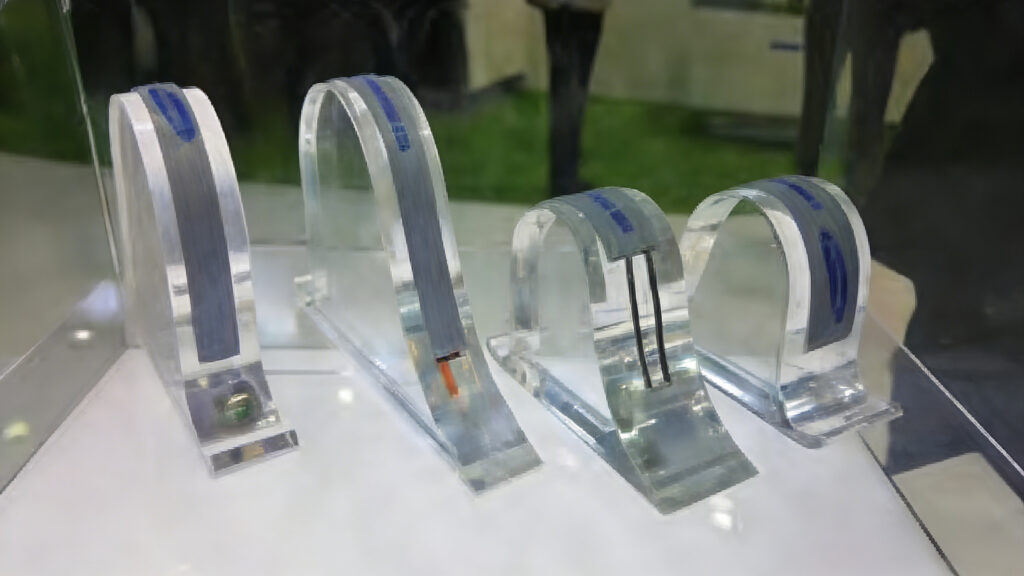
Development History and Main Types of Flexible Batteries
Development History
The concept of flexible batteries originated in the late 20th century with the emergence of flexible electronics. Researchers modified traditional rigid batteries into “thin-film” versions.
Early prototypes were thin-film batteries centered around thin-film electrode materials and polymer electrolytes. They achieved some bending capability but had significant gaps in mechanical flexibility and electrochemical performance compared to traditional lithium-ion batteries.
As research deepened, flexible batteries gradually transitioned from thin-film versions to truly flexible designs. The introduction of flexible materials like conductive polymers and electrochemically active fibers, along with designs featuring flexible electrolytes based on polymer matrices and electrodes coated on flexible substrates, laid the theoretical and practical groundwork for subsequent development.
In recent years, flexible battery technology has entered a period of rapid development. New energy storage devices like flexible lithium-ion, sodium-ion, and multivalent metal-ion batteries have emerged, achieving significant innovations in electrochemical performance, material selection, and structural design.
Main Types
- Flexible Lithium-Ion Batteries
- Research began around 2010, using lamination processes to integrate battery components on paper.
- Carbon nanotube films served as current collectors, and copy paper acted as substrate and separator.
- These batteries (~300 µm thick) could bend to radii below 6 mm, combining high energy density with good cycling performance.
- Subsequent developments include universal transfer methods, wearable textile batteries, co-planar structures, and stretchable batteries prepared by slurry coating.
- Printing technology in medical electronics, carbon cloth substrate-based, and gel polymer electrolyte-based aqueous lithium-ion batteries have expanded application scenarios.
- Companies like Jenax, Panasonic, Samsung, and LG Chem have launched flexible lithium-ion battery products.
- Flexible Sodium-Ion Batteries
- Use sodium as the energy storage ion, offering abundant raw materials, low cost, environmental friendliness, and safety.
- Flexible electrodes include carbon-based materials and conductive polymers, paired with flexible solid or semi-solid electrolytes like gel electrolytes.
- Optimizing electrode-electrolyte interfaces and designing flexible support structures ensures stable performance under bending, stretching, and deformation.
- Application prospects include wearable devices, smart textiles, and flexible sensors.
- Flexible Zinc-Ion Batteries
- Gaining attention due to high theoretical energy density and safety.
- Zinc ions transfer 2 electrons, providing higher charge capacity; zinc metal is less prone to dendrite formation and has low self-discharge.
- Electrode materials include carbon-based and nanostructured oxides; 3D nitrogen-doped carbon fiber arrays improve surface area and conductivity.
- Aqueous and gel electrolytes enhance flexibility and mechanical stability; 3D printing enables complex substrates and personalized customization.
- Integration with textiles or stretchable materials improves bending and stretching; fiber-shaped zinc-ion batteries maintain high capacity after multiple bends.
- Organic materials like pyrene-4,5,9,10-tetraone are explored as cathodes.
Core Components of Flexible Batteries
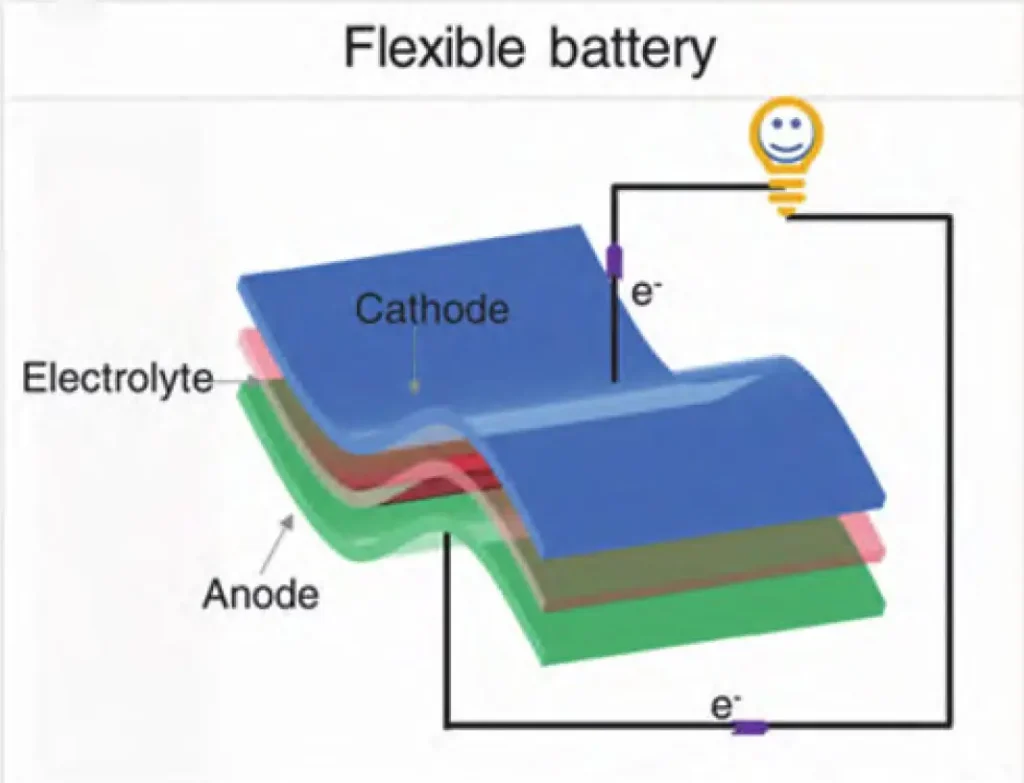
Flexible Electrodes
Electrodes are the energy storage core, composed of active materials, conductive agents, and binders. They must possess good conductivity, mechanical strength, and flexibility.
- Lithium-Ion Electrodes: Composite designs with carbon nanotubes, graphene, or organic cathode materials improve flexibility and capacity. Silicon-based anodes (theoretical 4200 mAh·g⁻¹) mitigate volume expansion using carbon nanofibers.
- Sodium-Ion Electrodes: Flexible substrates with carbonaceous, titanium-based, and alloy materials; carbon nanotubes and graphene enhance conductivity and stability. Organic polymers like polyaniline are emerging as low-cost, high-performance options.
- Zinc-Ion Electrodes: Cathodes include vanadium-based, manganese-based, MOFs, and organic materials. Fiber-shaped zinc anodes maintain capacity after bending. Carbon nanotubes and cloth serve as flexible current collectors; self-supporting anode designs reduce volume expansion effects.
Flexible Electrolytes
Flexible electrolytes combine flexibility and ion transport capability, overcoming limitations of liquid electrolytes under deformation.
- Organic Gel Polymer Electrolytes: Polyethylene oxide (PEO)-based polymers, enhanced via crosslinking and fillers, balance ionic conductivity, flexibility, and mechanical strength. 3D printing allows precise shaping for customized production.
- Hydrogel Electrolytes: Composed of polymer matrices (PEO, polyacrylic acid) and ionic salts; offer high flexibility, safety, and adaptability. Crosslinking strategies include free radical, physical, covalent, and ionic methods. Self-healing and multi-network hydrogels enhance mechanical and electrochemical performance.
Current Collectors
Current collectors conduct current and provide mechanical support under deformation.
- Metal-Based Collectors: Copper, aluminum foils, porous meshes, and wires. Good conductivity but low flexibility; improvements include coating, in-situ growth, and compositing with polymers or graphene.
- Carbon Materials: Graphene, carbon nanotubes, carbon fibers. Offer flexibility, high conductivity, and lightweight properties, ideal for wearable and stretchable applications.
Structural Design and Manufacturing Technologies
Structural Design
Innovative designs improve stretchability and mechanical stability:
- Wavy Structures: Periodic curves distribute strain and reduce fracture risk; can increase surface area and electrolyte penetration.
- Island-Bridge Structures: Rigid active islands connected by flexible bridges; strain localization strategy enhances stretchability.
- Kirigami Structures: Cutting/folding patterns disperse stress and protect electrodes; enable printable mass production.
- Other Structures: 2D/3D/4D designs improve deformation tolerance and multifunctionality.
Manufacturing Technologies
- Inkjet Printing: High-precision, non-contact printing for electrodes on various substrates.
- Electrospinning: Produces nanofiber membranes with high surface area; enhances electrochemical performance.
- Screen Printing: Low-cost, efficient, suitable for various conductive inks and substrates.
- Transfer Printing: Transfers patterns to substrates for complex flexible electronics.
- 3D Printing: Builds complex 3D electrodes layer by layer; improves energy density and surface area.
- Other Processes: Vapor-phase deposition (PVD, CVD), solution methods, photolithography for thin-film preparation.
Challenges and Development Trends
Current Challenges
- Lack of unified performance evaluation standards; testing often relies on geometric parameters.
- Balancing electrochemical and mechanical performance is critical.
- Current collectors must maintain integrity and resist corrosion; combining flexibility and high energy density is challenging.
- Electrolytes need compatibility, high ion transport, and interface stability.
- Fiber-shaped batteries face energy density, textile integration, safety, and stability challenges.
Development Trends
- Self-Healing and Self-Repair Technologies: Extend battery lifespan and stability.
- High Energy and Power Density: Advanced materials like MXenes, 2D materials, conductive polymers.
- Integrated Sensing and Energy Harvesting: Develop self-sustaining flexible devices.
- Green and Sustainable Technologies: Biodegradable polymers, non-toxic materials, recycling.
- Multifunctional Composite Materials: Combine battery, capacitor, and sensor functions.
- AI and Smart Manufacturing: Optimize materials, processes, and enable customized production.
- Interdisciplinary Collaboration: Materials science, chemistry, engineering, electronics, biology integration.
Looking ahead, flexible batteries will evolve towards higher energy density, longer lifespan, greater environmental friendliness, and smarter functionality, unlocking applications in intelligent health monitoring, wearable tech, and AI-enabled devices.
Looking Ahead: From Research to Real-World Applications
As flexible battery technologies continue to advance toward higher energy density, longer lifespan, smarter functionality, and improved sustainability, the gap between laboratory innovation and real-world application is becoming increasingly important. Turning cutting-edge materials, structures, and manufacturing concepts into reliable, scalable products requires not only technical expertise, but also deep experience in customization and engineering integration.
BluePower specializes in providing custom flexible and custom-shaped battery solutions tailored to the unique requirements of wearable electronics, flexible devices, medical equipment, robotics, and emerging smart technologies. From material selection and structural design to prototyping and mass production, BluePower works closely with engineers, product designers, and innovators to transform advanced battery concepts into practical, production-ready power solutions.
If you are developing next-generation flexible electronics or exploring customized battery solutions to support complex form factors and demanding performance requirements, BluePower is ready to support your journey from idea to application.
👉 Learn more about our custom battery solutions or contact the BluePower team to discuss your project.
Email: [email protected]
Whatsapp: +86 18938252128
