As smart rings continue to shrink in size while expanding in functionality, battery performance is increasingly limited by internal resistance rather than capacity. In such compact devices, even small voltage drops can affect BLE communication, sensor operation, and overall system stability.
Unlike larger wearables, smart rings must handle short, high-current pulses within extremely tight space and thermal constraints. Under these conditions, internal resistance becomes a critical design factor that engineers can no longer afford to overlook.
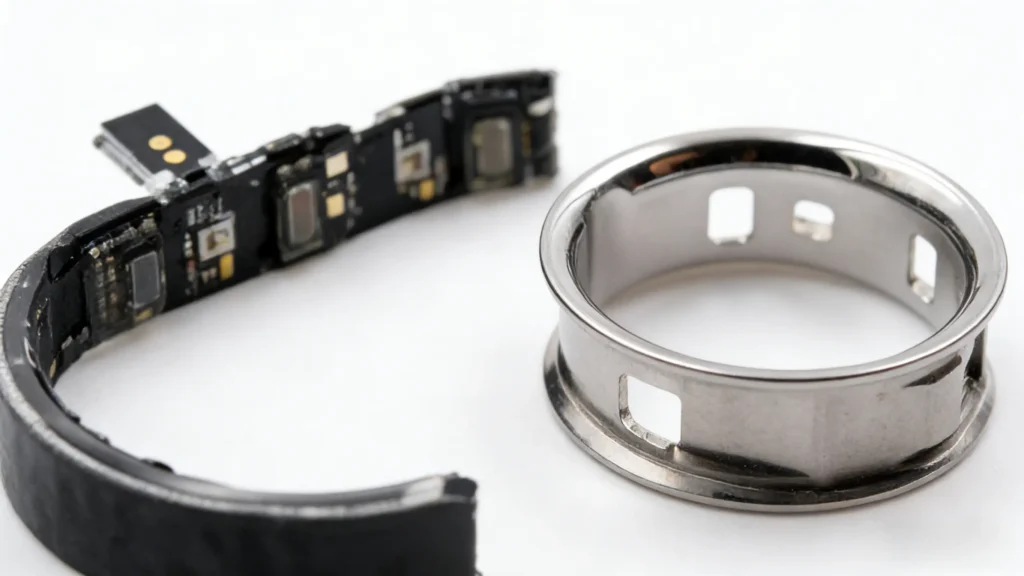
Why Internal Resistance Is Critical for Smart Rings?
Internal resistance plays a crucial role in smart ring performance because these devices combine extremely limited space, highly dynamic power demand, and strict reliability requirements. In practice, internal resistance often determines whether a smart ring works stably, efficiently, and safely.
1. Internal Resistance Directly Affects Power Stability
Smart rings experience short, high-current pulses during normal operation, such as:
- Bluetooth advertising and data synchronization
- Heart rate, SpO₂, or motion sensor sampling
- MCU wake-up and on-device processing
When battery internal resistance is high, even small current spikes can cause significant voltage drop:
ΔV=I×R
This can lead to:
- Brown-out resets of the MCU
- Unstable Bluetooth connections
- Sensor malfunction or inaccurate data
- Premature low-battery warnings
In ultra-thin smart ring batteries (often just 1–2 mm thick), these effects are especially pronounced.
2. Peak Power Capability Depends on Low Internal Resistance
Although smart rings have low average power consumption, they rely on short bursts of high power.
A high internal resistance battery:
- Limits peak current delivery
- Reduces usable output power
- Forces longer task execution times
This creates a negative loop:
Higher resistance → lower peak power → longer active time → higher total energy consumption → shorter battery life
3. Higher Internal Resistance Increases Heat Generation
Heat generation follows:
In smart rings, where:
- Heat dissipation is extremely limited
- The device is in direct contact with skin
- Temperature rise must be tightly controlled
High internal resistance can cause:
- Increased safety and reliability risks
- Localized heating
- User discomfort
- Accelerated battery aging
4. Internal Resistance Reduces Usable Capacity
In many cases, a battery may meet its nominal capacity specification, yet deliver poor real-world runtime.
The reason is often high internal resistance:
- Voltage drops reach the cutoff threshold too early
- A portion of the stored energy becomes unusable
For smart rings with very small batteries, this means:
Every milliwatt-hour lost has a visible impact on runtime
Effective capacity is significantly reduced
5. Internal Resistance Impacts Battery Lifetime and Consistency
In ultra-small batteries, electrode thickness and electrolyte volume are tightly constrained. High internal resistance is often associated with:
- Faster resistance growth over cycling
- Rapid performance degradation
- Poor batch-to-batch consistency
For mass-produced smart rings, this directly affects product reliability and yield.
Why Do Smart Ring Batteries Have Such High Internal Resistance?
High internal resistance is a common and often misunderstood characteristic of smart ring batteries. In practice, it is not unusual for the internal resistance of a smart ring battery to exceed 1,000 mΩ. This is not the result of poor manufacturing quality, but rather a consequence of extreme size constraints, structural limitations, and safety-first design priorities.
From an engineering perspective, the reasons can be explained as follows.
Extreme Miniaturization Is the Fundamental Cause
Smart rings allow only ultra-small, ultra-thin, and often curved battery geometries, which directly leads to:
- Very limited electrode surface area
- Narrow current paths
- Miniaturized current collectors
Since internal resistance is inversely proportional to the effective conductive area, smaller batteries are inherently higher in resistance. At the scale of smart ring cells, this effect becomes dominant.
Energy Density Is Prioritized Over Power Capability
Smart rings are designed for long standby time, not high current output. As a result, battery design typically favors:
- High energy density electrode materials
- Thinner electrodes with higher compaction density
- Reduced conductive additives
These choices improve capacity per volume but reduce rate capability, pushing DC internal resistance higher.
Ultra-Thin Electrodes Increase Interface Impedance
To meet strict thickness requirements, smart ring batteries often use:
- Ultra-thin electrodes
- Multi-layer micro-stacked structures
This leads to:
- Higher contact resistance between electrodes and current collectors
- A relatively thicker SEI layer
- Increased electrode polarization
Both AC impedance and pulse resistance are therefore elevated.
How Can the Internal Resistance of Smart Ring Batteries Be Reduced?
First, an important reality check:
The internal resistance of smart ring batteries cannot be eliminated—only engineered down and managed.
Given today’s size, safety, and wearability constraints, only limited but meaningful optimization is realistically achievable.
The key is to address the problem at three levels: battery design, manufacturing & structure, and system design.
Reducing Internal Resistance at the Battery Design Level
Increase Effective Electrode Area
The most fundamental principle is: Make the current path wider, not faster.
Practical approaches include:
- Multi-tab or distributed tab designs
- Optimized tab positioning to shorten average electron paths
- Symmetrical tab layouts for curved or ring-shaped batteries
Impact:
Significant reduction in ohmic resistance and pulse voltage drop.
Trade a Small Amount of Energy Density for Power Capability
Smart ring batteries are often pushed to the absolute limit of energy density, which naturally increases internal resistance.
Engineering compromises that work:
- Slightly lower electrode compaction density
- A modest increase in conductive additives (carbon black, CNTs)
- Selecting rate-capable electrode materials instead of purely energy-optimized ones
Impact:
- Noticeably lower DC internal resistance
- Typically less than 5–8% capacity loss, but much better system stability
Optimize the Electrolyte System
Possible directions:
- Higher ionic conductivity at low temperature and high rate
- More stable, thinner SEI formation
⚠️ Critical constraint:
For a body-worn device like a smart ring, safety cannot be compromised. Electrolyte optimization must be incremental, not aggressive.
Reducing Internal Resistance Through Structure and Manufacturing
Minimize Interface Contact Resistance
In ultra-small batteries, interface impedance accounts for a surprisingly large portion of total resistance:
- Electrode ↔ current collector
- Current collector ↔ tab
- Tab ↔ external terminal
Optimization methods:
- Improved welding or bonding processes
- Better tab flatness and consistency
- Reduced micro-voids between electrode layers and collectors
Impact:
Lower AC impedance and pulse resistance with no increase in battery volume.
Control Bending and Mechanical Stress
Custom-shaped, curved, or ring-type batteries often suffer from:
- Local contact degradation
- Current crowding
- Faster resistance growth over time
Engineering solutions:
- Define a minimum bending radius
- Optimize electrode routing in high-stress regions
- Use structural simulation to eliminate current “dead zones”
BluePower Smart Ring Battery Solutions
The Fundamental Advantages of the Stacking Process
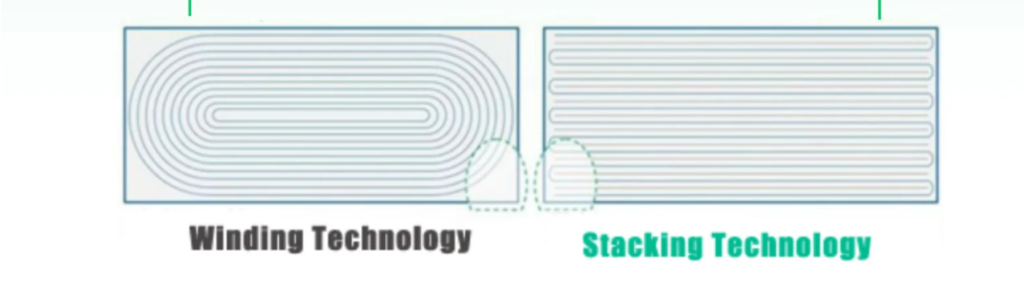
The unique ring-shaped and curved geometry of smart rings presents fundamental challenges to battery design and manufacturing. In this extremely compact, high-curvature application, the industry’s widely used traditional winding process has begun to reveal its inherent limitations.
Our core competitive advantage lies in a disruptive advancement in manufacturing technology—the electrode stacking process.
The winding process can be likened to rolling sushi, where the cathode, anode, and separator are layered and then rolled into shape. While this approach is well-proven in conventional cylindrical or prismatic cells, it encounters critical bottlenecks when applied to curved micro-batteries.
● Internal Stress Concentration and Structural Deformation
When a wound cell is forced into a curved form, significant stress gradients develop between the inner and outer layers:
- The inner layers are compressed
- The outer layers are stretched
This non-uniform mechanical stress can lead to:
- Delamination of electrode coatings
- Degraded interfacial contact within the cell
- Increased internal resistance and reduced cycle life
Ultimately, these effects compromise long-term electrochemical performance and reliability.
● Low Space Utilization and Structural “Dead Zones”
In curved geometries, the winding process inevitably creates inactive structural dead zones at both ends of the arc, where active materials cannot be effectively utilized. This results in:
- Reduced volumetric efficiency
- A significant penalty to achievable energy density
For space-constrained smart rings, such losses are particularly detrimental.
● Poor Consistency at Micro-Scale Dimensions
At 10–30 mAh micro-cell scales, precise tension control and electrode alignment during winding become extremely difficult, leading to:
- Electrode misalignment
- Large variations in cell capacity
- Wide internal resistance dispersion
This lack of consistency increases system-level design complexity and reduces manufacturing yield.
The Stacking Process: A Manufacturing Approach Purpose-Built for Smart Rings
● Stress-Free Forming for Enhanced Structural Stability
Our stacking process employs a stack-first, thermo-compression forming approach, allowing each electrode layer to conform to the target curvature in its natural, stress-free state.
Key benefits include:
- Uniform internal structure
- Elimination of mechanically induced stress
- Improved interfacial contact between electrodes and separator
These factors collectively deliver:
- Lower internal resistance
- More consistent electrochemical performance
- Extended cycle life (>500 cycles)
● Native Curved Forming for Superior Safety
Our core manufacturing sequence shapes the cell into its curved form after electrode stacking but before formation (initial activation charging) through a precision thermo-compression process.
This native curved forming ensures:
- Structural integrity of the separator and electrodes
- High layer-to-layer uniformity
By eliminating post-formation bending, this approach fundamentally reduces the risk of:
- Internal micro-short circuits
- Layer damage caused by mechanical stress
As a result, long-term reliability and safety are significantly enhanced.
● Maximum Space Utilization and Higher Energy Density
The stacking process allows the battery cell geometry to closely match the smart ring housing, minimizing unused volume.
Combined with our high-energy-density silicon–carbon anode materials, this enables:
- Higher capacity within the same physical volume
- A direct solution to smart ring battery life limitations
Conclusion
Due to extreme space constraints, high peak current demands, and strict thermal requirements, even small increases in internal resistance can cause voltage instability, communication issues, excess heat, and reduced usable capacity. In ultra-thin and curved smart ring batteries, these effects directly impact product reliability and user experience.
The key takeaway is clear: internal resistance must be treated as a core design parameter. Through optimized electrode design, improved interfaces, and manufacturing processes tailored for curved micro-batteries, internal resistance can be reduced and better controlled—enabling stable power delivery, safer operation, and longer effective runtime.
If you are developing a smart ring or other ultra-compact wearable and encountering voltage drop, peak current, or thermal challenges, it may be time to rethink battery internal resistance—not just capacity.
BluePower provides custom ultra-thin and curved battery solutions engineered for low internal resistance and high consistency.
Contact our engineering team to discuss your smart ring battery requirements.
Email: [email protected]
Whatsapp: +86 18938252128
