As an engineer who has worked for years in custom lithium batteries, I get asked the same question by clients every single day:
“Our product has extremely limited space. Can we fit a battery inside AND still get good battery life?”
This is especially true for products like smart rings, wearable medical sensors, and curved IoT devices.
Structural designers want to use every last bit of space. But traditional rigid or pouch batteries are square or rectangular—and that shape is the biggest problem for using space efficiently.
Today, using real projects from our team, I’ll explain how curved battery solves these difficult “small-space” challenges.
What Does “Extremely Limited Space” Really Mean?
Many people think “small space” just means small size.
For us engineers, limited space is more than that. It usually includes three main problems:
1. Shape Mismatch: The product is curved, but the battery is straight
The best examples are smart rings and wrist-worn wearables.
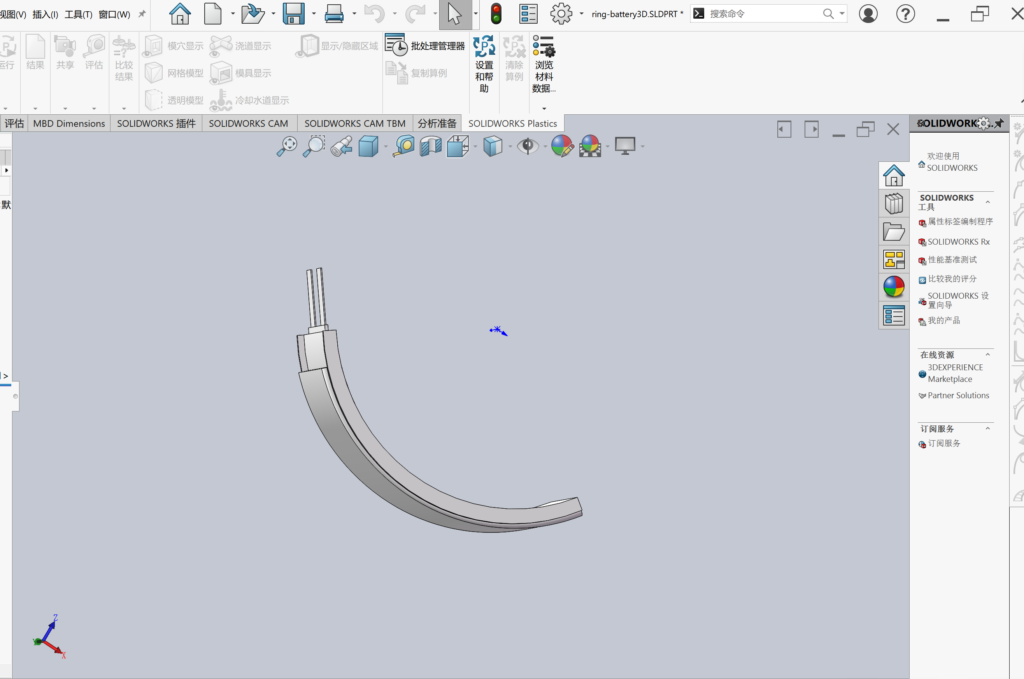
Their main structure is curved or circular to fit the human body. The usable space inside is a “crescent” or C-shaped chamber.
If you use a standard square pouch battery:
- You have to cut it very small, cutting capacity in half
- Or you force it in, and the edges push against the casing
- Or you leave a lot of wasted empty space
All of these waste valuable internal volume.
2. The Thickness vs. Battery Life Loop
Many wearable medical devices require the total thickness to be under 3 mm, sometimes even 2 mm.
When you add up the traditional battery cell, tabs, and protection circuit, the thickness just can’t go that low.
Clients often say:
“It needs to be thin, but also last 7 days on one charge.”
This creates a loop:
- Thinner cell = lower capacity
- Higher capacity = thicker battery
In the end, the product is either uncomfortable to wear or needs daily charging—ruining the user experience.
3. Irregular Surfaces: No Flat Space at All
Some IoT devices and car sensors have curved or uneven surfaces.
There is simply no flat area to put a square battery.
If you force a “battery compartment,” you:
- Break the clean, one-piece design
- Make the device stick out
- Increase weight
- Go against the goal of making a lightweight product
We deal with these problems every day. And by solving them, we have developed a complete, mature solution for curved batteries.
Let the Battery Fit the Product – Not the Other Way Around
A curved battery is not just “bending a normal battery.”
The real idea is to design the battery shape to match the product’s space from the very beginning, turning wasted space into usable energy space.
1. Space Usage: From “Forced Fit” to “Perfect Match”
Let’s use a real project as an example:
- Inside space: C-shaped, curve radius 15 mm, thickness 2.5 mm
- Traditional square pouch battery: only 180 mAh, with ~40% unused space
- Our custom curved battery: fits the C-shape perfectly, no wasted space
- Result: 320 mAh
Space efficiency improved by nearly 78%.
That is the real value of curved batteries:
They don’t make the battery smaller. They make the battery shape fill every usable millimeter of the product.
In many tight designs, curved batteries provide 20%–50% more usable capacity than standard batteries of the same size.
2. How It Works: Not “Bending” – Flexible Design From the Inside Out
Many people ask:
“If you bend a battery, will it break or leak?”
That is the key technical problem we solve. The reliability of a curved battery depends on full design — from materials to structure:
- Cell structure: We use ultra-thin electrodes (down to 8 μm) and flexible current collectors. We shape the curve during winding or stacking, so no stress from later bending.
- Material choice: We use highly flexible electrode materials and bend-resistant PP/PE separators. They don’t crack or short even after repeated bending.
- Packaging: Instead of traditional sealing, we use custom curved aluminum-plastic film. We also add stress relief at the tabs to prevent breakage.
- Simulation: Before production, we use 3D tools like SolidWorks to test stress and safety, avoiding risks like short circuits.
In short:
Our curved batteries are not “normal batteries bent later.”
They are born for curved spaces, designed for tight spaces from day one.
3. Performance Doesn’t Suffer: Thin ≠ Weak
Many clients worry:
“If you make it thin and curved, will cycle life and safety get worse?”
We use real test data:
- Cycle life: ≥600 cycles (80% capacity remaining), same as standard pouch batteries
- Bend test: 1000 bends (10 mm radius), capacity loss < 5%
- Safety: Passes UN 38.3, IEC 62133, overcharge, over-discharge, and crush tests
In our experience, better space use and stable performance are not choices — they can both be achieved with careful design.
Where Our Curved Battery Fits Best
Typical Applications for Our Curved Batteries
In real projects, we have found that the curved battery is not a one‑size‑fits‑all solution.
It is most often used in products where structural design takes much higher priority than battery design.
In other words, the design logic for these products is usually:
First finalize the structure and appearance, then make the battery fit — not the other way around.
Below are the most common and practical applications for curved batteries.
Smart Rings & Small Wearable Devices
For smart rings, wrist-worn or finger-worn devices,
the biggest challenge for the battery is not thickness, but efficient use of continuous curved space.
These products typically have:
- Internal space in a ring or partial curved shape
- Usable volume split into discontinuous areas by sensors, mainboards, and antennas
- No tolerance for sacrificing wearing comfort or appearance for the battery
Under these constraints, standard rectangular batteries can only be “shoehorned in”,
while curved batteries can follow the curved structure,
turning previously unusable space into effective battery volume.
Smart Glasses & Head-Mounted Electronics
For head-mounted devices, space constraints come with another sensitive factor: weight distribution.
These devices usually feature:
- Curved housings that fit the shape of the head
- Irregular, unevenly distributed internal space
- Very high requirements for balance and wearing comfort
The value of a curved battery here is not just “fitting inside”.
It can be laid out along the curve of the housing,
changing the battery from a single concentrated block into a distributed structure.
This results in:
- More reasonable internal layout
- Better weight balance
- Simpler overall structural design
Medical Monitoring & Rehabilitation Devices
In medical devices, the battery often has to make space for:
- Mechanical structures
- Sensing modules
- Safety and fixing components
Usable space is often along the edge or curved areas of the housing,
with extremely high requirements for long-term reliability and consistency.
In these applications, the curved battery acts more like a structure‑friendly component:
- The battery shape follows the curve of the housing
- Reduces extra fixing and cushioning parts
- Lowers the risk of shifting or stress during long-term use
The focus here is not maximum capacity,
but stable, reliable, predictable long-term performance.
Consumer Electronics with Highly Limited Internal Space
In some highly integrated consumer electronics,
battery design is often left until the very end:
- Final shape already fixed
- Internal structure already fixed
- Remaining space is scattered and irregular
Continuing to use standard batteries usually means:
- Compromising the appearance
- Increasing thickness
- Adding complex structural adjustments
The value of curved batteries is that they can:
- Fit irregular cavities
- Improve energy efficiency in limited space
- Reduce the need to “change the structure just for the battery”
What These Applications Have in Common
Although the application types vary, they share one clear characteristic:
Structure first. The battery must follow the design, not the other way around.
In these products, the battery is no longer a standard off-the-shelf part.
It must be carefully designed as part of the overall structure.
This is exactly where curved batteries deliver their greatest value.
Conclusion: When Space Becomes the Limit, the Battery Must Be Redesigned
In space-constrained products, battery issues are often simplified to “not enough capacity” or “battery is too thick.”
But in real engineering, we more often see this truth:
the space already exists — it just cannot be used efficiently by standard batteries.
Curved structures, irregular cavities, and distributed internal layouts make traditional rectangular batteries increasingly difficult to adapt.
Under these conditions, simply chasing “thinner cells” or “more advanced materials” often only brings short-term compromises, not long-term viable solutions.
The value of a curved battery is not its unique shape.
It lies in being designed around real structural constraints —
turning scattered, limited space into controllable, stable, mass-producible energy storage.
If your product design has reached the point where the structure cannot be changed anymore, yet the battery remains a bottleneck for space layout and reliability, the problem may not be with battery performance itself, but whether the battery truly fits your structural design.
If you are facing similar challenges:
tight space, curved surfaces, or irregular cavities,
we can evaluate together from the early structural stage to see if a suitable custom battery solution is possible —rather than being forced to compromise repeatedly late in the design process.
Email: [email protected]
Whatsapp: +86 18938252128
