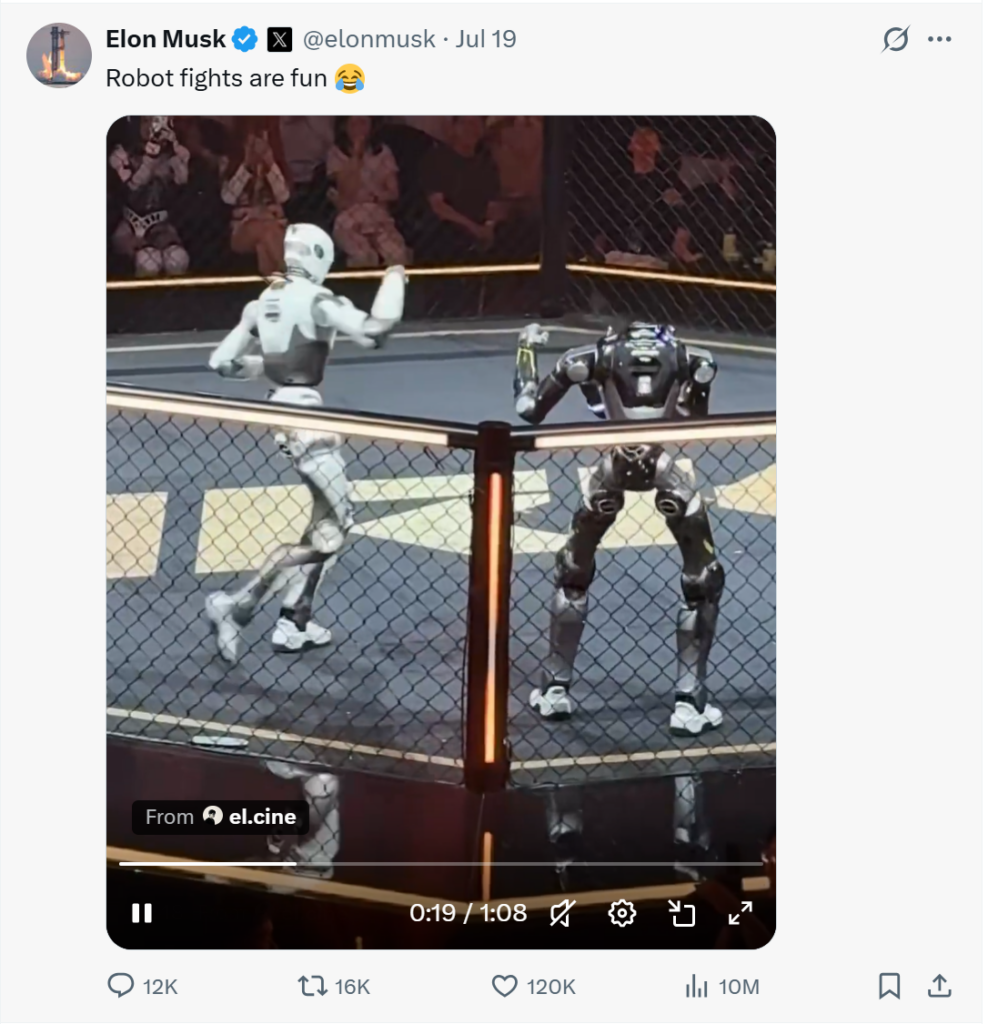
Late on July 19, Elon Musk shared a robot fighting video on X with the caption, “Robot fights are fun.”
The video shows two humanoid robots fighting inside an MMA-style cage. They throw punches, kick, dodge, and exchange attacks with smooth and fast movements. Within a short time, the video gained millions of views and quickly made robot fighting one of the hottest topics in the global tech community.
Robot Fighting Is More Than Entertainment—It’s an Extreme Test
Many people see robot fighting as a form of entertainment.
In reality, for engineers and developers, it is more like a full-system stress test.
A robot fight that lasts only a few minutes can push almost every core system to its limits.
For example, a robot must be able to:
- Detect and understand its opponent’s movements in real time.
- Plan attacks and evasive actions within milliseconds.
- Keep its balance while moving and avoid falling.
- Recover quickly after being hit or pushed.
- Deliver continuous power without slowing down as performance drops.
Behind these abilities are many advanced technologies, including computer vision, AI algorithms, motion control, servo systems, mechanical design, joint engineering, and thermal management.
In other words, robot fighting is not about which robot has the strongest punch. It is about which robot has the most advanced and reliable overall system.
And behind all of these technologies is one critical component that is often overlooked, yet plays a key role in keeping the robot performing at its best: the battery.
Every Punch Starts with a Burst of Power
When we use our smartphones, we rarely think about the battery. That’s because most phone apps consume power at a fairly steady rate.
But robots are completely different.
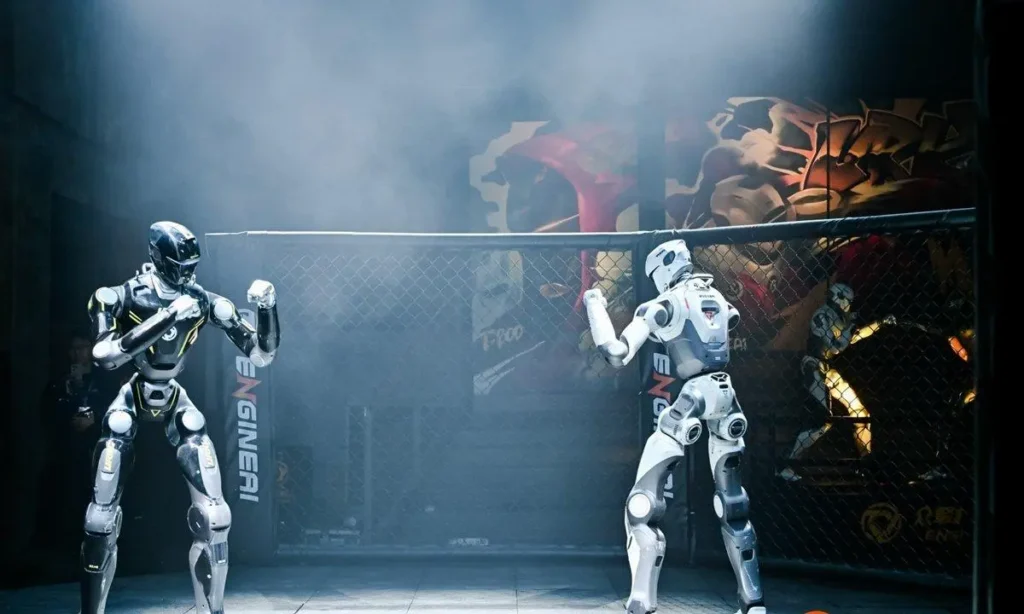
Imagine a humanoid robot getting ready to throw a powerful punch. From detecting the target and making an AI decision to activating multiple joint motors, the entire process may take only a few hundred milliseconds.
In that brief moment, the battery must deliver a large amount of power almost instantly to drive several motors at the same time. What’s more, when the robot performs a series of actions—such as punching, kicking, turning, and dodging—the battery must continue providing stable power without interruption.
So, what happens if the battery can’t keep up?
The most obvious result is that the robot slows down. Its punches become weaker, its reactions become slower, and it may even lose its balance because there isn’t enough power.
That’s why, for humanoid robots, the battery is not just about how long the robot can run. It also has a direct impact on how well the robot can move and perform.
Requirements for Humanoid Robot Batteries
1. High Discharge Rate
A humanoid robot does not draw power at a constant rate.
Actions like punching, jumping, sprinting, and sudden acceleration create short bursts of very high power demand.
This means the battery must be able to deliver a large amount of current in a very short time without a significant voltage drop.
If the battery cannot provide enough power, the robot becomes like a boxer running out of energy. Its movements slow down, and its explosive performance quickly fades.
That’s why a high discharge rate is one of the most important requirements for a humanoid robot battery.
2. Stable Power Output
A humanoid robot powers much more than its motors.
It also runs many electronic systems at the same time, including cameras, depth sensors, LiDAR, AI computing platforms, and communication modules.
All of these components consume power continuously.
If the battery output is unstable, it can reduce the robot’s movement performance and even slow the response of its control system.
For humanoid robots, stable power delivery is just as important as battery capacity.
3. Higher Safety
Robot fighting often involves collisions, falls, and rolling on the ground. These are also situations that humanoid robots may face in real-world applications.
As robots move into factories, homes, and public spaces, accidental impacts will become unavoidable.
For this reason, a robot battery must offer not only high performance but also excellent safety. It should have strong impact resistance, a stable structure, and reliable thermal protection so that it can continue operating safely even after being subjected to external force.
4. Lightweight Design and High Energy Density
Humanoid robots are very different from electric vehicles.
An EV can simply carry a larger battery pack, but a robot cannot keep adding weight.
A heavier battery increases energy consumption, reduces agility, and can even affect balance and movement.
That’s why humanoid robots need batteries that can store more energy in a limited space while keeping weight as low as possible.
This is one of the main reasons high-energy-density batteries are becoming increasingly important in the robotics industry.
5. Better Thermal Management
High-rate discharge creates another challenge: heat.
During continuous movement, battery temperature can rise quickly. Excessive heat not only reduces performance but can also shorten battery life and increase safety risks.
As a result, low internal resistance, efficient heat dissipation, and advanced thermal management have become key priorities in the development of batteries for humanoid robots.
BluePower’s Battery Solutions for Humanoid Robots
As a company specializing in custom lithium battery solutions, BluePower has been closely following the rapid development of the humanoid robotics industry.
When it comes to robot applications, we focus on several key challenges:
- How can more energy be stored in limited space?
- How can batteries deliver the high discharge rates needed for joint motors?
- How can internal resistance be reduced to minimize heat under heavy loads?
- How can lightweight design, safety, and long runtime be achieved at the same time?
There is no standard battery that can solve all of these challenges.
Every humanoid robot is different. Battery requirements vary depending on the robot’s size, number of joints, payload, and application.
That’s why custom battery solutions are becoming increasingly important for the robotics industry.
For humanoid robot applications, BluePower provides:
- High-rate lithium polymer (LiPo) batteries
- High-energy-density battery solutions
- Custom battery sizes and shaped battery designs
- Lightweight battery solutions
These solutions are designed to meet the different space, weight, and performance requirements of various robotic systems.
As humanoid robots continue to evolve, we believe batteries will no longer be just a power source. Instead, they will become a key factor in determining the overall performance, efficiency, and reliability of the next generation of robots.
Conclusion
Elon Musk’s repost brought robot fighting into the spotlight. But for us, the biggest takeaway goes far beyond the fight itself.
Every punch, every jump, and every quick turn is the result of multiple technologies working together—from mechanical design and motion control to AI algorithms, electric motors, and battery technology.
As humanoid robots continue to evolve, they will become more capable and more human-like. At the same time, the batteries that power them will continue to advance, offering higher discharge rates, greater energy density, lighter weight, and improved safety.
We remain committed to developing high-performance custom lithium battery solutions. As the robotics industry grows, we look forward to providing reliable, efficient, and tailored power solutions for the next generation of innovative humanoid robots.
Email: [email protected]
Whatsapp: +86 18938252128
