In real projects, I often hear engineers and product managers say:
“We’ll probably need to use a round battery for this product.”
The interesting thing is, they almost never mean they’ve already decided on 18650, 21700, or CR2032 cells.
They just know one thing:
the battery will most likely be round.
This usually tells us:
- The mechanical design is not yet finalized.
- The battery form factor is still under evaluation.
- There’s uncertainty between cylindrical cells, coin cells, and small round rechargeable lithium batteries.
This article will break down these three common types of round batteries clearly,
so you can choose the best fit for your product.
Round Battery: Cylindrical vs Coin vs Round Lithium
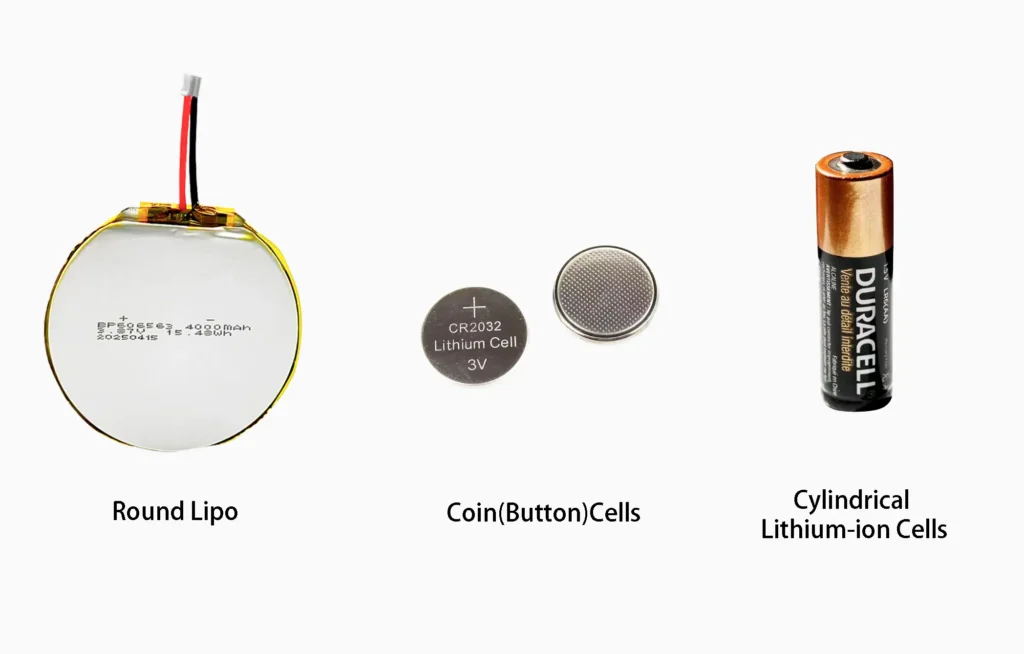
Strictly speaking, round battery is not a technical classification.
It is merely a geometric description, referring to:
a battery structure with a circular cross‑section.
In practical applications, round batteries fall into three main categories:
- Cylindrical Batteries
- Coin / Button Cells
- Round Rechargeable Lithium Batteries
While they all appear “round”,
their internal structures, performance limits, and application scenarios are completely different.
1. Cylindrical Batteries: The Most Mature & Capable Type
Cylindrical batteries represent the most industrialized lithium battery structure available today.
These familiar models all fall under the round battery category:
- 18650
- 21700
- 26650
Their common characteristics:
- Metal casing
- Wound electrode structure
- Standardized dimensions
Cylindrical batteries are highly engineer-friendly
From an engineering perspective, they offer several irreplaceable advantages:
First, high and stable energy density
The wound structure is mature, with high production yield and low parameter inconsistency.
Second, excellent thermal performance
The metal casing supports high-rate discharge very well.
Third, mature supply chain and controllable costs
Highly automated production ensures stable long-term supply.
This is why cylindrical batteries are almost always used in:
- Power tools
- Robots
- Drones
- Energy storage modules
They are not perfect
Cylindrical batteries have one major limitation:
Fixed dimensions.
You cannot freely change the diameter or height.
They are not ideal for products with strict requirements for internal space efficiency.
As a result, cylindrical batteries are often ruled out for miniaturized, ultra-thin, or appearance-sensitive products.
2. Coin Batteries: Small in Size, and Limited in Performance
Coin batteries are also typical round batteries.
The most common models include:
- CR2032
- CR2025
- CR2016
Their structure is simple, and their advantages are clear-cut.
Why are coin batteries still widely used?
The reason can be summed up in one phrase:
“Good enough for the job.”
Advantages of coin batteries:
- Ultra-small size
- Low cost
- Low self-discharge
- Long shelf life
They are ideal for:
- Low-power wearables
- Medical sensors
- Backup power (RTC)
Coin batteries have obvious drawbacks:
- Most are non-rechargeable
- Very limited discharge current
- Not suitable for continuous operation or high-power applications
If your product features:
- Wireless communication
- Motors
- Continuous power demand
then coin batteries can generally be ruled out directly.
3. Round Lithium Battery: The Underestimated Option
This is the solution many engineers don’t consider at first, but often circle back to in the end.
What is a Round Lithium Battery?
In simple terms:
It has a round shape and is a rechargeable lithium battery.
It is neither a standard cylindrical battery nor a disposable coin cell. Instead:
- Diameter can be customized
- Thickness can be customized
- Can be made as a single cell or a small battery pack
It solves the “in-between” problem
In many projects, the requirements are:
- The product has a round cavity
- Power consumption is higher than coin cells
- No space for 18650 / 21700 cells
In these cases, the round lithium battery is an ideal fit.
Core advantages of round lithium batteries
From an engineering perspective, its benefits are highly practical:
- Rechargeable, extending product lifespan
- Significantly higher energy density than coin cells
- Fully customizable: diameter, height, voltage, capacity
- Can integrate PCM/BMS for improved safety
Typical applications
- Compact IoT devices
- Wearable devices
- Smart electronics
- Medical devices
Core Differences Between Three Types of Round Batteries
| Battery Type | Key Advantages | Main Limitations | Typical Use Cases |
|---|---|---|---|
| Cylindrical Batteries | High energy densityHigh power outputCost-effective and mature supply chain | Fixed dimensionsLimited flexibility in compact designs | Power tools, drones, robotics, energy storage |
| Coin (Button) Batteries | Extremely compactLow costLong shelf life | Non-rechargeable in most casesVery low current output | Smart locks, wearables, backup power, sensors |
| Rechargeable Round Lithium Batteries | Balanced energy and sizeRechargeableHighly customizable for product design | Higher cost than coin cellsRequires charging circuit | Wearable devices, medical electronics, compact IoT products |
How to Choose the Right Round Battery
In real projects, experienced engineers almost never start by debating specific models, such as 18650 vs. CR2032.
Effective battery selection always begins with a set of practical questions.
1. Does the product require rechargeability?
This is the first and most critical question.
If the product is disposable, low-frequency, or ultra-low-power (e.g., only used as backup power),
coin batteries are often sufficient.
However, if any of the following apply:
- Daily usage is required
- Integrated wireless communication (Bluetooth, Wi-Fi, etc.)
- Designed to last 2–3 years or longer
- Frequent battery replacement is undesirable
then a rechargeable round lithium battery is almost always the more logical choice.
Rechargeability directly defines user experience, maintenance cost, and product lifecycle design.
2. What is the maximum discharge current?
This is where many battery-related issues actually arise.
Many products have low average power consumption, but experience instant high current during operation:
- Motor startup
- Wireless module transmission
- Display activation
Coin batteries struggle heavily in these scenarios, often causing voltage drops or system restarts.
Cylindrical batteries are naturally suitable for high-rate, high-current output.
If your product’s power requirements fall between the two,
a custom rechargeable round lithium battery is often an underestimated but highly practical solution.
3. Is the structural space fixed?
From an engineering perspective, mechanical design is often more restrictive than electronics.
In many products, battery space is already locked during ID or structural design:
- Fixed-diameter round cavity
- Fixed height or thickness
- Enclosure structure cannot be modified
In these cases, even high-performance standard cylindrical batteries may not fit.
This is where custom round lithium batteries shine:
By customizing diameter and thickness, you maximize energy density within limited space.
4. What is the target product lifespan?
Battery selection must always align with the product lifecycle.
A consumer product designed for 6–12 months
and medical/industrial equipment intended to operate reliably for 5+ years
have completely different battery requirements.
- Short lifecycle: focus on cost
- Long lifecycle: focus on reliability, degradation, and maintainability
In devices where battery replacement is inconvenient or impossible,
rechargeable solutions usually deliver better long-term value.
5. Are certifications and long-term supply required?
This critical point is often overlooked until late in the project.
The battery solution directly affects:
- Safety certifications (UN38.3, IEC, UL, etc.)
- Transportation compliance
- Long-term, consistent availability of the same specification
For products sold overseas, or used in medical, industrial, or B2B applications,
battery consistency and supply stability are critical.
Working with a reliable battery manufacturer for custom round lithium battery design
is often more controllable than frequently switching between standard models.
Why Are More Products Choosing Custom Round Lithium Batteries?
The biggest limitation of standard batteries can be summed up in one sentence:
They are designed for general‑purpose use, not for your product.
Standard models prioritize mass production and compatibility.
But in real‑world products, engineers often have to compromise on structure, electronics, and performance to fit off‑the‑shelf batteries — which is why many projects end up making concessions late in development.
The core value of custom round lithium batteries is the exact opposite.
What Problems Do Custom Round Lithium Batteries Solve?
In engineering practice, custom round lithium batteries deliver clear improvements across three key areas:
1. Higher Space Utilization
By customizing diameter and thickness, the battery can precisely match the round internal cavity of the product.
This eliminates wasted space and turns limited volume into usable energy.
2. Better‑Matched Electrical Parameters
Standard batteries often suffer from over‑specification or under‑specification in voltage, capacity, or discharge performance.
A custom solution is designed around your actual power consumption curve, so the battery serves the product — not the other way around.
3. More Stable System Safety
In a custom round lithium battery design, we can integrate from the start:
- Protection circuits (PCM / BMS)
- Charge and discharge strategies
- Operating temperature range
- Long‑term degradation control
These factors are often more important than energy density alone in product‑level design.
What Does Customization Mean in Real Projects?
When the battery is designed around the product, engineers typically see immediate benefits:
- Lighter overall product weight
- Longer real‑world battery life
- Greater freedom in internal structure design
- Fewer compromises on appearance and ID design
This is why an increasing number of smart hardware, medical devices, and industrial products are adopting custom round lithium battery solutions at an early stage.
BluePower Custom Round Lithium Battery Solutions
As a manufacturer focused on custom lithium battery solutions, BluePower’s priority in the round lithium battery sector is not just “making a battery” — but helping the battery truly integrate into product design.
In our partnerships, we support:
- Early‑stage product structure evaluation
- Voltage, capacity, and discharge requirement analysis
- Custom battery dimensions and form factors
- Protection circuit and safety design
- Sample validation and mass production support
We support everything from small‑batch prototyping to high‑volume manufacturing,
and provide custom round lithium battery solutions for:
- Wearable devices
- Medical electronics
- Smart hardware
- Compact IoT products
Choosing a Custom Battery Is Ultimately Simplifying Your Product
In most projects, custom round lithium batteries do not add complexity.
Instead, they help engineers reduce complexity in structure, electronics, and system design.
When the battery is no longer a design constraint,
the product can more easily achieve lightweight, stability, and sustainability.
Conclusion: Round Is Just Shape, Design Is the Essence
Many people start by asking:
“Should I use a round battery?”
But the question they should be asking is:
“Which battery best fits my product?”
Whether it is cylindrical batteries, coin batteries, or rechargeable round lithium batteries,
there is no hierarchy of which is “superior”.
There is only which one matches your product’s structure, power requirements, and usage scenario.
If you are in the product design phase,
or still weighing battery options and struggling to finalize a solution,
Contact Us | Custom Round Lithium Battery Solutions
BluePower specializes in custom lithium battery solutions for smart hardware, medical devices, and industrial products.
Our engineering team provides full‑cycle support:
from structural evaluation and battery design, to prototyping and mass production.
If you want to find the optimal round battery solution for your product,
we welcome you to contact us directly:
Email: [email protected]
Whatsapp: +86 18938252128
