In the highly mature yet extremely constrained form factor of smartwatches, battery performance has long been the biggest bottleneck holding back innovation. The screen size is inherently limited, the case cannot be made thicker without sacrificing comfort, and wrist-wearing ergonomics set a rigid boundary—yet user expectations for longer battery life keep rising.
As a manufacturer with years of experience in custom battery solutions for wearable devices, we deeply understand one core truth: the competition in the smartwatch market is no longer about piling on more features, but about how to pack maximum energy into the tiniest possible space. It is against this backdrop that silicon-carbon batteries have emerged as a game-changing solution.
Why Traditional Lithium Batteries Are Falling Short for Smartwatches
There is an unspoken reality in the industry:
for smartwatches, the challenge is no longer
“can we make the battery a little bigger?”
but rather
“can we even fit a functional battery inside the device at all?”
Space is extremely scarce.
Battery shapes often need to be irregular to fit the watch case.
At the same time, the battery must meet stringent requirements for:
- structural strength
- heat dissipation
- safety
As a result, the energy density of traditional lithium batteries with graphite anodes has nearly reached its practical limit in smartwatch applications.
Over the past few years, most improvements in smartwatch battery life have not come from breakthroughs in battery chemistry itself,
but from auxiliary optimizations such as:
- system tuning
- power management
- algorithm-driven scenario adjustments
However, this approach has a clear ceiling.
When software and algorithms can no longer squeeze out additional efficiency,
the only way forward is to evolve battery materials and structures.
Silicon Carbon Battery for Smartwatches: Real-World Case Studies
From a material science perspective, silicon anodes offer far higher theoretical capacity than graphite — this is a widely recognized fact across the battery industry.
Yet the challenges are equally prominent.
During the charge-discharge cycle, silicon undergoes significant volume expansion, which leads to structural instability and places extremely high demands on manufacturing processes and battery design.
This is why silicon-carbon batteries did not replace traditional lithium batteries overnight.
Instead, they were first adopted in specific scenarios where their advantages clearly outweigh the technical risks.
Smartwatches are precisely such a scenario.
Smartwatches are extremely sensitive to energy density, have strict requirements for battery size and custom form factors, and are relatively more tolerant of higher costs compared to smartphones. When these three factors converge, silicon-carbon batteries become engineering-feasible for the first time in wearable devices.
Case 1: 867mAh High-Silicon Stacked Custom Battery
in the Huawei Watch GT6 46mm
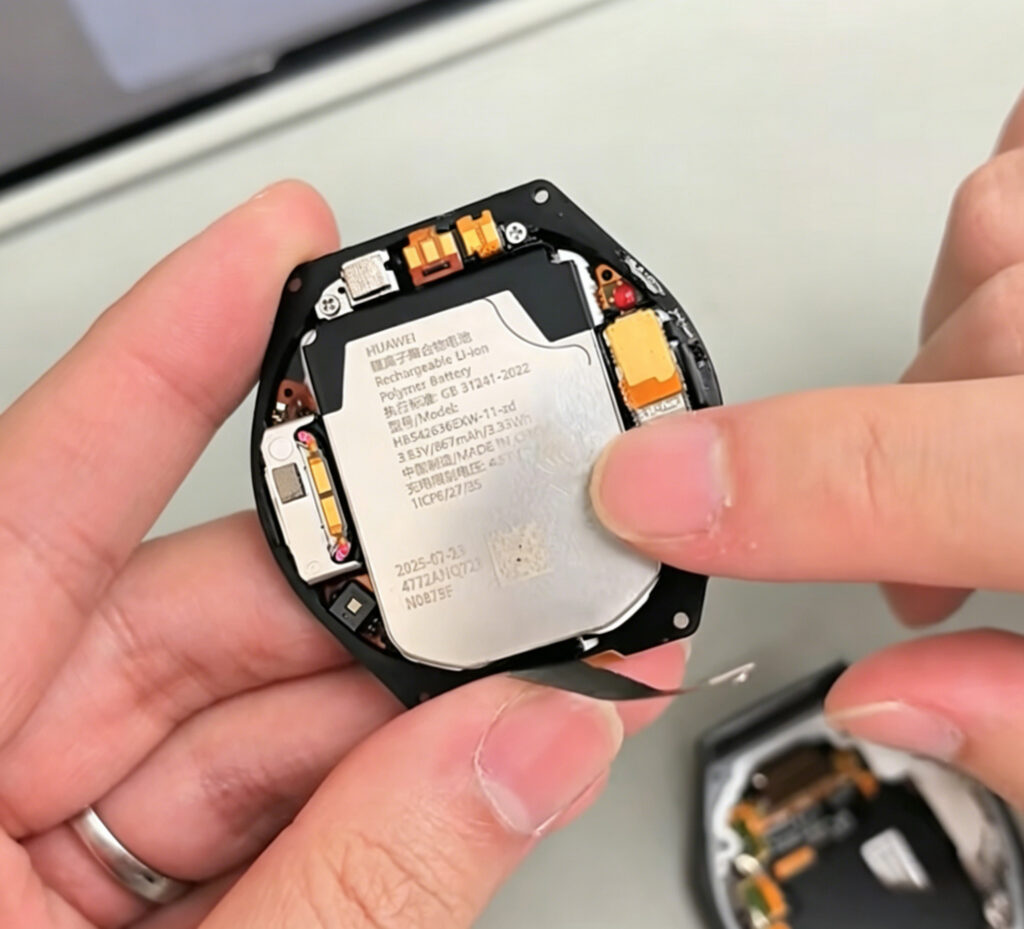
If you have followed smartwatch teardowns or new product launches, one number likely stood out: 867mAh. For a 46mm smartwatch, this is not only an impressive capacity figure, but also a highly symbolic one. Yet what truly matters is not the capacity itself, but the real-world battery life it delivers. Under official usage scenarios, the Huawei Watch GT6 46mm boasts a battery life of up to 21 days. This result is achieved not by a single technology, but by a well-coordinated and mature combination of technologies:
- a high-silicon anode system
- a stacked (laminated) cell structure
- a custom-shaped battery design
These three elements are also where the greatest challenges and trade-offs lie in mass production.
Compared to the traditional winding structure, the stacked structure offers better mechanical stability and lower internal resistance, which helps improve energy efficiency. However, it also requires a much more precise manufacturing process.
The custom-shaped battery design maximizes the use of internal case space, converting wasted volume into usable capacity. At the same time, it places higher demands on production consistency and yield. The high-silicon anode system, while boosting energy density, introduces stricter engineering challenges in material formulation, compaction density and long-term stress control.
From a manufacturing perspective, this is not a simple “battery cell replacement”.
It is a fully redesigned battery system, tailored to the smartwatch’s usage cycle, power consumption profile and wearing form factor. The core value of this design is clear: it extends the time between charges without noticeably increasing the watch’s thickness or sacrificing wearing comfort.
Case 2: Xiaomi Watch S5 – Leveraging Silicon-Carbon Batteries to Boost Capacity and Battery Life
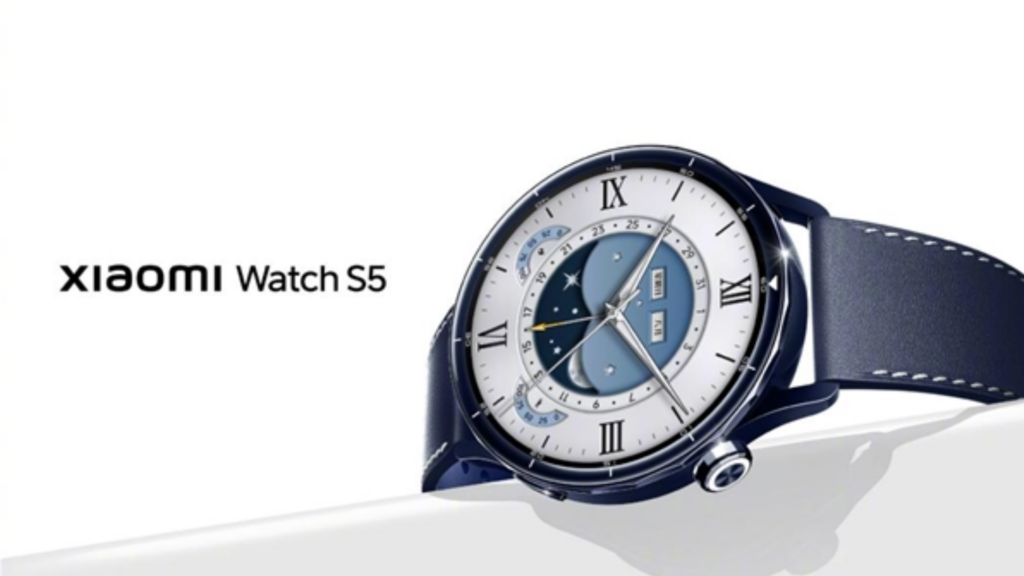
Xiaomi also turned to silicon-carbon battery technology with the Watch S5 to address battery life challenges under strict size constraints.
According to public information, the Watch S5’s battery capacity has reached the 800mAh level, which is relatively high among smartwatches in the same category. Based on this capacity, Xiaomi officially claims a typical battery life of 15–21 days, significantly reducing the frequency of recharging for users.
The adoption of a silicon-carbon battery allows the Watch S5 to achieve higher energy density without noticeably increasing the device’s thickness. As a result, the increased battery capacity translates into tangible improvements in real-world battery life, rather than just superficial specification upgrades.
From a product perspective, Xiaomi does not heavily promote the battery technology itself; instead, silicon-carbon batteries serve as a foundational upgrade that supports longer daily wear time, continuous operation of health monitoring and system functions, and a more stable and predictable overall usage cycle.
This approach ensures that the value of silicon-carbon batteries is reflected in actual user experience, rather than just technical marketing rhetoric.
Application Trends of Silicon-Carbon Batteries
The two smartwatch cases clearly demonstrate that silicon-carbon batteries are already delivering tangible improvements in battery life—and this trend extends far beyond smartwatches. As wearable devices and smart terminals continue to demand higher energy density and thinner, lighter designs, silicon-carbon batteries are gradually moving from “experimental new technology” to an industry-wide consensus.
1. Smartphones: Silicon-Carbon Batteries Becoming a Mainstream Flagship Trend
The smartphone segment is seeing the fastest and most clear-cut adoption of silicon-carbon batteries. Multiple smartphone manufacturers have begun integrating silicon-carbon battery technology into their flagship models to enhance both battery capacity and real-world battery life.
- According to recent industry analysis, Android smartphones equipped with silicon-carbon batteries now have battery capacities exceeding 6,000 mAh, with some models pushing even higher. At similar battery volumes, their energy density is significantly higher than that of traditional graphite-anode lithium batteries.
- Reports indicate that several flagship models, including the Honor Magic5 Pro, have already adopted silicon-carbon battery solutions. Its 5,450 mAh battery delivers approximately 12.8% higher energy density than conventional lithium batteries.
- Industry rumors suggest that future models such as the Samsung Galaxy S27 Ultra may further embrace silicon-carbon battery technology, with internal testing exploring capacity ranges of 12,000–20,000 mAh to push the boundaries of extreme battery life.
These examples send a clear signal: silicon-carbon batteries are shifting from an optional upgrade to a standard feature for flagship smartphones.
2. From Smartwatches to Smaller Wearable Devices
Compared to smartphones, smaller wearable devices face even greater battery challenges. Currently, large-scale commercial products using silicon-carbon batteries in smart glasses and smart rings are still limited. However, multiple industry analyses identify silicon-carbon batteries as a key technological path for improving energy density in micro-sized batteries.
In highly integrated products like smart glasses, battery volume is extremely constrained. Without increasing device thickness or compromising wearing comfort, improving energy density per unit volume has become almost the only viable way to extend battery life. For this reason, battery designs using silicon-carbon composite anodes are widely regarded by the industry as an engineering-feasible solution for next-generation wearable devices, with broader adoption expected in the coming years.
BluePower Smartwatches Battery Solutions
What sets BluePower apart is not just our ability to manufacture batteries, but our expertise in engineering batteries that fit real products and real user needs. Our core advantages lie in three key areas:
- Custom-shaped battery design: We specialize in irregular, application-specific battery shapes, enabling our batteries to fully utilize limited internal space and integrate seamlessly into compact or unconventional device designs.
- Advanced stacking technology: By adopting a stacking process instead of traditional winding, we achieve higher energy density, better structural stability, and more consistent performance—especially in thin or space-constrained applications like smartwatches.
- Silicon-carbon battery solutions: Our silicon-carbon battery solutions are engineered to balance higher energy density with practical cycle life, delivering improved performance while maintaining the reliability required for commercial mass production.
Conclusion
Silicon-carbon battery technology is no longer just a material-level upgrade; it has evolved into a system-level solution that combines structure, manufacturing processes, and energy density to address the real constraints of smart wearable devices. From smartwatches to future applications in smartphones and other compact electronics, the direction is clear: packing more energy into smaller spaces without compromising stability or user experience.
As a manufacturer, BluePower focuses on translating these industry needs into practical, scalable battery solutions that can reliably move from concept to mass production—empowering our partners to create devices that redefine user expectations for battery life.
Contact Us
If you are developing smartwatches, wearables, or other compact electronic devices and are exploring custom battery solutions, feel free to contact us for technical discussions or project support.
Email: [email protected]
Whatsapp: +86 18938252128
