After years of prototypes, limited pilots, and cautious experimentation, the smart glasses industry is finally reaching a real turning point in 2026. According to leading research firms such as IDC and Omdia, this is the year when smart glasses begin shifting from niche tech products to mass-market consumer devices.
In 2026, smart glasses are no longer just impressive demonstrations of technology. They are designed for all-day wear, frequent use, and real-world dependence. And behind this shift, one component is moving from the background to center stage: the battery system. More than any other factor, battery design now determines user comfort, product design freedom, and whether smart glasses can truly succeed in the market.
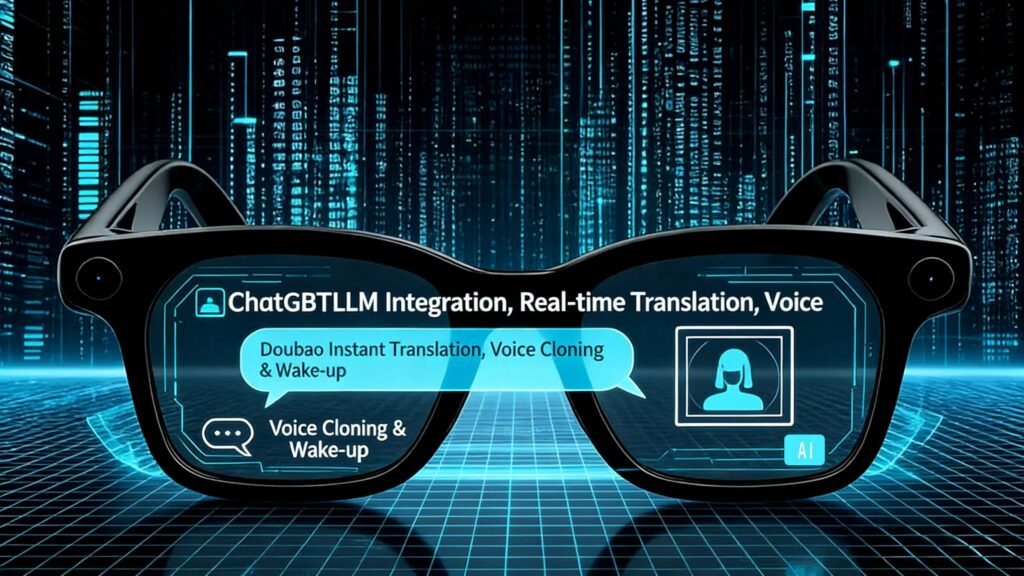
Why the Smart Glasses 2026 Market Is Different
Shipments Enter a Sustainable Growth Phase for the First Time
The key reason why the smart glasses industry changes in 2026 is the shift in shipment scale.
Global smart glasses shipments are expected to exceed 23 million units. Among them, AI smart glasses powered by generative AI will become the first true mainstream sub-category, with shipments exceeding 10 million units. In China alone, shipments are expected to reach nearly 5 million units, with year-on-year growth of 70%–80%.
What does this mean?
It means smart glasses are entering a phase with standardized supply chains, stable repeat demand, and predictable mass production cycles for the first time.
Once the market reaches this stage, the battery is no longer a “project-level custom part.” Instead, it becomes a key component that directly affects production yield, cost structure, and brand reputation.
The Chinese Smart Glasses Market Is Unique — and This Makes Battery Solutions More Complex
The growth of smart glasses in China follows its own path.
- Local AI applications focus on real daily use cases, such as translation, navigation, mobile payments, and work-related tasks — not abstract features.
- Smart glasses designs in China are different and place very strict limits on internal space.
- Products must balance low cost and high performance, with tighter requirements than in many other markets.
Because of these factors, custom-shaped, ultra-thin batteries are used more often in Chinese smart glasses than in other regions.
How New Form Factors Are Redefining the Smart Glasses Battery
From “Can Be Worn” to “Can Be Worn All Day”: Comfort Is Driving Battery Upgrades
Early smart glasses did not succeed, not because of weak features, but because they were uncomfortable to wear for long periods.
The weight was often concentrated at the back of the temples, the frame could become warm, and users felt clear pressure after extended use. These problems caused many users to stop using the product.
By 2026, the industry has reached a clear agreement: around 50 grams total weight is a key psychological threshold for smart glasses to become a true daily wearable.
This agreement is forcing a major upgrade of the battery system:
The battery must evolve from “just fitting into the frame” to “fully integrated with the product structure.”
It must move from standard, regular shapes to custom shapes that follow the curves of the frame.
The battery can no longer limit wearing comfort. Instead, it must become a natural part of the product form.
Product Differentiation Is Increasing, and Battery Demand Is Becoming Polarized
As the smart glasses market scales up, product types are clearly splitting into two major groups. Each group has very different battery needs, creating a “two-pole” demand structure.
- Non-display / light-interaction AI smart glasses (mainstream segment):
This group accounts for about 85% of the market. The main goals are all-day comfort, low power operation, and extreme light weight.
As a result, battery requirements focus on two points:
high space efficiency (to fit very compact frames) and very low standby power (to support all-day use). - Full-color AR smart glasses (professional / enthusiast segment):
These products have much higher power consumption and larger peak currents.
They place very high demands on instant discharge capability and thermal stability.
They also operate closer to the limits of battery materials and safety standards, making development much more challenging.
This clear product split leads to one conclusion:
There is no single “one-size-fits-all” battery for smart glasses.
Custom, use-case-driven battery solutions are becoming unavoidable.
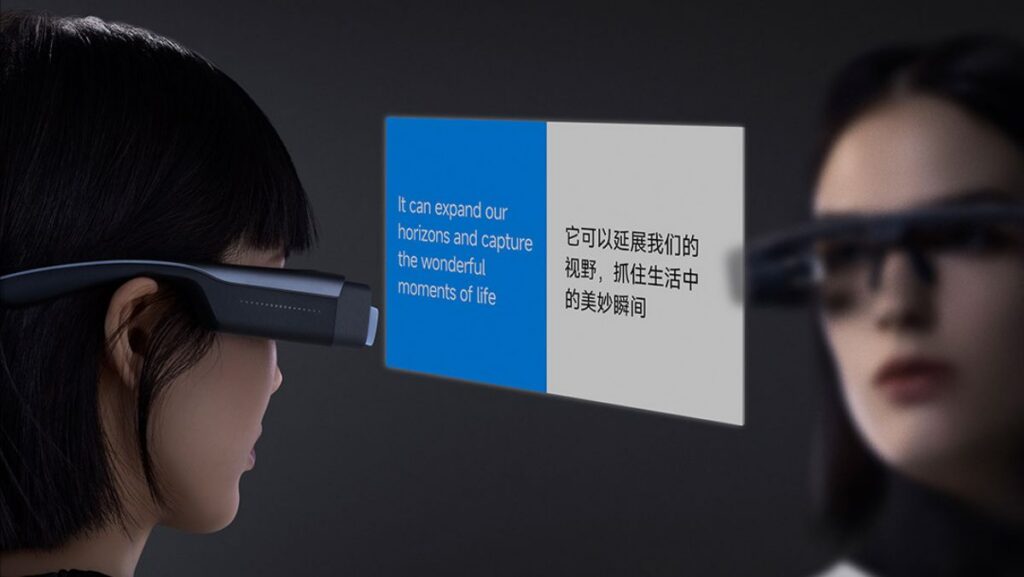
Big Tech Enters the Market and Sets “Invisible Standards” for Smart Glasses Battery
As the smart glasses industry enters a phase of scaled growth in 2026, global technology giants such as Apple, Meta, and Google are officially stepping into the market. Their entry is reshaping both the competitive landscape and the direction of industry development.
Unlike smaller manufacturers, these companies do not promote smart glasses by highlighting battery capacity or charging speed. Instead, they focus on user experience, setting a series of requirements that may seem invisible but are extremely strict.
These requirements do not explicitly mention the battery, yet every one of them ultimately translates into hard constraints on the battery system, gradually becoming “invisible standards” that the industry cannot ignore.
Experience Standards That Target Daily Wearability
The experience thresholds set by big tech companies directly address the core requirement of smart glasses as daily wearable devices. They mainly fall into three key areas, each bringing new challenges for battery technology.
1. Extreme Requirements for Wearing Comfort
Smart glasses are expected to support continuous wear for 6–8 hours, covering daily commuting, office work, and everyday activities, without noticeable heat or pressure.
This means the battery system must go beyond simple weight reduction. It must also offer excellent thermal performance, preventing heat buildup caused by energy loss that could affect wearing comfort.
2. Scenario-Based Energy Replenishment Efficiency
Big tech companies are moving away from traditional charging concepts and toward fast, flexible recharging that fits fragmented daily use.
A typical expectation is:
15–20 minutes of charging should support 2–3 hours of normal use.
This creates a difficult balance: the battery must support fast charging, while also protecting cycle life and long-term reliability.
3. Safety and Stability as Absolute Bottom Lines
For products used by hundreds of millions of users worldwide, safety is not a feature — it is a prerequisite.
Battery systems are expected to maintain:
- Extremely low failure rates
- Zero tolerance for risks such as short circuits, swelling, or overheating
Any battery-related safety incident could seriously damage brand reputation and even trigger a broader loss of trust in the industry. As a result, safety becomes the highest priority in battery system design.
Experience Requirements Ultimately Become Battery System Constraints
Although these standards are defined in terms of user experience, they are eventually broken down into clear technical requirements for the battery system, pushing battery suppliers toward deeper system-level upgrades.
Higher Consistency Across Mass Production
Each battery produced at scale must maintain very tight tolerances in key parameters such as:
- Capacity
- Voltage
- Internal resistance
Without high consistency, multi-cell systems may suffer from energy loss, uneven heating, and inconsistent user experience.
Stricter Thermal Management Capabilities
Through:
- Optimized battery structures
- Efficient heat-dissipation materials
The system must:
- Quickly conduct and disperse heat
- Precisely control operating temperature
This ensures comfort during long wear while protecting battery performance and safety.
More Advanced PCM and BMS Logic
The battery is no longer just an energy source — it is part of a controlled system.
Advanced PCM and BMS designs are required to:
- Precisely manage charging and discharging
- Balance fast charging with battery lifespan
- Monitor battery status in real time
- Actively prevent potential safety risks
This ensures long-term stability and reliable operation.
Invisible Standards Are Changing How Battery Suppliers Are Selected
For smart glasses buyers — whether big tech companies themselves or their supply chain partners — these invisible standards are transforming supplier evaluation.
In the past, purchasing decisions focused mainly on:
- Production capacity
- Price
- Basic specifications
Today, more critical questions include:
- Do they have full-chain capabilities in PCM/BMS development, thermal management, and consistency control?
- Does the supplier understand smart glasses at a system level?
- Can they correctly interpret implicit experience requirements?
- Can they turn those requirements into mass-producible battery solutions?
Battery Technology Evolution in Smart Glasses
1. Display Technology Upgrades Do Not Mean Less Battery Stress
Micro LED displays are indeed more energy-efficient than traditional display technologies.
However, this efficiency does not necessarily reduce the burden on the battery.
The real change lies in how the display is used:
- Information is no longer checked occasionally, but remains continuously visible
- Navigation, notifications, and contextual data are displayed throughout the day
- Overall wearing time has increased significantly
As a result:
While the power consumption of each display event is lower, the total daily energy consumption actually increases.
The battery challenge has shifted from “Can it power the display?” to
“Can it reliably support all-day usage?”
2. Edge–Cloud Collaboration Makes Power Demand More Fragmented
In smart glasses, AI workloads are no longer running at a constant high load:
- Most large-scale AI inference is handled in the cloud
- The device performs local processing only when triggered, such as wake-up detection and command handling
This creates a new power consumption pattern:
- Not continuous high power draw
- But frequent, short-duration power spikes
This changes what the battery must deliver:
The key requirement is no longer just total capacity,
but the ability to respond quickly and stably to dynamic power demands.
3. New Interaction Methods Amplify Instantaneous Current Requirements
Modern smart glasses increasingly rely on real-time interaction features, including:
- Instant camera activation and image capture
- On-demand voice recognition
- Rapid processing of bio-signals and motion data
These functions share common characteristics:
- Very short operating duration
- Extremely high instantaneous current demand
- Power surges occurring on the millisecond level
If the battery cannot supply sufficient instantaneous output:
- The system becomes unstable or unresponsive
- Voltage drops occur
- Processors may reset or stall
BluePower Smart Glasses Battery Solution
Silicon-Carbon Anode Solution: Creating Design Headroom, Not Just More Capacity
In our smart glasses battery architecture, the value of silicon-carbon anodes goes far beyond a 20–40% increase in energy density.
More importantly, they deliver system-level benefits:
- Greater design margin within the same physical volume
- Increased freedom for mechanical and industrial designers
- Additional headroom for fast charging and peak discharge performance
This transforms the battery from a structural limitation into a performance enabler.
Dynamic Fatigue Adaptation: Packaging Designed for Bending Spaces
Smart glasses batteries are often located at hinge or curved temple sections, where repeated micro-bending and mechanical stress are unavoidable.
Our solution:
- Stacked electrode construction replacing traditional winding
- Higher space utilization and improved structural integrity
- Reduced risk of electrode collapse or lithium plating under repeated folding
Sealing reliability:
- Customized high-adhesion heat-sealing layers
- Qualified through thermal cycling from –20°C to 75°C
- Even at ultra-thin profiles, achieving zero leakage and zero swelling
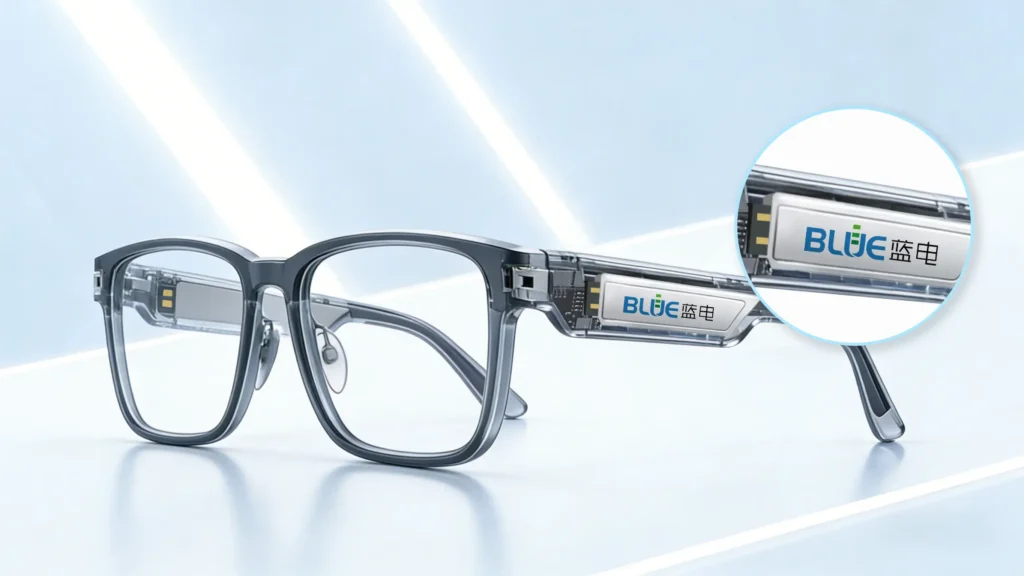
Thermal–Electrical Separation and Active Thermal Management Integration
As face-worn devices, smart glasses are highly sensitive to thermal perception.
Our approach:
- Integration of high-thermal-conductivity nano-carbon composite layers
- Rapid heat transfer from the skin-contact side to the outer-facing side
- Reduced perceived surface temperature during high-load operation
BMS coordination:
- High-precision NTC temperature sensors integrated at the PCM level
- Real-time coordination with the main controller via AOI protocols
Measured results:
In high-heat scenarios such as continuous video recording or AR navigation,
surface temperature rise is reduced by 3–5°C compared to previous-generation designs,
keeping thermal sensation firmly within the human comfort zone.
Why “Choosing the Right Battery” Must Be Rethought in 2026
As smart glasses move from prototype validation to large-scale commercialization, battery sourcing is no longer a matter of selecting a model and comparing unit prices.
It has become a system-level risk management decision.
Cost Is No Longer the Unit Price, but Lifecycle Risk
For high-visibility, face-worn devices such as smart glasses, the consequences of battery-related issues are significantly amplified.
The true cost of a battery choice includes:
- Rework and after-sales service costs (teardown and replacement are extremely complex)
- Brand and reputational risk (safety incidents are often irreversible)
- Regulatory and certification pressure (transportation, wearable safety, and compliance standards are tightening)
The reality is simple:
A single battery selection mistake can cost far more than the savings achieved by choosing a cheaper cell.
Custom-Shaped Battery Capability Defines Structural Freedom
In smart glasses, the battery is not a component that can be “fitted in later.”
It directly defines the product’s mechanical and industrial design boundaries.
True maturity in custom-shaped battery manufacturing is demonstrated by:
- Consistent curvature and dimensional accuracy
- Long-term reliability in ultra-thin structures
- Stable yield and quality in mass production
This ultimately determines whether a product can:
Preserve its original industrial design,
or compromise its form factor to accommodate the battery.
Manufacturing Infrastructure Determines Consistency and Deliverability
By 2026, the following capabilities are no longer competitive advantages—they are baseline requirements for smart glasses battery suppliers:
- Class 10,000 cleanroom production environments
- Highly automated stacked-cell manufacturing processes
- End-to-end in-line inspection and traceability systems
Without a robust manufacturing foundation, performance claims rarely survive the transition to mass production.
Conclusion: As Smart Glasses Scale, Batteries Must Be “Born to Fit”
As smart glasses evolve from experimental devices to mainstream consumer products, the battery can no longer be a passive component adapted at the final stage.
It must be a solution designed around the product from day one.
This philosophy is at the core of the BluePower Custom Battery Solution:
- Designed from real application scenarios, not generic specifications
- Engineered across structure, power dynamics, safety, and mass-production consistency
- Built to ensure that the original product vision remains intact—even at scale
When the goal is long-term, stable delivery
rather than a one-time prototype pass,
the right battery solution becomes a core competitive advantage.
Email: [email protected]
Whatsapp: +86 18938252128
