Apple has dominated the smartwatch market with the Apple Watch for more than ten years.
But what’s interesting is that this time, the challenger isn’t another, bigger watch — it’s something much smaller: a ring.
Apple didn’t make the ring itself.
Instead, the entire wearable industry is starting to shift toward smart rings as a new form factor.
By 2026, smart rings have suddenly become one of the most crowded — and most competitive — spaces in the wearable market.
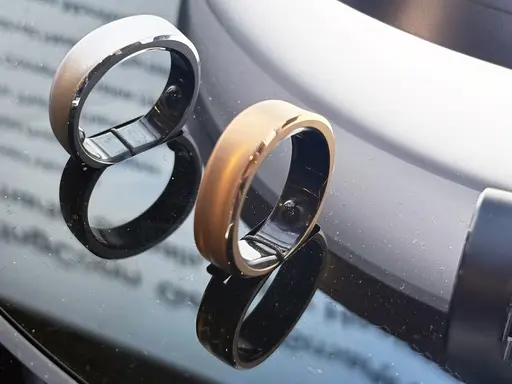
The Smart Ring Market Is Moving From a Niche Product to a Mainstream Wearable
If we go back three to five years, smart rings were still a fairly niche product.
They were mostly used for sleep tracking and basic health monitoring, far from being mainstream.
But that has clearly changed.
Today, the five smart rings most often seen as the strongest players on the market are:
Oura Ring 4, Samsung Galaxy Ring, Dreame Smart Ring, RingConn Gen 3, and Ultrahuman — which has been forced to exit the U.S. market due to patent disputes.
Behind these products are very different companies:
Oura, Samsung, Dreame, RingConn, and Ultrahuman.
They come from completely different backgrounds.
But the fact that all of them are entering the smart ring space at the same time already says a lot.
Smart Rings in 2026: Five Major Brands Face Off
Oura is the “big brother” of this space.
It was also the first company to truly make smart rings work as a real product category.
Its real strength is not hardware, but data.
With years of sleep, blood oxygen, and heart rate variability (HRV) data from millions of users, Oura has built very strong algorithms.
Algorithms don’t improve overnight — and this is Oura’s true moat.
The logic behind Samsung Galaxy Ring is completely different.
This is not a single-product strategy, but an ecosystem play.
The ring is just one more node in Samsung’s phone ecosystem, backed by strong channels, deep funding, and a huge user base.
The arrival of Dreame surprised many people at first.
After all, it comes from home appliances like robot vacuums and cordless cleaners.
But at CES 2026, Dreame launched three smart rings at once.
They support NFC payments, transit cards, access control, and vibration alerts.
At that moment, it became clear that this is no longer just a health device — it’s more like a “universal key” worn on your finger.
RingConn Gen 3 takes a different path.
Its main focus is continuous blood pressure monitoring.
This is something smartwatches have tried to do for years, but never truly solved.
As for Ultrahuman, its experience has become a warning for the entire industry.
Due to patent disputes, it was sued by Oura and forced to stop selling its products in the U.S. market.
This sends a clear message to all new players:
Features can be copied.
Hardware can be imitated.
But patent walls are not easy to get around.
Why 2026 Becomes a Key Turning Point for the Smart Ring Market
The sudden increase in smart ring brands around the same time is no coincidence.
There is one core reason behind it:
smartwatches are hitting a user experience ceiling.
Watches can get in the way during workouts.
They press against the wrist during sleep.
Showering, charging, taking them on and off — users always have to compromise.
Rings are different.
They are light.
They have very low presence.
They can truly be worn 24 hours a day.
For health tracking, this is a fundamental change.
Medical research has long shown that continuous data is far more valuable than one-time measurements.
The real problem is not algorithms — it’s whether people can actually wear the device all the time.
Smartwatches struggle to stay comfortably and consistently attached all day.
Smart rings, by their nature, do this much more easily.
Smart Rings Are Evolving From Health Trackers to Multi-Function Wearables
At CES 2026, the smart ring shown by Dreame sent a very clear signal.
It is no longer just a health tracking device.
It combines payment, identity, access control, and notifications in one small ring.
The idea is changing —
from “a device you wear on your hand”
to “something that feels like part of your body.”
This is exactly why more and more companies are starting to take smart rings seriously.
The investment by RingConn in blood pressure monitoring tells the same story.
As health tracking moves toward more serious and medical-level metrics,
the need for stable, continuous wearing only becomes higher.
And that is where smart rings have a natural advantage.
Oura Ring’s Strengths and Challenges — Will Apple Enter the Smart Ring Market?
At this stage, Oura Ring is still the benchmark of the industry.
But it is not without pressure.
On one side, Samsung can bundle its Galaxy Ring with smartphones and sell through its existing channels.
Oura, however, must acquire users on its own — which naturally means higher customer acquisition costs.
On the other side, pricing is a real challenge.
The cheapest Oura Ring starts at $299,
and most mainstream models are priced between $349 and $399.
By comparison, Dreame and RingConn are much more aggressive on price.
This means the smart ring market is moving
from a single high-end segment
to multi-level competition.
Why Has Apple Not Entered the Smart Ring Market Yet?
This is the question the entire industry is waiting for.
Apple has already filed patents related to smart rings,
but so far, no product has been released.
The reasons are not hard to understand.
If Apple launches a ring, it would likely compete directly with the Apple Watch. Fewer people would buy both.
Also, the battery space inside a ring is extremely limited.
Feature trade-offs are very harsh.
Apple is known for not rushing products that feel “compromised.”
But from another angle, things get interesting.
What if Apple positions the ring as a companion to the Apple Watch?
For example:
– The ring focuses on sleep tracking at night
– Handles contactless payments and identity during the day
If Apple connects the ring and the watch this way,
the combined system could become extremely powerful.
The Core Technical Challenges of Smart Rings: It’s Not Just About Software or Algorithms
Many discussions about smart rings focus on algorithms, features, and ecosystems.
Whose data is more accurate.
Whose app is smarter.
Who can connect to more platforms.
But in real product development,
what truly forces teams to redesign again and again — and slows everything down —
is often not these visible selling points.
It’s the basic problems that rarely show up in early PPT slides.
For example: the battery.
A smart ring is usually only a fraction of the size of a smartwatch.
Yet it still needs to support heart rate, blood oxygen, skin temperature, and activity tracking.
Some models also add NFC, vibration motors, and higher data sampling rates.
Less space, but more tasks.
That contradiction is built into the product.
More importantly, a ring is almost meant to be worn 24 hours a day, directly on the skin.
Unlike a watch, you can’t easily take it off to “rest.”
If a ring feels uncomfortable or gets warm, users will quickly give up on long-term use.
This puts extremely high demands on battery safety and stability.
The ring shape makes things even harder.
The battery is no longer a simple rectangular block.
It must be designed in a custom shape to fit inside the ring, while still keeping good consistency and long lifespan across every batch.
If consistency is not well controlled, some rings may last four or five days, while others drop to two or three days.
User experience breaks immediately.
When NFC is added, these problems become even more obvious.
Instant power demand goes up.
Heat and energy control become much more sensitive.
If the battery and system power design are not planned together from the start,
the result can be shorter battery life —or in worse cases, safety risks.
This is why smart ring batteries
can rarely use standard, off-the-shelf battery solutions.
The battery is more like part of the structure itself.
It needs to be deeply involved at the product definition stage —
not added in at the very end as an afterthought.
Is a Smart Ring Worth Buying?
If you already wear an Apple Watch,
a smart ring is not a must-have.
But if you hate wearing a watch while sleeping, or if you have a clear need for continuous health tracking,
a ring can offer a much more comfortable experience.
At the current stage:
- Oura and Samsung are relatively mature and safe choices.
- Dreame stands out clearly with its NFC features.
- RingConn is worth watching for its focus on medical-grade health tracking.
In short,
smart rings are not for everyone yet —
but for the right users, they already make a lot of sense.
Conclusion
Smart rings are not a short-term trend.
They represent a long-term evolution in wearable form factors.
As the industry moves from “showing off features” to long-term wearing experience, and from “single data points” to continuous monitoring, the factors that truly decide success are shifting from the surface to the inside.
Design can be iterated quickly.
Algorithms can be improved over time.
Ecosystems can be built later.
But batteries, structure, safety, and consistency are different.
If you choose the wrong path early in product development,
you often end up redesigning again and again —
or even starting over completely.
This is especially true for smart rings.
They are extremely small, worn directly on the skin, and highly integrated.
In this form factor, the battery is no longer just a power source.
It directly affects battery life, wearing comfort, data stability,
and even overall product safety.
How We Support Smart Ring Projects
As a manufacturer focused on custom lithium battery solutions, BluePower has long supported wearable devices, smart rings, and other miniaturized products.
In smart ring projects, the real question for us is not
“Can this battery be made?”
Instead, we focus on more practical challenges:
- How to achieve stable battery life within extremely limited space
- How to design custom-shaped, curved, or ring-style batteries based on the ring structure
- How to support NFC and continuous monitoring while controlling heat and safety risks
- How to ensure consistency and mass-production reliability across sizes and batches
We usually get involved at the product definition or structural design stage,
working with clients to evaluate power consumption, space limits, wearing scenarios, and certification needs —
rather than simply offering an off-the-shelf battery spec.
If You’re Working on a Smart Ring Project
Whether you are:
- Building your first prototype
- Moving from samples to mass production
- Or facing issues with battery life, heat, or structural limitations
We’re happy to work with your engineering team
to help you get the battery solution right from the start.
BluePower
Specialized in custom lithium batteries and miniaturized power solutions, providing stable and reliable battery support for smart rings, wearables, medical, and consumer electronics.
Email: [email protected]
Whatsapp: +86 18938252128
If you’d like, feel free to contact us directly.
Just share a brief description of your product and requirements,
and we’ll help evaluate a more suitable smart ring battery solution for your project.
