AI glasses have been sweeping the market at an unprecedented pace. From Rokid to Leetor, Xiaodu, INMO, Looktech (a brain-computer interface company), and Thunder Technology, manufacturers across the board are racing to launch their own smart glasses, even touting them as “the next smartphone.” This “hundred-glasses battle” has sparked excitement among many, with market enthusiasm reaching unprecedented levels. Yet the most immediate experience with AI glasses today may not be “the future is here,” but rather battery life anxiety.
Smart Glasses Battery Life Anxiety
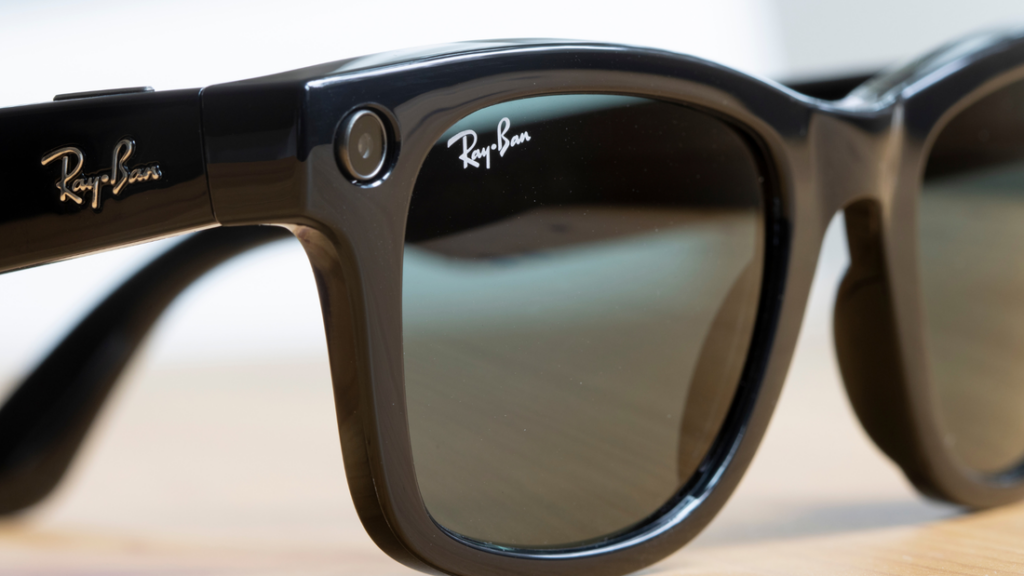
In manufacturers’ promotional materials, visions of AI glasses often revolve around the idea of “conversing with AI anytime, anywhere.” The reality, however, is that such “anytime, anywhere” conversations may only last a few dozen minutes. A prime example is Ray-Ban Meta, the product that ignited this “hundred-glasses battle.” While its daily continuous usage battery life is around 4 hours, if used solely for AI conversations, it barely lasts 30 minutes.
Meanwhile, while smartphones can be conveniently charged anytime, anywhere, most nearsighted users typically carry only one pair of optical glasses. It’s not practical to constantly return them to a charging case. This means wearing AI glasses might induce anxiety—will they run out of power when you need them most?
Even without aiming for all-day wear, the battery life of AI glasses often proves discouraging for just four or five hours of outdoor use. Currently, the battery performance of AI glasses on the market varies wildly. Let’s first examine a set of official data.
| Product | Battery Capacity | Rated Battery Life | Weight |
| Ray-Ban Meta | 150mAh | 4 hours of continuous daily use | 50g |
| Rokid Glasses (Display Supported) | 220mAh | 4 hours of continuous daily use, 40 minutes of recording | 49g |
| Thunderbird V3 | 158mAh | Up to 7 hours in typical scenarios, 30 minutes of video recording, about 3 hours of continuous music playback | 39g |
| Xiaodu AI Glasses | Unpublished | More than 5 hours of continuous listening | 45g |
| Looktech AI Glasses | Unpublished | 14 hours (no specific details) | 37g |
| Flash A1 | 450mAh | 10 hours of Bluetooth audio, 2 hours of video recording | 50g |
| INMO GO 2 (Display Supported) | 440mAh | 2.5 hours of continuous use | 61g |
Facing the battery life challenges of AI glasses, manufacturers in this market are exploring different strategies to address them. A common approach is “compensating for insufficient battery life with charging,” with companies attempting to optimize the charging experience and increase fast-charging power through various methods to improve daily usability. However, regardless of the strategy, one fact remains undeniable: AI glasses still rely heavily on charging and are far from achieving the all-day usage capabilities of smartphones.
Why is Smart Glasses Battery Life so Short?
AI Performance Comes With a Hidden Energy Cost
If AI is the most attractive feature of smart glasses, then AI computing is also their most underestimated power consumer.
Many users expect AI smart glasses to offer “always-on” conversations with AI, but few realize how much computation and connectivity are required behind every interaction. In today’s products, most AI smart glasses rely on a hybrid AI architecture, combining local processing with cloud-based intelligence to balance performance and usability.
Due to strict size, weight, and thermal constraints, smart glasses cannot accommodate smartphone- or PC-class processors. Instead, they typically use compact, energy-efficient chips equipped with NPUs that handle basic local AI tasks such as wake-word detection, intent recognition, and simple voice interactions. More advanced AI functions are then offloaded to the cloud through continuous network connectivity.
This design means that local AI computation never truly stops, forming the foundation of the user experience.
Chip Capability Directly Affects Power Consumption
As a result, many manufacturers build their AI smart glasses around relatively advanced platforms such as the Snapdragon AR1 Gen 1, which offers a better balance between performance and energy efficiency. However, some products choose to rely more heavily on cloud processing and therefore use older wearable chipsets.
For example, devices like FlashGeek A1 and INMO GO2 are based on the UNISOC W517, a wearable processor introduced in 2020. Compared with newer AR-focused platforms, this chipset lags behind not only in CPU performance and ISP capabilities, but more critically in AI computing efficiency and network performance.
The consequence is not limited to system responsiveness. Insufficient local AI capability forces the device to depend more on cloud services, making voice assistant latency and stability highly dependent on network conditions. In practice, this often leads to both poorer user experience and higher overall power consumption, even when the device is equipped with a relatively larger battery.
Always-On Connectivity Becomes a Battery Killer
Cloud-based AI inevitably increases power demand, especially in devices with extremely limited internal space and tightly packed electronics. For smart glasses, maintaining long periods of active wireless connectivity—Bluetooth, Wi-Fi, or cellular links—can quickly turn into a battery endurance nightmare.
This is why enabling AI features on products like Ray-Ban Meta can reduce battery life to around 30 minutes under intensive use. Continuous data transmission, combined with background AI processes, drains energy far more aggressively than most users expect.
Cameras Are One of the Most Power-Hungry Components
An even more visible source of power consumption is the camera system. Following the success of Ray-Ban Meta, most AI smart glasses now integrate cameras that allow first-person photography, video recording, and AI-based visual recognition.
Image capture, video processing, and real-time AI inference are all high-power tasks. Unlike smartphones, however, smart glasses lack the battery capacity required to sustain these workloads for extended periods. When AI computing and camera operation overlap, battery drain becomes dramatic during intensive use.
AR Displays Further Increase Energy Demand
Some products, such as Rokid Glasses and INMO GO2, go a step further by integrating AR display capabilities, effectively positioning themselves as AI + AR smart glasses. While this significantly improves usability in scenarios like real-time translation and navigation, it comes at a clear cost.
AR functionality requires a complete optical display system, including display drivers and light engines, all of which consume power continuously during operation. As a result, AI + AR smart glasses typically experience even faster battery depletion than AI-only designs.
How to Extend Smart Glasses Battery Life?
When it comes to improving battery life in smart glasses, the challenge can be approached from two fundamental directions: increasing energy supply and reducing energy consumption. Let’s talk about reducing energy consumption first.
1. AI-Optimized Chipsets for Smart Glasses
One of the most effective ways to reduce power consumption is the introduction of chipsets designed specifically for AI glasses, rather than adapting general-purpose mobile or wearable processors.
These specialized chips focus on:
- Ultra-low-power operation for always-on scenarios
- Dedicated AI acceleration for on-device inference
- Efficient task partitioning between main processors, sensor hubs, and low-power microcontrollers
By tailoring computing architecture to the unique usage patterns of smart glasses—such as event-driven interaction, intermittent AI inference, and lightweight visual processing—manufacturers can significantly reduce unnecessary power draw while maintaining responsive AI performance.
2. Continuous Hardware and Software Optimization
System-level optimization plays an equally critical role in lowering energy consumption.
On the hardware side, manufacturers can reduce power usage through optimized sensor selection, display control, power management circuits, and thermal design. On the software side, intelligent scheduling, adaptive sensing, lightweight AI models, and context-aware power management help ensure that computing resources are only activated when truly needed.
Rather than relying on a single breakthrough, battery efficiency in smart glasses is achieved through ongoing, incremental improvements across the entire hardware–software stack, turning constant power consumption into demand-driven energy use.
While reducing power consumption is essential, battery life in AI smart glasses ultimately depends on how much usable energy can be stored within an extremely limited form factor. This makes increasing energy density the second—and equally important—path to longer runtime.
From a battery design perspective, there are two practical and scalable ways to achieve higher energy density in smart glasses: custom battery design that maximizes available space, and the adoption of advanced electrode materials such as silicon–carbon anodes.
3. Custom Batteries: Maximizing Every Millimeter of Available Space
Unlike smartphones, AI smart glasses face far stricter constraints on volume, weight distribution, and shape. Standard, off-the-shelf batteries often leave unused internal space or force compromises in industrial design.
Custom battery solutions address this limitation by:
- Adapting the battery’s shape to complex and non-standard internal geometries
- Improving volumetric efficiency by eliminating wasted space
- Allowing higher capacity without increasing overall device size or weight
By designing the battery around the product—rather than designing the product around the battery—manufacturers can unlock significantly more usable capacity within the same physical envelope. This approach is particularly critical for AI glasses, where even small gains in capacity can translate into meaningful improvements in daily usability.
4. Silicon–Carbon Anode Materials: Pushing Energy Density Beyond Conventional Limits
In parallel with structural optimization, advances in battery materials are reshaping what is possible in terms of energy density. Silicon–carbon anode technology, in particular, has already demonstrated its impact in the smartphone industry.
Recent flagship devices illustrate this trend clearly:
- The realme Neo7 (6.78-inch display) integrates a 7,000mAh battery within an 8.5mm-thick body
- The Xiaomi 15, with a compact 6.3-inch display, increases its battery capacity to 5,400mAh—an almost 800mAh jump
- The vivo X200 Pro mini, also featuring a 6.3-inch display, accommodates a 5,700mAh battery
These gains are largely driven by higher energy density enabled by silicon–carbon anode materials.
If this technology is successfully adapted for AI smart glasses, battery capacity could be significantly increased without adding extra weight, directly extending usage time while preserving comfort and wearability. For next-generation AI glasses, material innovation combined with form-factor-specific battery design represents a realistic path to multi-hour, all-day use scenarios.
However, the higher energy density offered by silicon–carbon anodes does not come without challenges. Silicon materials undergo significant volume expansion during charge and discharge cycles, and for AI smart glasses—where battery cells are far smaller than those used in smartphones—controlling this expansion within such a confined space remains a major technical hurdle.
Even so, silicon–carbon anodes represent the most realistic and promising path toward improving battery life in AI smart glasses today. Compared with temporary solutions such as relying on fast charging or limiting AI computation to ease battery anxiety, advances in battery technology address the problem at its root. Once the current battery limitations are overcome, battery life may no longer be a constraint, but rather a foundation that enables a more seamless and reliable intelligent experience.
BluePower: Turning High-Energy Battery Concepts into Scalable Solutions for Smart Glasses
At BluePower, we focus on transforming advanced battery technologies into practical, manufacturable solutions for compact and wearable devices such as AI smart glasses.
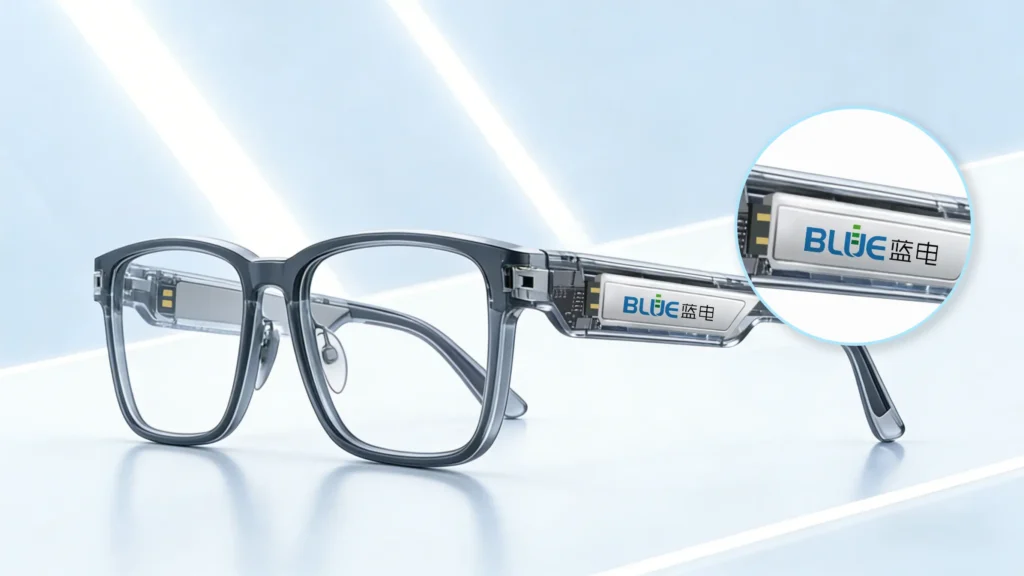
One of our core strengths lies in custom battery form-factor design. Instead of relying on standardized cells, we engineer batteries that precisely match the internal geometry of the device, enabling maximum space utilization while maintaining strict requirements for weight balance, safety, and long-term reliability. This approach is especially critical for AI glasses, where available space is fragmented and every millimeter matters.
Beyond structural customization, BluePower has also achieved mass production of silicon–carbon anode batteries, with verified energy density reaching up to 778 Wh/L. These batteries are already deployed in real commercial applications, demonstrating that high-energy-density silicon–carbon technology can move beyond the laboratory and into stable, scalable manufacturing.
To address the inherent volume expansion challenges of silicon-based anodes, BluePower applies low-expansion battery design techniques, including optimized electrode formulation, controlled silicon content, and structural buffering strategies. By minimizing dimensional change during charge–discharge cycles, we ensure that high energy density does not come at the expense of mechanical stability, cycle life, or safety—factors that are particularly critical in miniature batteries for wearable devices.
By combining custom-shaped battery engineering, high-energy-density silicon–carbon materials, and proven mass production capability, BluePower provides AI smart glasses manufacturers with a realistic path toward longer battery life—without increasing device weight or compromising user comfort.
Conclusion: Making Battery Life a Strength, Not a Limitation
AI smart glasses are moving fast toward the mainstream, but battery life remains the key barrier between concept-level innovation and real all-day usability. Without sufficient and stable power, even the most advanced AI features struggle to deliver lasting value.
Solving this challenge requires more than fast charging or usage compromises. AI-optimized systems, custom-shaped batteries that fully utilize limited space, and high-energy-density silicon–carbon anode technology are the most realistic path to longer, more reliable runtime.
At BluePower, we help AI smart glasses manufacturers turn advanced battery concepts into scalable, production-ready solutions.
👉 Contact BluePower to unlock longer battery life for your next-generation AI smart glasses—and turn power into a competitive advantage.
Email: [email protected]
Whatsapp: +86 18938252128
