The LiPo battery C rate is a key parameter that indicates how quickly a lithium polymer battery can safely discharge its stored energy. In simple terms, the C rate defines the relationship between a battery’s capacity and the maximum current it can deliver.
For example:
- 1C means the battery can discharge its full capacity in 1 hour.
- 2C means the battery would discharge in 30 minutes.
- 10C means the battery could theoretically discharge in 6 minutes.
For LiPo batteries, the C rate tells you how much power the battery can provide without overheating, damaging the cells, or reducing its lifespan. A higher C rating means the battery is capable of supplying a higher discharge current, which is especially important for devices that require significant power output.
The C rate is directly related to the maximum current the battery can provide. To calculate the discharge current, you multiply the battery capacity (in ampere-hours) by the C rating.
For instance, consider a 5000mAh (5Ah) LiPo battery:
- 1C → 5A maximum continuous current
- 20C → 100A maximum continuous current
How to Calculate LiPo Battery Discharge Current
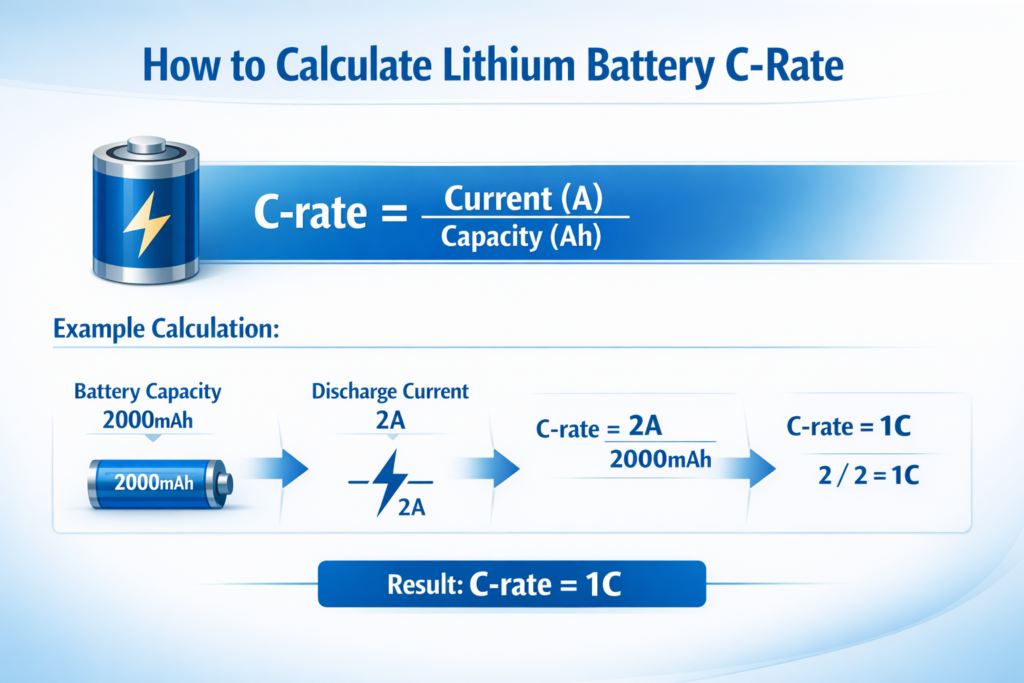
Calculating the discharge current of a LiPo battery is straightforward once you understand the relationship between battery capacity and C rating. The maximum discharge current is determined by multiplying the battery capacity (in ampere-hours) by its C rate.
The formula is:
Maximum Discharge Current (A) = Battery Capacity (Ah) × C Rating
Continuous C Rating vs Burst C Rating
LiPo batteries often list two C ratings: continuous and burst, and they mean different things.
Continuous C Rating
The continuous C rating is the maximum current the battery can safely deliver over a long period without overheating or damaging the cells.
For example, a 5000mAh (5Ah) battery with a 30C continuous rating can provide:
5Ah × 30C = 150A
This means it can safely supply 150 amps continuously.
Burst C Rating
The burst C rating is the short-term maximum current the battery can deliver for a few seconds, used for sudden power spikes like drone takeoff or rapid acceleration.
For example, a battery labeled 30C continuous / 60C burst can safely handle 60C for a short period.
Key Point
Always focus on the continuous C rating when choosing a battery for stable and safe operation. Burst current is only for temporary power surges.
Why C Rate Matters for High-Power Devices
The C rate of a LiPo battery is crucial for devices that demand high or fluctuating power. A battery with too low a C rating cannot supply enough current, which can lead to voltage drops, reduced performance, or even battery damage.
High C rate batteries are essential for devices that require sudden or sustained power output, such as:
- Drones – for rapid takeoffs, sharp maneuvers, and sustained flight.
- Robotics – to drive motors consistently under heavy loads.
- Electric tools – for continuous high-power operation like drills or saws.
- RC vehicles – to handle bursts of acceleration and jumps.
- Industrial equipment – where stable high-current delivery is critical for reliability.
By selecting a battery with the right C rate, you ensure that your device performs at its best while maintaining safety and battery lifespan. High C rate batteries provide the power your high-performance devices need exactly when they need it.
Factors That Affect Battery C Rate
Not all LiPo batteries are created equal, and several factors determine how high a battery’s C rate can safely go. Understanding these factors explains why some batteries can achieve high discharge currents while others cannot.
1. Internal Resistance
Internal resistance (IR) limits how much current a battery can deliver. Lower IR allows higher current flow with less heat buildup, enabling higher C rates. Batteries with high IR will overheat quickly under heavy load.
2. Battery Chemistry
The chemical composition of the electrodes and electrolyte affects ion movement and overall current delivery. Advanced chemistries can support faster electron flow, making high C rate performance possible.
3. Electrode Design
The thickness, surface area, and material of the electrodes play a key role. Optimized electrode design reduces resistance and allows more uniform current distribution, which is essential for high-power discharge.
4. Thermal Management
Efficient heat dissipation prevents the battery from overheating during high-current use. Batteries with better thermal design maintain performance at high C rates and avoid damage from excessive temperature.
By carefully controlling these factors, manufacturers can produce LiPo batteries capable of safely delivering high currents, meeting the demands of drones, robotics, RC vehicles, and other high-power applications.
Custom High‑Discharge LiPo Battery Solutions
Many high‑power applications require battery packs that go beyond standard specifications. Off‑the‑shelf batteries may not provide the necessary discharge rates, capacity, or form factor for demanding devices. Manufacturers and designers often need:
- Higher discharge rates to support sudden or sustained power demands.
- Optimized battery packs that balance energy density, weight, and safety.
- Customized form factors to fit unique device designs or space constraints.
For example, in one real‑world project, a company needed a tiny 100 mAh LiPo battery capable of continuous 30C discharge performance even at –20 °C — a combination of high discharge rate and low‑temperature stability that standard batteries simply couldn’t meet.
To solve this, BluePower engineers redesigned core elements of the battery, including the internal structure, electrolyte system, and resistance control, enabling stable high‑current output under extreme conditions.
This case demonstrates how tailored battery engineering can overcome challenges that ordinary products cannot. By working with BluePower on custom high‑discharge LiPo battery solutions, companies can get batteries designed specifically for their power, performance, and environmental requirements, whether the application involves high‑power robotics, drones, industrial equipment, or other demanding electronics.
Conclusion
The C rate is one of the most important factors when selecting a LiPo battery for high‑power applications. It determines how much current a battery can safely deliver and directly affects the performance, reliability, and lifespan of your device. Understanding continuous and burst C ratings, calculating discharge currents, and choosing the right battery for your application ensures that drones, robotics, RC vehicles, and industrial equipment operate safely and efficiently.
For applications that require high discharge rates, custom form factors, or specialized performance, off‑the‑shelf batteries often fall short. This is where BluePower excels. With expertise in custom high-discharge LiPo battery solutions, BluePower helps companies design and manufacture battery packs that meet their exact power, size, and environmental requirements—even in extreme conditions like low temperatures or high-current applications.
If you want to explore custom LiPo battery solutions for your project or device, reach out to BluePower today:
Email: [email protected]
Whatsapp: +86 18938252128
