On April 19, 2026, the Humanoid Robot Half Marathon in Beijing E-Town came to an end.
The “Lightning” robot from the Glory Qitian Dasheng team won the race with a time of 50 minutes and 26 seconds. It not only broke the event record, but also beat the human men’s half marathon world record. Even more impressive, robots from the same company took all top six places in the race.
In just one year, winning times improved from 2 hours and 40 minutes to under 50 minutes. The number of teams grew from 20 to over 100, and nearly 40% of them used autonomous navigation.
This race is no longer just about speed. It has become a full-scale test of how humanoid robots move from labs into the real world.
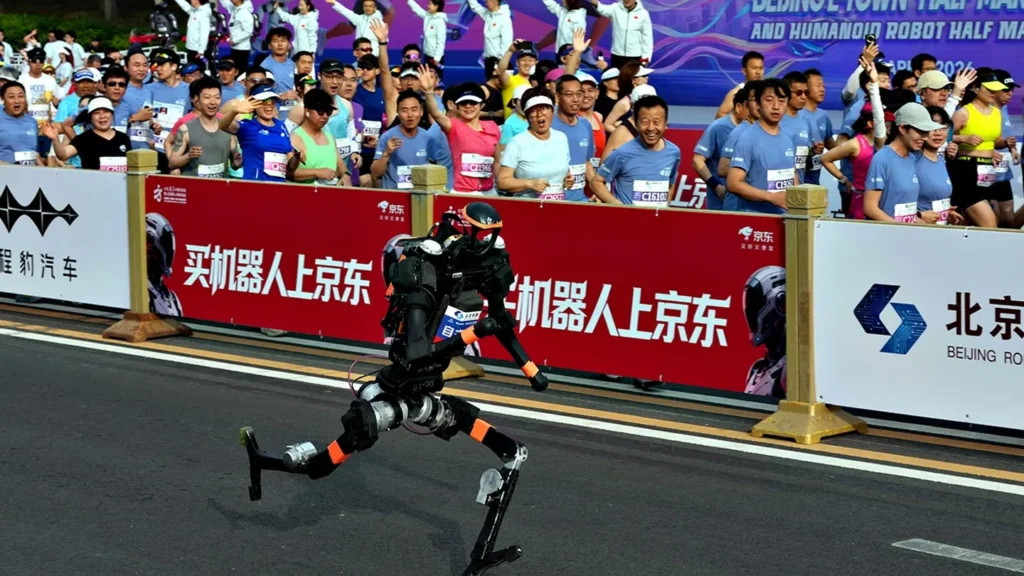
Why Did Honor Dominate the Robot Marathon?
The Honor robotics team was founded just over a year ago with more than 200 members. As a newcomer in the industry, it managed to take all top six positions. This was not luck, but the result of strong core capabilities built over years in the consumer electronics industry.
1) Cross-industry cooling technology transfer
A 21-kilometer half marathon is an extreme endurance test for robots. Motors run under continuous high load, and overheating can slow them down or even cause shutdowns.
Honor adapted its mature liquid cooling system from smartphones into robotics. Liquid cooling channels were built deep into the motors, with a heat exchange flow of over 4 liters per minute. This solves overheating problems at the source.
2) Power system + control algorithm synergy
The “Lightning” robot is 169 cm tall and uses a self-developed integrated joint module with a peak torque of 400 Nm and an effective leg length of 0.95 m. This enables longer strides and higher step frequency.
With a multi-sensor fusion motion control system, the robot can adjust its balance in real time on complex terrain, ensuring stable and continuous running.
3) Manufacturing consistency and supply chain advantage
Honor deployed six robots, and their performance differences were extremely small. This comes from strict quality control in the consumer electronics industry.
Battery supply chains, cooling systems, and production processes can all be reused from mature platforms. This “hidden supply chain advantage” is very difficult for startups to replicate in a short time.
Standard Batteries: The Hidden Bottleneck of Humanoid Robots
After looking at Honor’s advantages, let’s focus on the core of energy systems — the battery. At present, widely used standard batteries are becoming one of the biggest obstacles for humanoid robots.
Standard batteries are general-purpose, modular, mass-produced battery packs. Their voltage, capacity, size, and discharge characteristics are fixed, and they are ready to use out of the box. This works in early-stage R&D. But in demanding real-world scenarios like a half marathon — long distance, high intensity, and complex terrain — their limitations become obvious.
1) The weight vs. energy density trade-off
Mainstream lithium batteries have an energy density of around 200–300 Wh/kg. To extend runtime, more batteries are needed. But more batteries also mean more weight, which increases the robot’s load and energy consumption. As a result, the robot runs slower and cannot go as far.
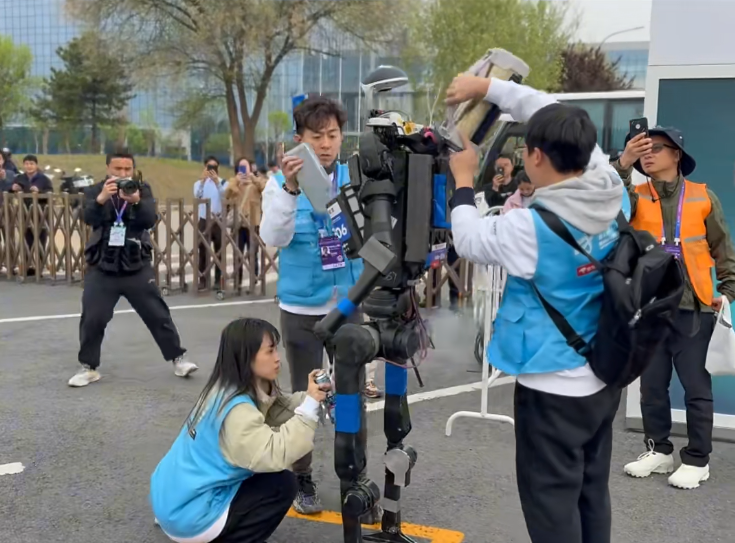
In the half marathon, most robots needed a battery swap every ~5 km, which seriously affected performance and stability.
2) Weak high-discharge performance
When a robot runs, sprints, or makes sudden stops, the battery must deliver high current instantly. Standard batteries struggle to handle these dynamic loads. Voltage drops significantly, causing unstable movement, weak power output, or even triggering BMS protection that reduces performance.
In last year’s event, overheating caused torque to drop by 28%. Even with improved cooling this year, standard batteries still remain a limiting factor.
3) Poor structural fit
Standard batteries usually come in regular rectangular shapes. They cannot fully fit into irregular spaces such as the chest or back of a humanoid robot. This either wastes internal space or disrupts weight balance, affecting motion stability.
4) Mismatch with thermal management systems
Standard batteries are not designed for robotic thermal systems. Under heavy load, they heat up quickly. Even if the robot has a liquid cooling system, the battery cannot efficiently integrate with it, becoming a weak point in overall heat dissipation.
5) Safety and lifespan concerns
Humanoid robots perform complex movements, which accelerates battery degradation compared to normal devices. Standard batteries have limited cycle life and are prone to swelling and increased internal resistance over time, creating safety risks.
In simple terms, standard batteries are like putting a professional marathon runner in regular canvas shoes. They can still run, but they will never reach peak performance — and they are more likely to get injured.
As humanoid robots move toward mass production and real-world deployment, standard batteries are no longer enough to keep up with the pace of development.
Custom Batteries: The Inevitable Choice for Humanoid Robot Energy Systems
If standard batteries are not enough, why do custom batteries become inevitable? The answer is simple: robots are not standardized products, so their energy systems cannot be standardized either.
Custom batteries are not just about changing size. They involve full system-level design — from cell selection, structural design, BMS development, thermal management, to system integration. Everything is built around the needs of the robot itself, working closely with joints, algorithms, cooling systems, and mechanical structure.
1) Structural customization: optimizing space and balance
Custom batteries can be designed to fit irregular internal spaces of humanoid robots. Curved or split-pack designs allow the battery to act not only as an energy source but also as a structural component.
This improves space utilization, reduces overall inertia, and enhances motion stability. It is especially important for scenarios like running, walking, and task execution.
2) Performance customization: matching dynamic workloads
Robot operation involves highly dynamic power demands — acceleration, climbing, sudden stops all require very different power outputs.
Custom batteries can be tuned for smoother discharge curves, more stable voltage platforms, and faster high-rate response. This ensures consistent power delivery and avoids sudden voltage drops or power interruptions.
3) Thermal management customization: system-level coordination
Custom battery packs can be designed with interfaces for liquid cooling or phase-change materials, allowing full integration with the robot’s thermal system.
This significantly reduces cell temperature rise, prevents overheating during long-duration high-load operation, and ensures stable output without performance throttling.
4) Smart BMS customization: intelligent energy control
A customized Battery Management System (BMS) can work directly with the robot’s main control unit. It monitors battery status in real time and adjusts gait and motion intensity based on remaining energy, temperature, and power limits.
This enables smarter energy usage, improves endurance, and enhances safety at the system level.
5) Safety and lifecycle customization
For humanoid robots operating under frequent movement, impact, and compression conditions, custom batteries can strengthen structural protection and optimize cell chemistry.
This improves cycle life, reduces the risk of thermal runaway, and ensures long-term stable operation in demanding environments.
Our Customized Energy System: Powering Humanoid Robots
As the industry shifts toward customized energy solutions, we provide a one-stop energy system for humanoid robots, covering the full chain from cells to system integration.
Core Capabilities
Full safety protection
Uses high-safety cells with multi-layer protection including overcharge, over-discharge, overcurrent, short circuit, and over-temperature protection for reliable operation in complex environments.
Deep system-level design
Involved early in robot development. Battery design is based on size, weight balance, power demand, and motion behavior. Supports irregular, curved, and distributed structures for better integration and stability.
High-rate dynamic performance
Optimized for running and task scenarios. Delivers stable voltage, fast response, and minimal voltage drop for consistent power output under dynamic loads.
Integrated thermal management
Battery thermal design is aligned with robot cooling systems (liquid or air cooling). Improves heat dissipation efficiency and supports stable long-duration operation.
Smart BMS integration
Supports CAN communication and real-time monitoring of voltage, current, temperature, and SOC. Works with robot control systems for intelligent power management and higher efficiency.
Mass production reliability
Built on mature manufacturing systems with strict testing (charge/discharge, temperature, vibration, compression). Ensures consistent quality in mass production.
Conclusion
The humanoid robot half marathon has clearly proven one thing: no matter how strong the algorithms and power systems are, without a tailored energy system, robots cannot reach their full performance potential.
Standard battery solutions have already reached their limit. Customized energy systems are now the inevitable path for humanoid robots to move toward mass production and real-world applications.
If you are developing humanoid robots and facing challenges in battery life, power output, thermal management, or space design, we welcome you to connect with us.
We provide one-on-one battery customization and energy system optimization based on your full robot design, helping your robots run more stable, farther, and longer.
Email: [email protected]
Whatsapp: +86 18938252128
